Monday, 21 March 2016

Commonplace 160  George & Children PART TWO

From the miserable Dickensian early start of a poor unloved waif, through to the neglect foisted on offspring by indifferent parenting, children fare no better than adults in any Gissing outing. Not only are their lives designated as miserable, unhappy and futile when they are small, all will end up disillusioned, unfulfilled and wasted in their adult lives because of early setbacks. Even when he had children of his own - particularly when he had children of his own! -  George failed to recognise that he was the least suited to either father children or influence their upbringing. Being too selfish, emotionally constipated, misanthropic and pessimistic to offer a small person a decent role model of happiness and what we now term 'centredness', strangely, George considered himself a student of child psychology.
Madonna and Child
by Pietro Torrigiano c 1525
Was it the learned hard-heartedness of the disappointed person whose life had been a series of self-inflicted disasters, or an innate lack of emotional intelligence that rendered George incapable of identifying with his own children? After all, it doesn't take a genius to work out those things that make an adult unhappy are likely to have an even deeper impact on a developing mind. What made him miserable as a child could make any child, at any time, anywhere, equally as sad. But, empathy was never George's strong suit. Let's take a look at a few of his literary child victims.

Arthur Golding in Workers In The Dawn.
If ever the spectre of Charles Dickens reared up as the Ghost of Childhood Past in George's canon, it is with young Arthur. Of course, Dickens was walking the walk - he had been on the receiving end of genuine poverty as a child, and the experience of the blacking factory with its bullying, deprivation and loneliness informed many of his characters and stories. George had never lived through such hardship, and so through Arthur Golding, all of his early love of Dickens (which rapidly left him when he was a grown up) poured out in what is clichéd, sentimental but ultimately banal. If Monty Python had been writing a book about Victorian orphans, they would have invented Arthur click. For starters, he makes his début in a squalid garret rugged and sloped from one side down to the other (rugged as in having an uneven surface, or was it covered in rugs??) found sleeping next to his dying father by Edward Norman, an old friend of the sick man. Naturally, he is an angel of a child not at all marked by the vicious surroundings - a quick 'lick and a promise' (as my old mother used to say) and he will clean up nicely. Please see Commonplace 156 and the sad tale of Billy Burden for more of the same. When Arthur is finally left fatherless (his whorish mother is already gone), he clings to the corpse with all the determination of a small Scottish terrier click


Fast forward a few months and the wee lad, after a social experiment phase that backfired when he was semi-adopted by Norman (a man who owns an exquisite little copy of Horace, so we know he is a typical George superior male), is up to his arm pits in classic Victorian slum fiction world - bullied, exploited, unclean, unloved and on the brink of becoming the new Artful Dodger. But he rises above - of course, he is your actual natural aristocrat. What are the chances of that in a novel written by a chap who considered his own humble origins as a freakish error of lineage, as if the stork had dropped him off at the wrong residence? On the plus side, Arthur is as gentle as a girl. Not sure George realised how that would scan. Arthur rejects the financial and social advantages Norman offers and sets off on his own voyage of self-discovery back in the streets of his birth. 

If all this sounds preposterous and silly, we must recall the intrinsic harm this trite, over-long book has done in cementing the George Gissing myth that he was a superior sort of chap dragged down by associating with inferior women. Many of the claims made by biographers that they know who George was - and know his first wife, too - are based on Arthur's father and Arthur, himself, and the deplorable portrayal of women in this book. You would have to be a real dufus to fall for it, but they do! It may well have been the myth George wants us to believe, but that doesn't make it true.

Hughie Rolfe in The Whirlpool
Poor Hughie. Brought into the novel to help George explain how he will someday abandon his own child, Walter, whilst putting the blame for that onto the boy's mother. Hughie's father, Harvey Rolfe, one of George's vilest creations, in an unlikely conversation of indelicate intimacy with the odious Ms Abbott, a self-proclaimed governess/educator (and not at all like his sexy wife, Alma) offers the chance for George to justify his own heartless actions whilst appearing to be an appreciator of the put upon, low born woman. In conversation these two:
...spoke of the people who were so anxious to be relieved of their children.
'One lady wrote to me that she would pay almost anything if I would take her little boy and keep him all year round; she only has a small house, and the child utterly upsets her life.' Says Ms Abbott.
This was published in 1893, when George was unhappily married to Edith and young Walter was a toddler. Already, the seeds of the boy's downfall were being sown; George didn't carry his plan out until he had worn down his second wife and she was in no position to complain, but George it seems always planned to take Walter away from her and send him to his two spinster sisters and child abusing mother in Wakefield. Because it is clear from the way he wrote about Walter in his Diaries that the boy very much 'upset' his father's life. Poor Hughie is seen to be a victim of a mother's neglect, and eventually dies. This is what is termed an 'Easter egg' in modern parlance when films and their trailers contain hints as to future productions, especially for cinematic universe renditions of superhero comics. Such as this click. Harvey, the boy's father is absolved of his neglect but of course, Alma, the alleged bad mother, has to be punished. It's what the Greeks would have wanted haha.
Identical Twins by Diane Arbus 1967
The eponymous Whirlpool is Modern Life (1897-stylee) with its social demands and capitalist fancies, and the whole world conspiring to keep a man from his Homer. Did George live in a Whirlpool? Not judging by the endless moaning he did about a lack of social life, if we are to delve into the Diaries and Letters. But, if George's life was a Whirlpool, then mine is a veritable Charybdis - no doubt George got his title/concept from the Greek legend click.
George's ideal holiday 
The Madden Sisters in The Odd Women.
Six girls whose mother is already dead (Mrs Madden, having given birth to six daughters had fulfilled her function in this wonderful world). Father intends to insure his life for £1K in order to provide for them, but suffers what will be a fatal RTA the day before he sets this plan in motion. The fickle finger of fate once more enters into George's realm. He nails his colours to the mast in the opening chapter when old Madden says: ...nothing upsets me more than those poor homes where wife and children are obliged to talk from morning to night of how the sorry earnings should be laid out. No, no; women, old or young, should never have to think about money... George claimed to be making use of irony (when he was schmoozing Gabrielle Fleury and she queried his misogyny) in his writing and so we can assume, here, he is not referring to his first wife's death in poverty brought on by his meagre alimony payments! That would require a level of insight George did not possess. He writes on: Human beings are not destined to struggle for ever like beasts of prey. 'Beasts of prey'?? Doesn't he mean 'beasts of burden'? Or does he mean prey in general as in a lion's dinner?? Maybe his version is some lost to us Victorian phrase - but I doubt it.

So, these orphans are left with £800, a little over £7K in today's money. If a single word could sum them up in their childhood, it would be 'mediocre'. Nothing beautiful about them - looks and charm being bankable skills - with the exception of baby Monica. Which we can predict will be punished and ruined over the course of the book - every temptress gets a whacking in a Gissing outing (Alma in The Whirlpool?? So, guess what becomes of Monica?). She might be the salvation of the group if she can marry well, which means finding a man with money. That is held against her when she chooses it. But, as a baby, she is just a liability; another mouth to feed. Only Alice, the eldest, reared to be their surrogate mother, is strong-minded enough to pull it all together and get them through.

We are never told how their childhoods unfurled, but we can guess the girls were raised by women not unlike Ms Abbott from The Whirlpool - unsuited to the task, indifferent to the outcome, but in need of the money. Not unlike the Gissing sisters. The Maddens set out as young adults to make a living in a world not set up to accommodate single girls. Monica's marriage - doesn't Widdowson treat her the way George treated Edith? By reminding her he was the one with the power because he had the money, and that she should know 'which side of her bread is buttered' - as George did to Edith? Of all George's novels, The Odd Women is his most contentious and open to interpretation. I am always amazed when it is seen as a novel about the emancipation of women when all I read is George's misogyny, unchained. He sees women as their own worst enemies, and it is innate weakness of mind that leads to their downfall. Did he ever stop to ask what is the fundamental aspect of the debate: exactly what will men get out of women's emancipation? A loss of power would be inevitable if women worldwide were ever truly emancipated, so why would men ever want to relinquish the upper hand to a tribe of competitors? Does George expect women to be more like men in order to fit into a man's world? Until women are freed of sex slave status and incubators to children, we will never be equal. And, when we are free of our sexual functions and gynaecological entrapments, men will kill us as superfluous to their needs and because we pose a threat to diminishing natural resources. But that's another post!

Bubbles: Children At Play by Charles Dawson Watson 1856


Friday, 18 March 2016

Commonplace 159   George & Children PART ONE

Follower of the Master of the Dangolsheim Madonna, 
South German, Virgin and Child, late 15th–early 16th century,
What was George thinking of when he fathered two children? He didn't ever want to be a man encumbered by dependents of any age or capability, and he was never in love with his second wife, Edith, so bringing two defenceless mites into that hot mess of anger and resentment is bordering on the psychotic. As he was the one (he) considered to have the brains in the relationship, the blame lays fairly and squarely at his door.

First son, Walter, came along nine months after the wedding day - of course. George complained, during their 'courting' days Edith was not amenable to 'living in sin', and he put this down to her conservative nature. Did he really have the cheek to ask her to? I doubt that very much - I expect he raised the topic obliquely and she leapt back in horror. His wooing of her was low-key and raised no hope of romance or passion - it was to be a practical arrangement based on Edith understanding he was the boss, the one with his hands on the financial reins, and all she had to do was cooperate and he would drag her out of the social slime of Camden Town from where she was spawned. He must have promised things he didn't/couldn't deliver in order to trick her into it.  He, rightly, realised she didn't have too many options in her life, and marriage to a chap of a slightly higher social class who was not in trade was a step up in life for her. I presume Kate Middleton was on the receiving end of similar counsel haha.

Anyhoo, it's clear from his letters and Diaries that George was not ecstatic or in celebratory mood at the thought of impending fatherhood, although the paucity of information in the Diaries (heavily edited by George, etc) doesn't allow for a true reflection - May 4th 1891, a visit from the doctor, presumably to see Edith, may refer to the pregnancy diagnosis. If he had come to see George, more would have been made of it! By May 11th, the phrase he uses is 'Edith's illness'. By the time of the birth: So, the poor girl's misery is over, and she has what she earnestly desired'. In fact, her troubles were just beginning. And the fact she had what she 'earnestly desired' would eventually be used against her
Ushering In Banality by Jeff Koons 1888
George was not best pleased at the amount of disruption the infant caused his daily routine. Even for George, a man who could have moaned for England if that had been an Olympic sport, the amount of droning on about how put out he was by the new infant, the added fussing from servants and the needs of an ailing wife, pissed him off just as much as having to shell out for the medical bills and staff wages. The noise of the crying baby, the coming and going of inadequate domestic help, and with Edith too ill to supervise - in fact, her attempts were seen by George as interfering - got in the way of the reading. His unreasonable unreasonableness is a sign of how self-centred he was - his attitude was that of one who thought of bringing a child into the world should not have been more than a blip on his radar.
Floating Baby by Marc Quinn 2013 click and click
Although he does mention the level of suffering his wife endured during childbirth, and he acknowledges that she really wanted to be a mother (presumably she assumed that role would fill her life with the love she missed out on as a wife), his first impressions of his first born were dire. For a start, the child had a conspicuous birthmark on his face: The baby has a very ugly dark patch over right eye, Don't know the meaning of it.

Now, as we know, George often mulled over the works of the dreaded eugenicists (see Commonplace 101). Perhaps the shock of seeing the fruit of his loins in some way blemished was a shock, and may have caused him some sort of negative reaction based on what he saw as the boy being genetically inferior. After all, his own claim at being 'aristocratic' was based on innate superiority, so having a child who was less than perfect will have been seen by George as... Edith's fault. Obviously she being working class - though her father ran his own business much like George's father, who ran a shop - would carry the taint, never George, the intrinsically superior special one he always considered himself to be.

Did giving birth to a faulty child signal the end of Edith? Though George didn't know her that well - whirlwind courtship (NOT romance!) and nine months together in Exeter making a new life for themselves with George insisting she leave all her family behind. Much to George's dismay, one of Edith's family members turned up cold calling on April 18th 1891 to find out if Edith was still alive and kicking, so long had it been since she had been in touch with her family - hardly secure footings for a lifelong union.

Hopefully, son Walter never read the Diaries and uncovered what his father really thought of him, because at one point, George says the neighbours are scared of him when he is taken out in his pram.
A Girl by Ron Mueck 2006
George's own childhood was reasonably comfortable, with domestic servants to do the skivvying, a reasonable education, and a typically distant Victorian set of parents. His mother was a fan of child abuse - as in corporal punishment - for transgressions against her rules. Presumably, being headstrong, defiant and ever resentful of constrictions imposed by those he considered his intellectual inferiors, George must have been on the receiving end of that sort of correction. He described himself as being in need of discipline so we can assume he was somewhat indulged and allowed a certain amount of freedom to please himself with his spare time, then beaten when he stepped out of line. You need opportunities to be bad in order to earn punishment, and George saw himself as a natural leader of the gang, but playing out and making friends with the local children was never on the cards. Henry Hick, a childhood friend from Wakefield, once said George and the Gissing children rarely mixed with their peers. It is difficult to see George playing conkers and swapping marbles or chalking a hopscotch court to use with others over a shared bag of bullseyes (the sweet, not the animal organs haha).
Minty bullseyes - yum!
So, when the little nipper with the blemish turned up, his mother exhausted, his father inadequate to the task, he was farmed out (for the first but not the last time) to a family of strangers. Things were different then so maybe it didn't seem so counter-productive to get others to raise your child out in some country backwater instead of in the bosom of its secure loving family. George realised he couldn't cope with two rivals for his time - Edith was suffering post-partum, and Walter was a sickly babe with complex nursing needs. Instead of George stepping up and offering his fatherly services as childminder and chief carer, precious bonding time was wasted both for the parent-child relationship, and for the wife/husband thing. They should have set out in their family adventure as a little group, with their capable leader - George! - at the head of the team.

JOIN ME IN PART TWO TO EXPLORE GEORGE'S PESSIMISM ABOUT CHILDREN - WHOM HE DID NOT SEE AS 'THE FUTURE'.

Tuesday, 15 March 2016

Commonplace 158   George & The Genius of the Crowd PART TWO

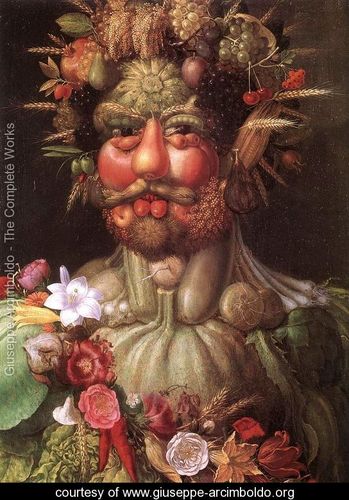
With the weird and fab paintings of Giuseppe Arcimboldo (1527-1593) click
Autumn 1573
George, if he had been alive in the late twentieth century and if he had done some serious introspective thinking precipitated by mind altering substances and 'ardent' beverages, would perhaps have been intrigued by the work of Charles Bukowski. He would certainly have found an affinity there. Apart from both being rampant misogynists who paraded as the opposite, they both dabbled in painting (hopefully, George's works were better than CB's truly dreadful daubs click); they both hated proper work (as in the sort that makes you break a sweat), and then there is their shared disdain for all things 'Demos' - or, as Bukowski described it, the 'Crowd'. How they both needed to prove they were above the everyday person - a sure sign of some inner battle with feelings of inferiority. How they both raged against their mediocrity!

From Bukowski's wikipedia page:
His writing was influenced by the social, cultural, and economic ambience of his home city of Los Angeles. His work addresses the ordinary lives of poor Americans, the act of writing, alcohol, relationships with women, and the drudgery of work.

Vertumnus click c 1590
George's work is generally about the social, cultural and economic ambience of London; his early writing concerns the lives of the poor working class and then the poor middle class - as George Orwell summed it up, our man always wrote about 'not enough money'. He was preoccupied with the technical business of writing (and when he wasn't doing books he was scribbling letters and diaries), and each book seems to have been dragged out of him (that's how stagnant his creative flow could become), but it was all insignificant when compared to the amount of reading he did. He lived to read, and that solitary vice kept him from achieving his full potential. Reading is essentially a passive act, and is always a good excuse to be alone and not be forced to socialise. George read in order to study his contemporaries and learn his craft from these experts, but his own 'voice' was never easy or natural. Though he was a massively uptight cove, so perhaps it was!

Then we have George's relationships with women - always problematic and unsatisfactory on every level. Indeed, much of his anger was directed against the sex in general because he perennially felt we had let him down - typical of a man who seeks to make women objects of veneration and cannot accept us as equal human beings. And he held women accountable for forcing men to fritter away their talents in providing for dependents - New Grub Street's Amy Reardon is seen as some sort of a harpy because she requires food and a decent roof over her head - all is put in jeopardy by her husband's all-round impotence. In a world where she was unable to work for a living (for want of jobs for women of her class) - but could no doubt have turned her hand to anything if she had to - she was forced, by traditional gender roles, to rely on her man - the father of her child - for support. That dependency was part of the marriage set-up, and, to be fair to her, what had been promised in the marriage contract. Edwin's anger at what he sees as her unreasonableness is just his spite - he has reneged on his responsibilities as husband, father and writer, and yet it is somehow all Amy's fault! At the bottom of it, his fear of expressing his jealousy towards the child is what keeps him trapped in a cycle of bad faith, all the while blaming her demands for support of al kinds for his inertia. The death of the child liberates him - just as sending Walter off to live with his family in Wakefield (much to his wife's horror and dismay) allowed some of the rage to leak out of him like pus from a zit.

Alas also for George, marriage was the contract he signed up for. He never took his vows seriously. One has only to think of the silly fake ceremony he went through with Gabrielle to understand how little time he had for promises he had no intention of keeping. (I bet he stood next to her with his fingers crossed behind his back haha.) And he famously said that no-one should be expected to sacrifice themselves for someone else - which is, surely, his misunderstanding of a loving relationship such as husband and fatherhood? Well, he reneged on all his commitments in order to fulfil his own 'genius'. If only he and his talent had been worthy of the ordeals they had to suffer.

And then there is the ludicrous stance of preferring to starve rather than lower himself to take up a proper job. Bukowski was a postal worker for many years and hated it; George was a teacher who hated teaching. How tragic to be born without an independent income! What exactly did George have against work? Well, it got in the way of reading, but it also brought him that thing he so dreaded - a boss. He hated to think anyone was better than he was at anything, and voiced the opinion he loathed being told what to do. And then there was the company you are usually forced to keep when you work, over which you have no control. Is it any wonder folk sometimes 'go postal'? click

One of Charles Bukowski's most celebrated poems in this one: and click to hear the man reciting it, and below is the text.

The Genius of the Crowd

there is enough treachery, hatred violence absurdity in the average
human being to supply any given army on any given day

and the best at murder are those who preach against it
and the best at hate are those who preach love
and the best at war finally are those who preach peace

those who preach god, need god
those who preach peace do not have peace
those who preach peace do not have love

beware the preachers
beware the knowers
beware those who are always reading books
beware those who either detest poverty
or are proud of it
beware those quick to praise
for they need praise in return
beware those who are quick to censor
they are afraid of what they do not know
beware those who seek constant crowds for
they are nothing alone
beware the average man the average woman
beware their love, their love is average
seeks average

but there is genius in their hatred
there is enough genius in their hatred to kill you
to kill anybody
not wanting solitude
not understanding solitude
they will attempt to destroy anything
that differs from their own
not being able to create art
they will not understand art
they will consider their failure as creators
only as a failure of the world
not being able to love fully
they will believe your love incomplete
and then they will hate you
and their hatred will be perfect

like a shining diamond
like a knife
like a mountain
like a tiger
like hemlock

their finest art


Is the term 'genius' to be taken as the older definition - the one George used? To the ancient Romans:
the genius (plural in Latin genii) was the guiding spirit or tutelary deity of a person, family (gens), or place (genius loci).[2] The noun is related to the Latin verb genui, genitus, "to bring into being, create, produce". Because the achievements of exceptional individuals seemed to indicate the presence of a particularly powerful genius, by the time of Augustus the word began to acquire its secondary meaning of "inspiration, talent".[3] The term genius acquired its modern sense in the eighteenth century, and is a conflation of two Latin terms: genius, as above, and ingenium, a related noun referring to our innate dispositions, talents and inborn nature.[4] Beginning to blend the concepts of the divine and the talented, the Encyclopédie article on genius (génie) describes such a person as "he whose soul is more expansive and struck by the feelings of all others; interested by all that is in nature never to receive an idea unless it evokes a feeling; everything excites him and on which nothing is lost." [5]  
Thank you wikipedia. 
Whimsical Portrait 
On the surface, this genius Bukowski invokes is a malodorous, malign influence for harm, being skewed towards the darker side of the human mind. George was of the opinion the world and its humans were hypocritical and vicious, though where he found such misanthropic views - as with Bukowski - is hard to explain. Neither had lived a life of hardship that hadn't been self-inflicted; both hid their inadequacies behind a veneer of cod philosophical distance, but both were really angry children moaning about not having had enough love, or attention - personified as food and drink? 

A mob may be ruled with treachery hatred violence absurdity. George's fear of Demos was based on his belief that the average human being is capable of all three as default and is only kept in bay by the endeavours of their superiors - ie the likes of his own class (whereas poverty and want, ignorance and fear are better at controlling the masses, and have usually been the weapons of choice in the class war). And George was of the opinion the whole world is absurd, so he was in agreement there.

Bukowski wrote:
I see men assassinated around me every day. I walk through rooms of the dead, streets of the dead, cities of the dead; men without eyes, men without voices; men with manufactured feelings and standard reactions; men with newspaper brains, television souls and high school ideas... How can I be concerned with the murder of one man when almost all men, plus females, are taken from cribs as babies and almost immediately thrown into the masher?

George would have agreed. His bleak view was that children were a curse and a burden, destined as they were for lives of misery whatever their class, and he would not have had any if Edith (his second wife) hadn't needed them to get her through being married to him. He never really stepped up to the plate of fatherhood, and found it difficult to love either of his boys - with Walter being a disappointment to him and Alfred being virtually a stranger. Bukowski had a daughter, Marina, and said he loved her. Here is a poem he wrote for her:

What were these two men so afraid of? Being average, and the awful realisation they weren't special enough for greatness to come easy to them? 

From Bukowski's The Strongest of the Strange.

you won’t see them often
for wherever the crowd is
they
are not.
those odd ones, not
many
but from them
come
the few
good paintings
the few
good symphonies
the few
good books
and other
works.
and from the
best of the
strange ones
perhaps
nothing.
they are
their own
paintings
their own
books
their own
music
their own
work.

'nuff said.


Friday, 11 March 2016

Commonplace 157  George & The Genius of The Crowd. PART ONE

Poetry was George's first love; he considered it his métier. He thought only a select few could ever really appreciate it. There used to be a school of thought that said real writers should be poets first and authors second as being a poet of good standing was well above being a writer of similar acclaim. But it's a hard act to pull off - very few good writers are also good poets. One thinks of the Divine Oscar Wilde succeeding and George Orwell failing. However, the latter made up for it with his journalism.
from the video Sleeper by Mark Wallinger  2004
The working class, George said, were incapable of appreciating poetry, despite the evidence right under his nose that the working people enjoyed all manner of verse and poetry in an oral tradition that went back to before Beowulf click, continued through the folk song tradition of the early medieval to the popular works of the 18th century to the tunes of the music hall. Poetry, as with the visual Arts, is awash with over-educated people telling you it is for a select few, and that it contains arcane truths unfathomable to the ordinary person. If it does, then it has failed.

Art, if it does nothing else, attempts to raise the human animal above the mundane if only for the few seconds of sentience experienced in the face of the Artwork. Music, poetry and the visual Arts have an immediate and unconscious effect on the audience - reason and rationalisation follow an initial hit of sensation, or sometimes, emotion - even if the feeling evoked is repugnance. Sometimes, it is to be remembered, repugnance is what the Artist wants us to feel. (One thinks of the Austrian Hermann Nitsch's 'Aktionen' events, though I am probably projecting here as I find his work repugnant!)

Poetry, in George's day, was considered a higher form of expression, but one that operated within fairly strict confines. We are speaking of Pre-Modernism days, which Algernon Swinburne in England, and the likes of France's Baudelaire and the USA's Walt Whitman were doing their best to dismantle. Consider this by Baudelaire:
If rape and poison, dagger and fire,
Have still not embroidered their pleasant designs
On the banal canvas of our pitiable destinies,
It's because our souls, alas, are not bold enough!

It was written in 1857, the year George was born. Consider this, written by George in 1876:
As when an autumn breeze in hurrying flight
Catching a ripe seed from a garden rose
Over a meadow wafts it, and then throws
'Mid the rank herbage, where 'tis hid from sight,
Till the kind spring uprears it, the delight
And beauty of the wild spot where it grows;

This is from George's 'Perdita', as found in the ultra slim volume 'Six Sonnets on Shakespearean Heroines'. George can only perform within the confines of the sonnet form, and would have rationalised that the exercise was one that was harder than any other form of composition. But he lacked real imagination and descriptive powers, unless he was using these to give a flavour of some real event. Some of George's best writing is to be found in his non-fiction; some of his worst, in his poetry. Words like herbage, leafage and uprears abound with unselfconscious abandon throughout George's canon - even in his day these would be taken as archaic and pedantic terms.
Ghost House by Rachel Whiteread 1993
Despite living in what Baudelaire proved were interesting times for poetry, George never came on as a trailblazer. In spite of a brief flirtation with bohemian tropes of mild debauchery and petty crime, he was essentially a deeply conservative mind with a devotion to tradition, and there is precious little evidence of any poetry in his soul. Tradition was what George wanted to excel at - to be recognised as being a soulmate to his own select club of revered poets - Tennyson, Dante, Goethe, Heine, Keats, Shakespeare were his idols. But being a wordsmith of prodigious talent is not enough; you have to deliver something unique, fresh and innovative. When he won prizes at Owens, it was for the sort of cliched doggerel he found easy to toss off: homages to the point of being pastiche.
Detail from The Annunciation by Fra Angelico c1426
OMG - 1426!!!
Swinburne, all bells and whistles, was almost the opposite of George. Algie S liked to boast he just took up a pen and it all poured out, and the length of some of his works supports this. There are two psychological conditions that help poetry form: logorrhoea, often an element of hypomania or bipolar disorder, where excessive wordiness dominates click. And flight of ideas where thoughts ricochet and bounce round in reaction seemingly without design or structure. Swinburne is supposed to have been somewhat psychotic, with bouts of mania and depression - can we assume he was bipolar? The Beat Poets used amphetamines to access torrents of words and flights of ideas, and the Dadaists cut up chunks of text and rearranged them to make a different syntax. George liked to refer back to the Greeks for a structure and for themes, and to any historic precedent - his distrust of the modern is well-documented. It limited, more than supported, his voice.
from Half a Man by Mike Kelley c 1991

Despite winning a prize for his poem 'Ravenna' when he was at Owens College, George never really evolved his own style, being wedded so firmly as he was to the Greeks and to his own heroes of verse. Why? To a great extent, George was an autodidact who had to continually prove he was just as learned as the next cove who was a university graduate and in possession of a degree certificate proving educational worth. The accepted trajectory and therefore, the established route to knowledge (such as Oxford or Cambridge) was in George's mind, cut off from him because of his criminal past, more than his lack of finances, and so it became all the more important for him to have some visible sign of learnedness - which he took to be a sign of a superior nature. This stark difference between himself and those successful writers he looked down on who were university graduates would have been an humiliation hard for him to endure. George had to constantly reinforce his own ego and prove he was cultured, sophisticated, well-read, intellectually capable and middle class. (Those with real middle class credentials never break a sweat about which class they belong to.) Besides, culture has always welcomed the talented amateur or untutored 'natural' - the Outsider. One example is the way the group of intellectuals made up of Thomas Wainewright (see Commonplace 95), Charles Lamb and the artist Fuseli and their appreciation of and socialisation with the labouring class poet, John Clare, he of the much-loved poem, written when he was in Northampton Asylum, which we know as 'I am' click.
The Funeral of Shelley by Louis Edouard Fournier 1889
George would probably see Clare's social class not as being one of a member of the Demos crowd but as one of those rare beings born into the wrong social grouping, have innate 'aristocratic' genes. William Hazlitt (1778-1830) click, friend of John Keats, who entered into many contentious and sometimes semi-friendly public debates with Thomas Wainewright's alter ego Janus Weathercock, wrote this, in March, 1818:
What is the People?
And who are you that ask the question? One of the people. And yet you would be something! For what is the People? Millions of men, like you, with hearts beating in their bosoms, with thoughts stirring in their minds, with the blood circulating in their veins, with wants and appetites, and passions and anxious cares, and busy purposes and affections for others and a respect for themselves, and a desire for happiness, and a right to freedom, and a will to be free. 

Being born in Wakefield, George is one of that select group of Yorkshire Poets made up of many but represented by: Andrew Marvell, Emily Bronte, Ted Hughes, and Simon Armitage. George's father, Thomas, was also a poet, and published a small collection - read all about it here click. Of them all, Marvell is the genius. This:

To His Coy Mistress
Had we but world enough, and time,
This coyness, Lady, were no crime
We would sit down and think which way
To walk and pass our long love's day.
Thou by the Indian Ganges' side
Shouldst rubies find: I by the tide
Of Humber would complain. I would
Love you ten years before the Flood,
And you should, if you please, refuse
Till the conversion of the Jews.
My vegetable love should grow
Vaster than empires, and more slow;
A hundred years should go to praise
Thine eyes and on thy forehead gaze;
Two hundred to adore each breast,
But thirty thousand to the rest;
An age at least to every part,
And the last age should show your heart.
For, Lady, you deserve this state,
Nor would I love at lower rate.

But at my back I always hear
Time's wingèd chariot hurrying near;
And yonder all before us lie
Deserts of vast eternity.
Thy beauty shall no more be found,
Nor, in thy marble vault, shall sound
My echoing song; then worms shall try
That long preserved virginity,
And your quaint honour turn to dust,
And into ashes all my lust:
The grave's a fine and private place,
But none, I think, do there embrace.

Now therefore, while the youthful hue
Sits on thy skin like morning dew,
And while thy willing soul transpires
At every pore with instant fires,
Now let us sport us while we may,
And now, like amorous birds of prey,
Rather at once our time devour
Than languish in his slow-chapped power.
Let us roll all our strength and all
Our sweetness up into one ball,
And tear our pleasures with rough strife
Through the iron gates of life:
Thus, though we cannot make our sun
Stand still, yet we will make him run.

Gosh! How could any red-blooded wench resist?

JOIN ME IN PART TWO TO EXPLORE A POET GEORGE WOULD UNDERSTAND: CHARLES BUKOWSKI. 


Saturday, 5 March 2016

Commonplace 156  George & The Day of Silence

With images by Helen Chadwick (1953-1996).
Self Portrait 1991
Death. As we all are, George was obsessed with it, being both attracted to and repelled by it. Freud postulates a 'death drive' - Thanatos, named after the Greek personification of death. See Commonplace 130 for more on this. In George's time, death was not the one-step-removed experience we have of it today - at least, here in the West. It was ever present and in your face. George grew up in the back rooms of a shop that sold medicine and remedies. Not quite the sort of place we think of today as a pharmacy/chemist's, where the main worker has a degree in pharmacology or chemistry and has undertaken many science courses to gain the role. This was a shop on a street of other shops, serving a mixed community of poor more than rich.

In Commonplace 2 there is an account of how the late Victorian chemist shop worked. It was, first and foremost, a shop, and often something one step removed from a place of science. There were patent medicines for sale - some of them quack remedies click, that made ridiculous claims for their efficacy but which were little more than syrup or chalk; folk remedies that everyone used such as witch hazel for bruises and cloves for toothache; and genuine scientifically proven treatments such as aspirin and carbolic. Some of the shopkeepers extended their range by making up their own preparations, using centuries-old remedies with recipes from sources such as Nicholas Culpeper click. For this, George's father turned to botany - or, his love of botany drew him to apothecary work in order to make a living. Either way, he was a businessman who might have used plants to make cures he sold in a shop to the sick and dying, in all their icky horribleness. Which meant George was up close and very personal with people suffering the sort of ailments that often led to death. Quite a lot for a child to deal with.
Of Mutability 1984-86

When George's father died, the lad was thirteen. A very delicate age for a youth, but as Gissing Snr was often an absent presence in the home (due to work and civic responsibilities towards the needy), and as George tended to look down on his father as an unsophisticated amateur scholar and part-time poet, there will have been deep psychological and emotional forces of conflict and guilt working in the boy's mind upon the news that his main male role-model had gone. Death, in the form of a parent laid out in the best room, surrounded by medicines on sale in the shop - a line of products his medical expert father should have been able to use to save himself - brought on a severe reaction that made a lasting impression on George's fertile mind. The triad of civic duty towards the needy, lack of faith in the salvation promised by science, and untimely death were central themes in George's writings and certainly coloured his adult thinking. Add to it his contempt for shopkeeping, and you can see how many of what became George's more Conservative and reactionary values were formed with his father's passing.

The Day of Silence is a short story first seen in the collection 'Human Odds And Ends, Stories and Sketches by George Gissing' published by Lawrence and Bullen, Ltd, in 1898. It starts with a gloriously sunny summer's day, a Friday, but not the sort of fine day a person can trust or enjoy. George hated hot weather for its impact (or so he thought) on his health. In the story, we are introduced to sunny weather as a threatening, living, entity suffocating and poisoning as it stalks the crowded neighbourhoods of the overcrowded city. Not the benign and healing stuff of dreamy days spent basking by cool pools in the countryside, where all aches and pains can be eased, and where perfect rest can be found. In George's world - but only when we are in Britain (Italian heat is OK with George) - a hot day's foul malodorous miasma (a Peter Ackroyd favourite word!) clogs the vital functions and renders all food foul and lethal. Smells become offensive and oppressive; all activity slows to a sweat-laden slumping on cool pavements. Butter liquefies. George suffered from hyperhidrosis - excess sweating - on even a mild day, so the heat of London will have driven him to distraction. The city architecture of tall buildings forbade any breeze and even the Thames smelt bad, and would not have offered relief from the temperatures. But, it was tempting to think it might offer some blessed relief.

Piss Flowers 1991-92
We are introduced to Billy, an angel of a working class boy - everyone loves him for his innate goodness and intelligence (he's a natural born aristocrat like his creator, of course, but named after George's dead brother) - a typical George type of 'hero' - born amongst the degradation of the back streets of a slum, and yet transcendent over it all. He is exceptional in every way - even the rage of the sun can't phase him as he remains untrammelled by the sweltering heat. Poverty can't blemish the glow of natural health he exudes. But then we discover he has a dark side (just to make him seem less of a pansy) personified by a handy way with his fists when he loses his temper. Very manly! A wife beater and child abuser sociopath in embryo - just like George haha. Something of a bully, we learn Billy is the natural leader of the boys in his neighbourhood. Much as George was to his siblings.

His doting mother is only moderately (as George puts it) clean - in her way, a good housewife. George hates to accord the working class with middle class hygiene standards; he considered these beyond the sensibilities of the poor, because it requires innate grace to want to wash (or even notice that you need to!), according to our man. Billy's ma is forty and worn down by a lifetime's poverty, but she has survived as a decent and simple soul whose priorities have always been family and home. She works several menial jobs to keep the family going as her husband isn't well paid. However, some invisible disease threatens to finish her off but she does her best to play it down to her son. She is weakened by it - even drawing water (that mysterious substance that should be a friend) from the street pump drains her of energy. Water can be so treacherous, can't it? Her husband, Solomon is a moderately good sort and the couple are good together - Burden and his wife were regarded by the neighbours, and rightly, as an exemplary pair; they never came to blows, never to curses, and neither of them had ever been known to make a scene in public. Making a scene in public was one thing George dreaded in his typical British fuddy-duddy way. Anyhoo, they do their best to care for Billy and all their efforts are rewarded by the child's beauty and grace, this imp who skips over the filth on the streets like a wee cherub and whose natural wisdom and charm mark him out as exceptional. (If this isn't George also describing himself, I don't know what is!).
Cacao 1994

So we have Billy Burden - children were always seen as a burden, to George, especially his own two - an angel from a solid family, with everything to live for and full of beans. Loved, loveable, well fed, happy - obviously, in a George Gissing outing, he is headed for a fall.

Solomon comes home from work that hot Friday all sweaty and tells his wife he has been invited to go with a friend who has access to a boat, for a trip on the river the next day. The friend is scathingly referred to as 'Old Four 'arf' - which was the title of a cheap beer-based beverage not unlike the modern British (not the American version, as it uses beer and whiskey) cocktail known as a Boilermaker, a mix in equal proportions of stout, such as Guinness, and mild beer, such as Burton's, best served at room temperature. This chap's nickname hints at what's to come. And doesn't Old Four 'arf sound mighty like the nautical terms 'fore' and 'aft' (front and back) of a boat? Wheels within wheels...

Mrs Burden (wives are burdens, too, in George World) can't go as she is skivvying, and besides, it's really a man's sort of outing - they will be swimming. Nude swimming even in public parks like the Serpentine click or Hampstead Ponds click was not uncommon in George's day. Mrs B wouldn't want to be part of that horror show, would she? Besides, she'll be skivvying that day, too, and won't be available for fun. Father and son will have to go without her. They spend what will be their last evening together in their disparate ways - Billy playing out with his pals, Mother Burden dozing on the door stoop, and the old man on his usual stroll round the 'hood to see what's doing. A decent family doing decent enough things. Billy goes to bed; his parents end the day with a drink of beer to ease their night's rest.

The next day, all three prepare for their various commitments. Mrs B makes it clear to her husband that he must take very good care of Billy, and not trust him to swim in the water, no matter how tempting that might be, no matter how hard the boy pleads for it. Solomon gives his word that he won't. He sets off for work and Mrs Burden gets ready for a full day's job at cleaning. Billy will be alone all morning waiting for his father to finish work at one o'clock; children are used to caring for themselves when their parents are absent.
Meat Abstract 1989
The scene is set for a tragedy - why else bring us in this direction if not to make us readers suffer? The father, weak and feckless, is talked into taking a glass of ale or several provided by the borrower/owner of the boat, who quips that the drinks cans he carries are actually full of water - from the Lambeth Water Company. This was the company set up in reaction to the cholera outbreaks of the 1800s to supply clean water to the south of England and took water as far south as the Downs above Eastbourne that George so loved. The LWC was situated where Hungerford Bridge now stands - not a million miles from where Marianne aka Nell died in Lucretia Street, now called Grindal Street. See Commonplace 32 for a better view of the area. It was also the main supplier of water for the Lion Brewery (see Commonplace 91) which adds a level of irony to the story, as the brewery was sited more or less next door to the water works. Beer is 90-95% water.

Fate, that demon devil that dogs our footsteps (well, not mine!) finally enters, stage right. Being a man, Solomon is useless at impromptu risk assessments for children's play activities. As he becomes more chilled under the influence of beer, father's grip on accountability slackens. He lets Billy take a swim off the side of the boat. To cut a short story shorter, Billy drowns - of course. Solomon does his best to save him but he too, drowns. The boat borrower/owner and beer provider takes his vessel home, solo.
Meat Abstract 2 Tongues 1989
Meanwhile, Mrs B struggles back from her day's work, much afflicted by the pain from her serious but invisible physical ailment. She decides to visit the surgery at Guy's Hospital when it opens again after the weekend to ask the doctor for something for her pain. She has previously ignored his warnings to take things easy - what choice did she have but to forget what he said? At St Bride's Churchyard click she stops to rest and ease the pain in her side. A slight shiver of unease crosses her mind - Billy is safe on the water with his father, isn't he? Yes, his father will protect him, won't he, St Bride? St Bride is patron saint of many things - including boatmen. However, she must have been taking the day off, and has not looked out for Billy and his pa.

Mrs Burden, is observed slumped on the bench. She is not resting, but dying. She goes softly, peacefully. On dry land, but St Bride's is situated in Fleet Street, named after the river of the same name. Typical George: hoping it all has symbolic meaning for those with a good education - or access to google.

The story ends with Old Four 'arf visiting the Burdens' house looking for the (now dead) widow to tell her the bad news. He lets himself in, and finds no-one home. All is silence. So, not really a Day of Silence - more an evening of it.

George had a bit of a thing about drowning. His man-wife, Eduard Bertz once saved someone from drowning in the Thames, and George. who was with him at the time, was mightily impressed. It's almost impossible to think of George acting as decisively - he would have dithered about shouting suggestions, then left them to their fate! But he liked watersports (stop it now haha!) and often took his women for boat rides - possibly to tip them in, of course, and claim they fell haha. He inflicts death by drowning on several of his characters - notably Arthur Golding in Workers In The Dawn. Arthur's friend, Mark Challenger (an odd cove and a wee bit fake) has previously mentioned it as a reasonable way to go. He says: It is a rare death, drowning. You feel the water, at first deadly cold, grow warmer and warmer, and a kind of music in your ears lulls you to sleep.
Helen Chadwick click
Well, is that true? Not according to this website The Biology of Drowning click. From which I quote:

Upon submersion, the victim holds his breath until forced to inhale. He gulps water. The water induces spasms of the larynx, which closes of the trachea to protect the lungs. Little water enters the lungs. With the trachea blocked by laryngospasms, no fresh air enters the lungs and the supply of oxygen begins to fail.  Lack of Oxygen, anoxia, affects the brain within 30 seconds the laryngospasms begin to weaken with imminent brain failure.  
The victim then inhales again, this time aspirating water into the lungs before a fresh spasm closes the trachea again but for a shorter duration. With each successive inhalation, more water is aspirated; anoxia increases, and laryngospasm duration decreases until they are finally abolished and the lungs are filled with water. 

And...
The studies indicated that the main cause of death from drowning in fresh water is the explosive dilution of the blood with water from the lungs. This dilution resulted in rapid failure of the bloods ability to carry oxygen resulting in oxygen deprivation in critical areas and asphyxiation. The studies showed dilution occurred so quickly that after three minutes of submersion, the blood of experimental animals was diluted with an equal volume of water. In salt-water submersion, an opposite effect occurs. The brine in the lungs acts through osmotic pressure to remove large amounts of water from the blood. In three minutes, experimental animals loss 40% of the normal water volume in their blood. This over concentration of blood can cause heart failure. Additionally, seawater chemicals pass quickly into the blood stream through the lungs disrupting normal fluid balances. In either case, death from submersion occurs quickly, often in two minutes or less, depending on the physical status of the victim and other factors. In many instances, victims removed from the water alive later die from the delayed effects of submersion. 


Wreath of Pleasure 1992 click
So, not quite an easypeasy ride after all. Maybe George was letting Mark Challenger's reassurance pave the way for such a serious decision, and to tip off the readers that there is to be no suffering when death comes for dopey Arthur Golding whom so many confuse with George, himself. As if George could ever be so damned gullible. But, it suits those who like to portray him as a dingbat doughboy who was the innocent victim of a scheming slut who did him wrong. Or a martyr. Note to self: George Gissing: The Martyred Life would make a good title for a three volume biography. Three volumes!! Mudie's would have turned it down haha.

The Day of Silence is a slight fable, predictable to the max, and plainly told. George's disdain for the poor is much in evidence - he sounds like an anthropologist bringing back data on an indigenous tribe from a distant land, amazed that they have feelings in common with white folks. 'Them and Us' - one of George's tropes. And it's clear George wants to steer the story towards a scenario where he won't have to discuss their grief or sadness. That would humanize them too much, and by 1898, he was way beyond wanting to do that. Using the church of St Bride even slides in his mistrust of organised religion. If only he had chosen to set that bench Mrs Burden so needed in St Nicholas' churchyard along the river in Chiswick. St Nicholas is patron saint of, amongst other things, sailors and children. And William Hogarth, one of George's heroes, is buried there. 
Hogarth's tomb in Chiswick 
See Commonplaces 88 and 89.