Friday, 12 June 2015


Commonplace 76  George & His Starstruck Luvvie Affair With Miss Julia Gwynne.

George was fancy free from Christmas 1882, when Marianne aka Nell left her home to live a life alone in Brixton. He was a gay bachelor once more, if not legally or morally, then in his own mind - we know he never took those silly, legally morally binding things seriously (honesty with others' cloakroom pockets, marriage vows...).

Throughout 1883, George pitched himself headlong into the whirlpool of London Theatreland. He loved going out, if only to get away from himself, and so he joined the crowds for the shows. In fact, he loved it so much he thought he might be a closet playwright, and mentions thinking he can turn his hand to writing plays, even going so far as to start a couple of works, then abandoning them. There seems to have been a tendency in George to think certain things must be as easy-peasy as falling off a log - starting a periodical (with Algernon), for example - based on the fact he sees what he regards as his intellectual inferiors successfully doing it, so how hard can it be? This kind of immature arrogance is what got him into trouble on more than one occasion - though some (including George) might regard his cock ups as Fate, they were usually the result of the over-estimation of his own abilities. The early realisation he was smarter than his father (at the crucial time of Oedipal development), and too much praise in his schooling where he was top of the academic food chain, might have been to blame for this misplaced and superficial self-confidence.

Judging from his Diaries and Letters, he steered clear of attending quality productions as far as drama was concerned - so perhaps his sensibilities were skewed in a musical theatre bent. He often went to see proper plays not to experience them - as in to immerse himself in the form - but he did like a belly laugh, unsubtle and (he would deny it, of course!) somewhat vulgar though that broad humour is - and so farces and musicals were right up his Tin Pan Alley. I am no dramaturge, but did his love of all things of this ilk begin with his reading of the Greeks? click


It takes all sorts to make a world, and thank goodness for it, say I, and we are rightly encouraged to be tolerant of others' harmless foibles. But... can it be right that we have to share a planet with those who find Gilbert and Sullivan entertaining?

If one had to look for signs of middle-classness in all its crassness then Gilbert and Sullivan might be a marker to guide you on. Like Glyndebourne and The Last Night of the Proms, G&S is not for the likes of me, guv - it's for nobs. Or is that knobs? Now, George berated Edith for letting Walter hear working class songs (they were on holiday but obviously not in holiday mode) and yet he assailed his own ears with the tosh of G&S. As if he needed any encouragement, the D'oyly Carte crew brought out the inner snob in him. And the starstruck fan.

Odd as it may seem, George was a bit of a luvvie click when it came to certain actors... well, actresses. For a short while, his pin up dream girl crush was Miss Julia Gwynne. Luckily for Julia, she was thinking of marriage to George Edwardes, the manager of the D'Oyly Carte and later, the Savoy where she subsequently performed. But our George was much taken with her, and allowed this to seep out of his normally suppressed, secretive consciousness into his correspondence.

This little piece of self-revelation allows us to see how confident he was that women would fall for his 'charm' offensive. And how wrong he was on that score!

The first we hear of George's passion for Miss Gwynne is in an exchange of letters published February 5th 1883, in the Daily News. where George joins a debate on the woeful state of 'the farce' in English theatre, but sings the praises of his crush in her performance in 'The Little Sentinel'. It is distressing to see an actress of promise, like Miss Julia Gwynne, doing her best in an intangible part. (Is it me, or is this an odd use of the term 'intangible'?). As she had been doing Gilbert and Sullivan and other light drama pieces for some time, she was hardly 'an actress of promise' - she was, in fact, delivering central performances. George says in this letter that he has been to see 'Iolanthe' and would see it and 'Patience' again. For an example of this horrible genre - and I apologise unreservedly for sending you there - click which is from 'Patience'. Forgive me.

'Mock Turtles' was a one-act fluffer of an operetta that went on to warm up the audience before the main event - unless it was equal billing as a two-hander pair of operettas. It was mainly for those who were 'first come first served' for seats, and so had to arrive early. Here is an interesting little bit of info about the short plays put on before the main events click. George was so chuffed with his letter to the Daily News, he wrote to Algernon and told him all about it, wondering if the brains behind the Turtles piece would join battle in the letters page.

They didn't. Still, George was in good spirits, he says. But, he had begun to fall out of love with Frederic Harrison and Positivism, so he was obviously in a smidgen of turmoil, and the evidence for this is to be found in his lackadaisical attitude to work - he reports that his writing goes 'slowly' but, he writes to Alg: I have that which never fails one - confidence in myself. The day will come when I shall smile at the recollection of these initial difficulties. Preserve this letter, & look back on it in the year 1890! For anyone who ever thinks Algernon did not earn every penny George gave or loaned him, think again. How did Alg put up with his older brother's immense ego?? 


It seems Algernon wasn't the only one George told about his letter to the Daily News - he sent a clipping of it to Miss Gwynne, and, on February 20th, he writes to Alg to tell him so: A fortnight ago, I cut my letter out of the DN, & sent it to Julia Gwynne, together with a few complimentary comments on her playing. At length a reply comes. I have written again to tell her to let me know by all means, if she plays 'Polly'. It would be a treat.

The editors of the Collected Letters suggest 'Polly' might be Polly Peachum from 'The Beggar's Opera'. Now, this is an interesting choice of a role for George to want to see Miss Gwynne play - Miss Peachum is the love interest of Macheath, the antihero of the piece, a thief and a varmint who is torn between sweet Polly and the darkly seductive likes of Suky Tawdry, Lucy Lockit, Jenny Diver and Molly Brazen. Signs of George's tendency to reduce nice girls (Miss Gwynne) down to the gutter - as Anthony West might say? Here is a free copy of the original John Gay story click and here is a fabulous 1931 film version of the Brecht/Weill 'Threepenny Opera' version of the story click and here is Lotte Lenya's (Mrs B Brecht's) version of 'Mack The Knife' click.

On February 27th, two days after his wife's birthday, George wrote to his sister Ellen aka Nelly about his love of the music in 'Iolanthe' and 'Patience': The airs in it (Iolanthe) are not so taking as in 'Patience', but I am not sure that much of it is not of a higher character. On the stage, it is wonderfully beautiful.  Then he leaps to a mention of Wagner's death and a longing to visit Germany to hear one of the great composer's operas. If you recall, George's brother, William, had been a fan and saw Wagner as the 'coming man' of music. George tells Nelly he has been spending a lot of time looking at DG Rossetti's pictures (all that luxuriant, free-flowing hair will have appealed to our man!). He ends asking her to tell Alg that 'Mock Turtles' has been taken off - because of his Daily News letter! It seems George is pinballing between the cultural delights of the day, but by-passing the Aesthetic Movement - except for the piss-taking, execrable 'Patience' (which we have to thank for helping to launch the career of one Oscar Wilde.) 

The dedicated fan of Thalia and Melpomene click has to wait until May 23rd to see Miss Gwynne once more, this time in the Sartou play 'Fedora'. He writes to Alg: I went to see Fedora the other night. The somewhat vulgar critique in Punch was true on the whole. Mrs B Beere is simply Sara Bernhardt. Julia Gwynne has a wretchedly small part, a page's. To my amusement, there entered a stage box 'Albert Edward Prince of Wales, the Princess of Wales, & All the Royal Family'.  He can't resist that bit of name-dropping, can he haha??

Mrs B-Beere in a future performance
c 1884. 'Bernie' was 
a true friend to Oscar 
Wilde, and refused to shun him. 
On July 21st 1883, he writes again to Algernon: On Thursday  I was surprised by a note from Julia Gwynne, saying that she was going to play in a matinee at the Adelphi to-day, & would send me a stall if I liked. So I established myself in the stalls at 2 o'clock, & certainly beheld 'surprising things'. The piece was called 'Retaliation'. It was meant for melodramatic comedy, but proved outrageous farce. Throughout the three acts the house roared heartily, - always at the serious parts. No description could give an idea of the monstrosities of this piece... Fortunately, Julia had an inoffensive part, & was not ridiculous, about the only person who was not. 'Julia'? 
Here click we can see Julia was often fined for corpsing on stage - so it's hard to believe she was keeping a straight face throughout. 

Then we have to wait until February 27th 1884 (exactly a year to the day of a previous letter - see above!) to see how this romance rolls out. He has been to see 'Peril', another Sardou play with his Julia in the flesh, on stage, before his very eyes. George writes, in effusive luvvie praise: 'Peril'... is inimitably played. Such perfect acting I never saw... However, as noted by the Letters editors, the Athenaeum review said Julia Gwynne 'is seen to no special advantage'. That's the thing about being a fan - you tend to view your crush through rose-tinted spectacles. 


May 1884 sees George writing to Algernon: I have seen a good deal of the Theatres of late. You notice they are going to revive 'The Rivals' at the Haymarket, & with a most extraordinary cast. What he meant, was that Julia Gwynne was cast as Miss Lucy. George has definitely got the drama bug - he is talking of writing plays that will come to something and now subscribes to The Era, not exactly a theatrical publication, but a weekly newspaper with a strong commitment to stage reviews and actor-y gossip click. Not George's usual sort of publication, and at 6d a week, not cheap - an equivalent, based on today's UK median weekly wage puts this at about £9 per week for one paper. Still, he needed his fix of theatreland news, and the latest gen on his favourite thespian, and he was hoping to dwell in theatrical circles (not just the pits!) and so he needed to know who were the movers and shakers - the competition he would have to out-manoeuvre. From the Wiki entry:   
The theatrical historian W. J. MacQueen-Pope described The Era as "The Actor's Bible", with the theatrical coverage gradually assuming prominence over all else. By degrees and largely because of increasing advertisements, The Era began to take more and more interest in theatrical affairs and gave weekly reports of theatrical happenings in London and the great provincial cities.... [A]s Music Hall grew so the space devoted to it grew; The Era became the great theatrical journal and every member of the profession, stage or hall, just had to buy it although the price was steep, it remained at 6d. for many years. However, to be seen walking along the street with The Era under the arm, its title displayed for the passer-by to read, proved to all that the person carrying it was a "Pro".click

Of course, it wasn't to last, this obsession with Julia. She didn't reciprocate his attention and he probably never realised theatres give the stars free tickets to hand out when the house is nearly empty - it's better to have non-paying bums on seats and not look empty. There is one Diary entry (November 19th 1894) - when George reports that, upon leaving an Author's Club dinner he was stopped and asked for his address for 'Mrs George Edwardes', - 'who has kept me in remembrance'. It must have done his miserable old heart good to know Edith maybe had a little competition for his affections.

And George never wrote a play. It isn't easy to be a playwright any more than it is to be an actor; both just appear to be easy - to the uninitiated. It's difficult to think of George writing a farce - unless it was the story of his life haha - and one wonders what he would have thought of the twentieth century's Theatre of the Absurd click with its intellectual seriousness and the originality and courage it took to write such challenging works.

Last word must go to the Divine One who could write plays - hell, could he write amusing, learned, compassionate, wise and witty uncynical plays - and Newdigate-winning eternally loved inspirational poems and ground-breaking novels, and sparkling literary criticism and... letters. Beautiful, beautiful letters.

“The play was a great success, but the audience was a disaster.” 


An homage to Oscar's line: I find it harder and harder every day to live up to my blue china. 


Monday, 8 June 2015

Commonplace 75 George & Some of His Contemporaries.
Louise Jopling 1879

George is often (well, at least once) described as a 'major late Victorian novelist' (we are expected to park the Ionian Sea and the Dickens and other essays to one side here), which may or may not be true - if you want to make your own mind up on that, please do. Seriously, he is often compared to the greats and placed next to Thomas Hardy - which would have miffed him!
I find it is too difficult to rank Art and Artists except along lines of I like/I dislike/I am indifferent to. Fashion sometimes dictates what is popular, and the vagaries of taste (whatever that is) often determines what is worthwhile but whatever I think is good says more about me than the Artwork. Of course, these sorts of terms are bogus, but where would academia be without them - or Amazon and google Play? Would George have described himself thus? I don't think so. Most of his novels and short-stories are interesting and thought-provoking, and obviously we all have our favourites, but sometimes, his prose can be a bit... wordy. George is not likely to light everyone's fire. Not that he wanted to - he wasn't interested in populism or popularity; he wanted a select readership club with very few members. (He's certainly got his wish haha!) If you 'get' Gissing, then you might be able to knock on the door of that club and gain entrance. But, just as with the Skull and Bones set, you might have to sell your soul to the Devil to fit in!

What of those who walked the Earth literally (well, metaphorically literally) in George's literary shadow? I mean, his contemporaries.
Let's take a look at one year when George was productive - 1898 (chosen, at random) to see what some of these peers were up to. This was the year The Royal Academy held a retrospective for their late member, John Everett Millais, who died in August 1896 - all these pictures are by Millais.

Dipping a toe into the rich sea of wikipedia throws up:
Cinderella 1881
John Buchan - writer of popular ripping yarns, won the Newdigate Prize for 'The Pilgrim Fathers' this year. He went on to write 'The Thirty-Nine Steps' (made into films, most memorably by Alfred Hitchcock). If only Algernon had him for an older brother, what stories might have issued forth! click
Oscar Wilde - had won the Newdigate twenty years earlier for 'Ravenna'. In 1898, the Divine One released The Ballad of Reading Gaol onto our hearts and minds. Oscar Wilde is now a god. That's official. You don't need a click - if you do, then shame on you! But, here's one for the poem that gave us his line 'each man kills the thing he loves' click and click. (For those who don't know, Reading is pronounced Red-ing when it refers to the place).
Lewis Carroll died. Who hasn't weirded out on Alice? Major influence on the Surrealist Art movement. click Controversial re his photographs of Alice Liddell.
Stéphane Mallarmé - French Symbolist poet - died. Huge influence on the Dadaists and Futurist Art movements. click 'On the Road' would never have come into being without Mallarmé.
Eleanor Marx died - translator and socialist writer. Wrote essays - clarion calls! - and translated for her father, amongst others. Open your mind on all things nineteenth century and start your re-reading of Demos here click
Fred T Jane - published his 'Jane's Fighting Ships'. An odd bod, very jingoistic and a part-time eugenisist. A fascist at heart. Moved to Southsea - to tread the same streets as Dickens, Meredith, Besant, Kipling, Conan Doyle, HG Wells, Peter Sellers and A Fan - but, alas, not as creatively. Spawned this click 
Thomas Hardy - published Wessex Poems and Other Verses. Who hasn't read a Hardy or seen a film adaptation of one of his works? There are still new film versions of, for example, 'Far From the Madding Crowd' and the topic of Hardy's Women is always on the feminist agenda. click
The Martyr of The Solway 1871
George Bernard Shaw - published 'Arms and the Man' - political satire and unbelievable yarns going hand-in-hand. Plenty of scope for musical interpretation. One of the Fabians. Famously wrote: Life isn't about finding yourself. It's about creating yourself - right up George's alley. click
Emile Zola published 'Paris'. And battled the Dreyfus Affair, bless his beautiful heart, with his letter to the press: 'J'Accuse'. Don't believe what George said of him - that was just jealousy. click
HG Wells published 'The War of the Worlds'. Who would have thought he would end up being such a major influence on twentieth century-and-beyond cultural life? A legend and a cult hero. Not bad for a former draper's apprentice! click
Jules Verne - published 'The Mighty Orinoco' (but not about the Womble of the same name!). His books are still made into films, particularly of the sci-fi persuasion. Without Verne, there would be no Steampunk. (Think about it - a world without Steampunk? If only...) And no Alan Moore! And where would we be without his (and David Lloyd's) graphic novel 'V for Vendetta'? click And graphic novels in general.
Jerome K Jerome - published 'The Second Thoughts Of An Idle Fellow' - getting up the wind to write 'Three Men in a Boat', published the following year - one of (British) English literature's best-loved books. click
Mariana 1851
Henry James - published 'The Turn of the Screw'. Still has a massive following, but Edith Wharton may have overtaken him in his niche, certainly with feminists. click
Kenneth Grahame - published 'Dream Days'. Thinking up Toad and Co, for Wind in the Willows? Where would Alan Bennett be without Toad? click
Joseph Conrad - published 'Tales of Unrest'. The rest is history. click Probably the best of the bunch. As relevant today as then. 'The horror, the horror!' is now in common parlance.
Arnold Bennett - published 'A Man From The North'. Big fan of George's work though George would not have been that flattered - Bennett was never a social climber. A much-loved author during the inter-war years here in the UK. Not quite so popular now, but that doesn't mean he isn't a good read. If it was only about popularity... click
L Frank Baum - published 'By the Candelabra's Glare'. A book of poems so lavishly illustrated and finished that it bankrupted its publisher. But L Frank went on to make many Friends of Dorothy very happy. There is nothing quite like Oz. So, click your heels three times...
Mary Elizabeth Braddon - published 'Rough Justice'. Earlier success with 'Lady Audley's Secret' makes her an indispensable read for anyone interested in women writers click. Or mariticide (a Victorian obsession exemplified by Mrs Florence Maybrick! Shock! Horror! Read all about it click)
Swallow, Swallow 1864
Can you find the bird?
Also in 1898:
Eric Maria Remarque was born. His 'All Quiet on the Western Front' is one of the best-loved anti-war books, read by young people everywhere, and turns warlike souls lamb-like. “It is very queer that the unhappiness of the world is so often brought on by small men.” - a prophetic quote from 'Quiet'. click  Men, in general, some might say haha.
CS Lewis was born - and soon, wardrobes would never be the same again. click and click.

1898 was a pivotal year for George. He began it ill in bed, whilst in Rome, and the whole year was blighted by ill-health. The end was looming. Edith was giving Miss Orme a run for her money back home. Fever and insomnia dogged him. Alphonse Daudet had died of syphilis the previous month, and George may well have been brooding over his own perilous brush with his bout of paresis, which was to flare up once more later in the year. He was dosing himself with Scott's Emulsion, a wonder cure for all ills made from cod liver oil. It is difficult for us to appreciate the universal popularity of cod liver oil - in an 'emulsion' to help it stay down in the stomach as the fish smell was impossible to remove in the manufacturing process, and usually came back as wind - fishy wind! It was potentially iatrogenic because it seemed harmless and so people took it more often than recommended, and it prevented certain vitamins from being absorbed in the body - excreting them double-quick via explosive diarrhoea! Bertz wrote recommending Creosotal - a new patent treatment claiming to cure consumption; of course, it did no such thing, and in fact did much more harm than good click. George bought some and tried it but needed more guidance on how to take the stuff - and wrote to the German TB specialist Dr van Leyden click (also a specialist in tabes dorsalis) for advice. Only George would write to the top man for guidance about how to take a spoonful of patent medicine!
Miss Eveleen Tennant 1874
In the February of that year, Miss Collet put the wind up George by sending one of her old private diaries for him to read (what was she thinking of?) HG and Jane Wells arrived to keep him company in Rome and they became firmer friends. Mrs Rosalind Williams called. George returned to England, and finally gave Edith the slip for good and all, though he couldn't divorce her (despite the anonymous letter he received about Edith cohabiting with a man friend - would any man really have taken her and Alfred on, or could it be that she was not half as bad as George wrote she was??? The work of the minions Miss Orme and Miss Collet, one wonders). George's health continued to decline, his writing became even more of a chore, he learned to ride a bike.

And then, it all changed. A certain Gabrielle Fleury came into his life to offer her services. And that was it - he had finally found his life raft. He grabbed at the chance to have a helper, a nurse, a housekeeper and personal assistant all rolled up in one desperate-to-be-married bundle. The poor girl was doomed.

Friday, 5 June 2015

Commonplace 74 George & Mrs Annie Coward part 2.

Little Red Riding Hood by Gustave Doré 1883
Now, it seems unlikely George was looking for your actual love of the emotional kind, and he wasn't interested in a life partner when he had his dalliance with Annie Coward. There was the means, motive and opportunity for a bit of buckshee slap and tickle and he took it - according to Morley Roberts, who was a frequent visitor to George's Chelsea home. Annie was married, her husband was fertile and away from home a lot, so any unfortunate slips with whatever contraception they used could be hidden in the marital set up. Annie could also be presumed to be disease-free - sexually disease-free. George was beyond the 4-year long primary and secondary stages of his own syphilis, and in the latent stage which we now know is not contagious. This latent stage produced ailments for the sufferer, but not transmissible ones, but in George's time, little was known about the stages of syphilis or the prognosis. He would possibly not have realised the ailments he so frequently suffered are classic signs of the disease.

Wherever George resided, from the moment he was born - with the exception of the Alderley Edge few years - he sought out female company, not always for sexual reasons, of course. He liked to reap the rewards of his financial doings with them - if he was paying for services, by jingo! those services had to be provided! Good housekeeping was always high on his wish list of 'things a real woman must be good at', so a landlady who could give good housekeeping was an acceptable prospect, though she was, to him, of the lower orders. He needed someone to feel superior to, and he wanted to be the master of a female subordinate as the rolling out of the 'natural order' of things according to the Origin of Species - Him Tarzan; her, Jane sort of thing. He liked to be fed well, coddled when he was poorly, allowed to come and go as he pleased, never argued with and left in peace for most of the day - like some indulged pussy cat, who dominates and disdains in equal measure the humans who dote on him. 
And, with the taint of bohemianism still on him, and spouting the tosh he spewed about his emancipated views on women - but which he never evidenced in actions - he would have offered Annie a balm against her own suffering loneliness. What he needed to stimulate his egotistic libido was power over his mate - that he was Superman in the relationship (not the DC Comics version, the Fred Nietzsche one haha). And, as he had no moral compass originating in Christian doctrine to guide him on the way, he had no qualms about committing adultery - or encouraging Annie to. As it says in George Gissing's Commonplace Book (catchy title!): I strongly doubt whether husband & wife ever become as much to each other as relatives by blood.  This 'The Godfather/Michael Corleone' attitude is a continuing problem throughout all his three marriages (and will be fully described subsequently by letters to HG Wells from Gabrielle Fleury), because it informs his moral attitude towards responsibility and loyalty to these dependent women. Wives are expendable, but his family are never far from his thoughts. It makes you realise what a peculiar lot some of those Gissings were.

It might be presumed Annie threw herself at him, but, really... You can imagine how he screwed the maximum sympathy out of his situation. First, he posed as the caring and attentive husband, dealing compassionately with Marianne aka Nell's ailments; then, the frustrated artist, misunderstood and ignored by a fickle public; then the little boy lost miles from home and his mama's comforting bosom; he was then a put-upon drudge of a carer who was damaging his own health to care for a hopeless case; lastly, a young man in the full flush of his virility going to waste... the sighing, the moping about, the pathos dripping off him must have been overpowering. His refined ways, his love of quiet reading, his posh (manufactured) received pronunciation, the air of mystery only a man with dark secrets exudes... poor Annie was knocked bandy by the whole package, though we can assume at some stage, George must have negotiated some 'up front' arrangement to define the parameters as more of a 'you scratch my back and I'll scratch yours' sort of a deal. George would have exploited her womanly need for attention in a situation where she was temporarily deserted by her (much older) travelling salesman husband. Flattery, helpfulness (carrying heavy items, undoing tightly-lidded jars?), copious thanks for her services, intimations of understanding of her unhappy situation... all typical of the predatory male on the make.


The Madness of Orlando 
by Gustave Dore 1877. 
George grew a beard in 1884!

Annie will have been fully aware that Marianne's days as Mrs Gissing version 1 were numbered, right from the first time she studied George's attitude towards caring for her. Was she hoping to step into Marianne's shoes and leave her husband for George? Maybe she helped George make his decision to take a hard line on his wife - we know what he was like for getting others to make up his mind for him, and he had already been discussing his life with Marianne with Frederic Harrison, so he was open to suggestions. In fact, the only times he ever confided in others about his past, it was to manage their perceptions of his life story - and then, he could more or less tell them what he chose to, because no-one was ever going to check up on it (as we know from the Anthony West account!). Did Mrs Coward act in her own interests? Women are born optimists, after all, and perhaps she made herself available as a Marianne substitute to help her get away from her own unhappy situation, whilst helping George over his own woes. But, she might have realised her two small children might be more than George would be prepared to take on, and thought she might as well get a bit of fun in life while she could. Annie was probably flattered by his attentions - a well-spoken, well-educated artistic type, with a ready line in poetic patter, with good manners and quiet, clean habits might have seemed heaven-sent. If she was lonely, maybe she thought he might be lonely, too. Maybe her thoughts would have been other if she had known her favourite lodger was an ex-con, potential serial wife-abandoner. 


It seems a bold step to take for Marianne to leave George, but he had changed towards her, that is clear from his letters, and Marianne will have felt it. Did he ever stop complaining about the medical bills? Making her feel guilty for being ill, then emotionally blackmailing her into submission, blaming her for his lack of natural ability in the writing stakes by making it clear her care needs were the cause of his lack of success? He resented the time he had to spend on her ailments - probably more than the money they cost him, though he had to earn that money, which was, to him, wasted time. But, leaving him and setting up on her own would have been a huge step for Marianne to take - did she find out about Mrs Coward's sympathetic ways working their magic on her husband, and realise she couldn't compete? Marianne will have picked up on the little 'tells' that psychologists use to describe body language - eye contact (or lack of it!), unselfconscious proximity, lip-licking, blushing, displacement actions such as nervous habit ticks; and the constant praising of a rival, the preferment, the subtle signs of flirting. Did George engineer then exploit the situation to make Marianne jealous enough to storm out? 
Flirting by Eugene de Blass 1904
The Letters give us some information. He and Marianne moved into Oakley Crescent in September 1882. In October, Marianne has been hospitalized for an operation on her eyes and was recuperating with a friend - not in Oakley Crescent, under her husband's care. George complained he had to go to Lambeth to collect her in a cab - at a cost of 4/6d. He then tells us he is hiring a lady to go out with Marianne - a carer, in effect - which will cost 1/- a week plus meals and travelling expenses for the one day a week (it can be presumed) Marianne is allowed out (maybe this outing is for a hospital appointment?). George has been writing 'The Hope of Pessimism', and so his humane faculties have been banjaxed. Was it that he couldn't care less about Marianne and has no compassion for her? Well, he writes, on October 31st, 1882: The matter has been that Helen's (he has stopped calling her Nell) ailments clearly make it impossible for her to remain here, as we had hoped, & have been seeking high and low for some new retreat. Inquiries are at present being made at a Home for Consumptives in Marylebone, where they require an entrance fee of £1.1, & after 5/- weekly. This of course extremely cheap, &, as the place seems a very good one, it would be very fine to secure it. Was it so very difficult to provide care for her in Oakley Crescent, or was she in the way of his philandering and it was a case of she had to be ousted?
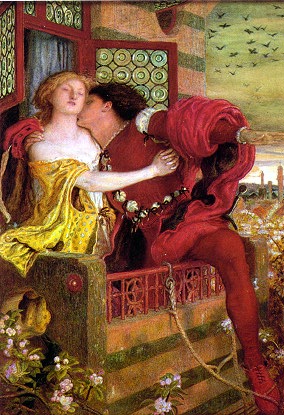
Romeo and Juliet by Ford Maddox Brown 1867
As it happened, Marianne was admitted to Westminster Hospital on November 7th, and she was expecting an operation on her arm. In the light of the hoped-for admission to a Consumption Hospital, we can assume she was suffering badly with her scrofula, which was known to cause various tumours, particularly around gland tissue (such as armpits). But, he wrote to Algernon on November 2nd:
A step has been taken. They have consented to receive Helen into Westminster Hospital, in all probability they will operate on her arm. She goes on Tuesday. This is not a day too soon. For more than a week I have scarcely slept more than half an hour at a time through the night, & the results are appreciable. I have, in the meantime, got Mrs Harrison's help in searching for a permanent home. This will be made use of when she leaves Hospital.  Not because, according to most biographers, Marianne was a drunk who was never sober, but because she was ill with TB and he was tired of caring for and shelling out for an invalid who had no chance for a long-term, meaningful recovery. Heroic? Well, he had his own long-term health costs to consider. George was already beginning to suffer the incurable effects of the syphilis he contracted in the 1870s, though these would not have been identified as such at that time (we now know a lot more about syphilis and the way it damages various bodily systems). All that lumbago, stomach problems and the alleged varicose veins...
Bacchus by Peter Paul Rubens 1638-40

On December 14th, George writes Marianne is returning home. On December 27th 1882, he writes the letter informing Algernon that My wife, in brief, has gone to live with some people in Brixton. Christmas, for those who mark it, is always a stressful time, but maybe something happened in the household that decided Marianne on her next step. George was always cruel and unfeeling towards people he no longer needed, and so perhaps he was making it clear he wanted her out of his life, and playing up to Annie's attentions might have been a ploy to make Marianne leave. There is no reason given for this cold statement, but, of course, biographers assume Marianne was to blame. With an attentive landlady, who offered sex on a plate, what use was there in his life, for poor Marianne?

Marianne had lived with George in Oakley Crescent for about two months, and for much of that time, she was in hospital, or being looked after by someone other than her husband. Did George realise, in Annie Coward, he had a free, better version of a wife, minus the obligations to faithfulness or responsibility to at least attempt to honour his marriage vows? Or did he use Annie to make Marianne see the hopelessness of her predicament? It would be like George to play people off against each other, and he had a low opinion of women in their interactions with each other. Schopenhauer was reigning supreme in his heart, and that old German misogynist spoke at length about how inferior he considered women to be. George, ever the cultural sponge soaking up others' ideas to mould into his own, much more of a follower than the pioneer in the social revolution he is mistaken for by some fans, liked little mottoes and life-affirming phrases. You can imagine him cutting out and copying Schopenhauer's words, can't you, for his Commonplaces collection. Today, he would have a Pinterest account full of them, and maybe an Art Journal with badly collaged pictures adorning his favourite 'words of wisdom' entries. 
The Flood - Deucalion Holding Aloft His Wife by Paul Merwart c 1882
George had made it clear (especially to Mrs Frederic Harrison) that he no longer wished to live with Marianne, but this was not because his wife really was a drinker, or a whore - it was because he was fed up with caring for her. He had no compunction in making it clear he did not want her in his life, but he was lumbered with paying for her - to the tune of £1 a week. This might seem like he was being generous, but she was an ailing woman much in need of frequent hospital treatment and nursing care with its medical expenses, for which she would have to pay. And, as Marianne convalesced in Brixton, and came to terms with her dreadful lonely predicament and her tragic medical prognosis, George took to the town and indulged his fancy for Gilbert and Sullivan. 
Landscape With The Fall of Icarus by Pieter Bruegel the Elder poss 1560 
On August 9th, 1883, George writes to sister Madge that he knows the Cowards are only going to be in Oakley Crescent for about another year. 

On May15th 1884, George sends Algernon his new address. And, on May 23rd, he writes to his sister, Madge: You will see that I have once more changed the place of my abode, & have come back to an old familiar neighbourhood. I was very comfortable indeed at Oakley Crescent, but the position of my room brought me so much into contact with the family that little by little my work had come to a stand-still. I could only save myself by exile, so here I am. 

Could only save himself from a damned good thrashing from a cuckolded husband, perhaps?? 


Sunday, 31 May 2015

Commonplace 73  George & Mrs Annie Coward PART ONE

The Temptation of Christ
by Ary Scheffer 1854
Sex pleasure in woman is a kind of magic spell; it demands complete abandon; if words or movements oppose the magic of caresses, the spell is broken. Simone de Beauvoir
One of the great disappointments in a woman's life is the realisation men are all, at heart, sexual predators. What separates the rapist from the chevalier, and the continent from the adulterer is opportunity - some of us might say. We know George was no different. Though he might have dressed up his motives much as a wolf dons sheep's clothing, he was clear on the subject of his sexual needs and how he could go about satisfying them.
He was not looking for romance. He took his chances wherever he could, preying on less than socially confident and worldly women. The three wives he got through in his short life are testament to a man who lacked sincerity and grace where women were concerned, who relied on the insecurities and precarious position in society those women occupied, all of them much weaker than himself and likely to be unable to withstand his domineering persistence. He lacked HG Wells' brio and playful charm (or was that playful smarm haha?) with the ladies; you can't imagine George flirting (given his dire performance in the letters to Gabrielle) in a convincing, stirring fashion, can you?

In the last year of their time together, George was forced into the position of being his first wife Marianne's carer, which he resented. Let's face it, he was never cut out for that sort of role - in order to fulfil that remit, one has to have empathy and unselfish devotion to duty. Not George's strong suits, and neither was he motivated to develop them. Throughout his life, he ran from responsibility when it was up close and personal, preferring to deal with life's moral conundrums by throwing money at them. As long as he was paying for something, his job was done. Algernon, Marianne aka Nell, Walter, Edith, Alfred... George demonstrated his 'caring' ways by handing out cash. He never really got the concept of what people really want from their supporters - which is authentic concern plus time - but then he can never be accused of not helping out the easiest, cheapest way of all. As Henry Ryecroft, that weird mouthpiece George invented to speak his reactionary worst, said: With money I buy for cheerful use the hours which otherwise would not in any sense be mine; nay, which would make me their miserable bondsman. Paying for someone else to do the caring for his disabled wife had the dual benefits of appearing to care whilst ensuring maximum time for him to indulge his love of reading. The misery of having no time to read a thousand glorious books. Never listen to anyone who claims George wanted time to write - if you add up all the hours that took up over his lifetime, you wouldn't amass much. He hated writing, and saw it as a means to an end - the 'end' being time to read.
One of The Family by Frederick George Cotman 1880
Biographers claim Marianne was a drunk and this was what eventually came between them - poor George was unable to keep her off the bottle. Utter claptrap, of course, but it was a convenient lie that George told Miss Collet when he needed her help to ditch Edith. And everyone else ever after sees it as truth. It's clear from the Letters, Marianne was not suffering from any effects of alcohol-related illness. For a start, hospitals for the poor would not entertain to admit anyone with drink-related problems - because these were not seen as medical diseases, but as self-inflicted side effects of a dissolute lifestyle. Poor people did not have access to the kind of care that supported this - unless it was in a designated hospital for inebriates. As Marianne was never taken into one of these (and there was one in the area of north London where they mostly lived together), we can assume what she required in terms of in-patient care for was not alcohol-related. Such services as were provided for anyone with an alcohol-related problem was usually paid for by Christian-based charities, all of whom held temperance in high esteem. George never mentions she spent time in any hospital for alcohol-related problems - any talk of Marianne being a heavy drinker starts with the policeman who called on George and offered to spy on Marianne so George could obtain a divorce. This was in 1883. As this self-serving policeman didn't unearth any evidence in the form of witnesses to her drunken behaviour, we can assume there wasn't any drunken behaviour to witness. Much later, when George, was manipulating Miss Collet with all the skill he had to muster (which, in terms of manipulative behaviour, was considerable!) when he was desperate to attract that (shamefully un-British) drug of sympathy he constantly craved, was when he framed Marianne as a drunkard. This is the only reference George makes to the subject of her being a drunk, but biographers have clung to it resolutely - whilst refusing to see the evidence for his syphilis haha. Still, there's none as blind as those...
Satan from Milton's Paradise Lost
by William Blake 1808
Throughout 1882, George and Marianne lived at 15, Gower Place, 29, Dorchester Place, and at 17, Oakley Crescent. It is clear from his letters to Algernon, going as far back as the beginning of the year, George was tired of Marianne. Her health was beyond poor, and no doubt it was becoming apparent to medically savvy George that she was not going to get better. In 1881, Marianne was 24 but the ravages of her disease must have already begun affecting her appearance, her personality and her state of mind. She had some years before developed epilepsy, for which there was no effective treatment, and that seemed to have become more profoundly disabling; her scrofula was becoming systemic and so was making itself known in various parts of her body, as it insidiously destroyed her vital organs. There was no cure, and no way of estimating the prognosis: it might be two or twenty years before it consumed her. At times, she required what is termed in the nursing trade as 'all nursing care' and required hospitalization; there was a raft of ailments connected to her scrofula, some of which required surgery, and all of which would be recurring, growing ever more disabling. With no NHS to draw on, George was caught between being too rich to qualify for what financial help there was available, and too poor to be able to afford the very best of treatment for Marianne. 


In May, 1879, he had sent her to stay with his brother, William, and that had been hugely beneficial to her health. But, by 1882, William was gone, and George's solution was to farm out her nursing support to various landladies who posed as carers. This might seem unkind, but there was a roaring trade in private health care - even George's old friend, Dr Henry Hick, did it (for HG Wells and George, himself). In order to understand this type of arrangement, it is important to remember the nursing profession was unregulated, and anyone with a spare room could set themselves up as a private home for convalescents. This had been the case with psychiatric patients, until the XXX introduced legislation to monitor the way residents were treated within the confines of private asylums and small, often single-patient, residences. Again, and it seems logical but is often overlooked, Marianne was sent to live with little old ladies and single women - who would not have tolerated a drunk under their care. She was never thrown out of these places, but always left when she felt well enough to return to her real life - with its freedom and independence. She had every legal right to cohabit with George and it does not seem at all a selfish and thoughtless thing for a wife to want to live with her husband - well, not to me! In September 1882, George boasts to Algernon that Marianne will have a servant in the new 'place of abode' that he had found for her - like that would appeal to the likes of Marianne, who was used to being George's servant. 
The Discobolus of/by Myron 460-450 CE click for link to British Museum video
The couple moved into Oakley Crescent, Chelsea (now 33 Oakley Gardens) in September, 1882. The landlady was Mrs Annie Coward. Her husband, a commercial travelling salesman (travelling in ladies' underwear, as the old music hall joke used to say??), was often away from home. This was not a flop house - Mrs Coward employed two servants - as George boasted to Algernon. And, in a letter of November 26th to his sister Madge, George wrote:
I am glad to say I am very well off in these present lodgings, have every attention, & get good cooking. The landlady relieves me of all trouble as to meals, & gives me for dinner at night just whatever she likes. It matters little what it is, as long as one's hunger is satisfied.  It sounds like Mrs Coward was very accommodating. 

George has begun to refer to Marianne as 'Helen'; the old familiar 'Nell' is no more. Was this rampant snobbishness or a sign he was desperate to see her as not on familiar terms?). On November 2nd 1882, he writes to Algernon:
A step has at last been taken. They have consented to receive Helen into Westminster Hospital, where in all probability they will operate upon her arm. She goes on Tuesday (that was 7th). This is not a day too soon. For more than a week I have scarcely slept more than half an hour at a time through the night, & the results are most appreciable. I have, in the meantime, got Mrs (Frederic) Harrison's help in searching for a permanent home. This will be made use of when she leaves Hospital. As he made use of anyone with excess 'sympathy', George had dragooned in Mrs Fred Harrison to help. Shameless. 
Mrs Frederic Harrison
by William Blake Richmond 1882 


George was going through a Gilbert and Sullivan phase (but you can't hold that against him haha). Algernon was staying in London (though, tellingly, and despite an invite, not at Oakley Crescent), and the two were out 'on the town' together. Whilst the cat's away, the mice will play - as they say. On December 11th, George went to visit Marianne in Westminster Hospital. On December 14th, he wrote to Algernon:
I hear that there is to be a return from the Hospital tomorrow. This, of course, alters all prospective arrangements, & I don't exactly know the next step. Presumably, Marianne returned home as predicted, on December 15th, and George and Algernon would have to curtail their bachelor ways for a while. 

On Christmas Day, George took his dinner at a cafe in Oxford Street and did not have it at home. On December 27th, Marianne moved out of Oakley Crescent and took half the furniture with her. She went to live with 'some people' in Brixton. This was a decisive step for Marianne, coming so close on the tail of a stay in hospital, and in the midst of the necessary convalescence period. What had happened to bring on this rupture? Had she come across something George might not have wanted her to discover? Mrs Annie Coward, perhaps, stepping up and filling in for her whilst she was in hospital? Husband away - George lonely and incompetently struggling at looking after himself? Long winter nights... sympathy given and received? Maybe Marianne stumbled upon some sort of liaison dangereuse and decided to call it a day on her less than ideal husband. 

George's plan was to find a small rented room of his own somewhere cheap - but Mrs Coward would have none of it; she 
...stepped in as my saviour by proposing that I should have a little back room of their own, & so save all the fearful trouble of removal, &c. ... My rent will be 7/- weekly, including all attendance! My wife receives £1 weekly; so that my expenses are still heavy enough.  Good old Mrs Coward - such a good egg. Her much older husband would have been proud of her. 'All attendance' covered a multitude of sins, no doubt. And, how selfless of her, to make it possible for George stay under her roof...
Something was changing - George decided to drop the 'R' from his authorial signature; Positivism was losing its allure. And Mrs Coward was demonstrating her sympathy. What a trouper she was! But, by March 1883, George was ailing, and he was complaining of his room being cold. Was clever Mrs Coward keeping his room freezing so he would seek out warmth like some feral alley cat... and find it along her back passage - I mean, in her parlour*? George, peacock-like, begins to use hoity-toity phrases - 'what the deuce!' slips into his letters to Algernon. He says this: By the way, is not Carlyle sadly gone off? I met him the other day, & he did nothing but blaspheme, & pour out a torrent of bad language against blackguards, fools & devils, that was appalling to listen to. I kid you not. Was he channelling Samuel Johnson, prithee, haha. And, then the man flu is rampant - he can't work for the sake of fretting over his publishers's lack of communication. Later, a nasty bout of lumbago means he can't turn his head - which is odd, as lumbago is a generic term for lower back pain. What has George been up to that has damaged his lower back right up to his neck??? Hmmm... 
By April, he has to decamp down to Hastings because of 'general seediness'. Whatever that is - I have my suspicions the emphasis should be on the 'seed' part of that!


The Woman, The Man And The Serpent
by John Liston Byam Shaw 1911
Then, developments. A curious entry on July 18th 1883, to Algernon:
My holidays have begun rather unpromisingly, with headache and inability to work, due to various strange complications & bedevilments in which no one has any interest but myself. (Then why mention it??) Is Mrs Coward exercising too much sympathy?? He adds: 
Have I told you yet that I have changed my quarters in the house here? At the proposal of the Cowards I have quitted my downstairs room, which was after all damp & unwholesome, & am fixed in the back parlour (*what did I tell you??), - the room, you remember, where we used to have tea. It really is very comfortable, quite dry, & - joy of joys - the chimney does not smoke even when the door is closed! I am convinced this saves me many a quinsy next winter.  
By July 21st, he is talking about going to a party with the Cowards. A party?? And, by jingo! He HAS been channelling Sam Johnson, for he is reading Boswell and Mrs Piozzi. But, there is a swelling in the veins of one leg he has to contend with.
My own position at present is not a little deplorable. For a week I have been laid up a somewhat serious malady, - a varicose (ie swollen) vein in one leg. It is very likely that I may have to give up any thought of leaving the house for some weeks to come. Of course the situation makes me feel generally out of sorts. It is to be hoped that I shall be in a safe state before the Harrisons come back ...  What was the origin of this business is hard to say. 

Now, whatever could be wrong with our man? A simple case of varicose veins?? Nah. He attributes the problem to too much walking - which is unlikely to cause it; rather, it would help prevent it. No-one is ever totally housebound by varicose veins - when walking is the recommended first line of relief - and few people have the psychic gift that can predict for how long they will last in a troublesome state. Here I sit or lie all day long, more or less head-achy, & as yet, incapable of getting on with my work. Luckily, Eduard Bertz is back from his American sojourn, extolling the virtues of communes and Walt Whitman, and he helps nurse George by doing any little things abroad for me that I may need.  What might these be? What 'little things' might he prefer a man friend to do, and not a landlady?? What might cause such an ailment, about 90 days after initial infection with a bacterium?? Hastings, like all seaside towns, had landladies with needs... and women desperate for love and money.
Satan As A Fallen Angel (detail) by Sir Thomas Lawrence 1797
In George's day - and probably even now because there's nowt as thick as folk, and ignorance and superstition worldwide is a heavy burden for the human race - there was a mistaken belief you couldn't catch syphilis twice - that a primary infection gave you immunity. As syphilis is a bacterium and not a virus, you can catch it as many times as you like - if experience doesn't teach you anything useful. But, what was a person to do, when desire needed to be fulfilled? George knew the consequences of risking his sexual health indiscriminately, but he had needs - heavens, he had needs!!
It is to be hoped that I shall be in a safe state before the Harrisons come back ...


JOIN ME IN COMMONPLACE 74 TO FIND WHERE ALL THIS BUSINESS WITH ANNIE COWARD LEADS OUR MAN.