Tuesday, 13 October 2015

Commonplace 117 George & The Influence of John Ruskin PART THREE: Lilies part 2.

TODAY IN THE UK IS ADA LOVELACE (1815-1852) DAY - AND WE ARE LOOKING AT HIGHLIGHTS OF RUSKIN'S TAKE ON WOMEN'S EDUCATION.
Ada Lovelace in 1840 click 

So we have the second part of John Ruskin's lecture from the Lilies part of Sesame and Lilies of 1865, which is quite complex and often off education message, so I will pick out some gems. The full text of both lectures can be found here click

In the first part of Lilies, Ruskin focuses on the nobility of women, and the innate Home-making utilities we possess that help to support all the endeavours of men (some of us fall way below this ideal, Mr R!). But Ruskin, in both Sesame and Lilies was concentrating on the potential for educating people through reading, and Lilies was written with Ruskin's young muse Rose La Touche, in mind. Rose was a child, then young adult who was Ruskin's soul-mate and true love. He marked her down as marriage material when she was little more than a child - 'Lilies' was written to set her straight about her way in life.

Firstly, let's remind ourselves that George took the view that women are 'as intelligent as the average male idiot'. There is no flannelling out of this statement as he made it in a letter to his sister. So, it's difficult to know how much he took to heart what Ruskin said about teaching girls - we know George had female pupils (the Lushington girls, for example), but did he invoke the spirit of Ruskin when he tackled their lesson plans? How closely did he follow the 'Master'?

Ruskin starts this part of his lecture with a plea for women to become physically fit. In a time when females did not zestfully race about (think of George's short story Fleet-Footed Hester and how weird she seemed) partly because they did not have the costumes to make movement easy, and the fashion for corsets undermined all women's attempts to keep moving above a slow baby-step pace. Sport may have had its appropriate outfits, but underneath that would be a metal straitjacket of a corset. As Ruskin was particularly interested in making Rose La Touche his protégé, muse and prospective wife, and therefore robust enough to survive to young adulthood, this was a clear message to her to get out and exercise. Rose tended to anorexia and consumptive chic, so probably needed guidance on food and fresh air and all that sort of malarkey.
Elsa Lanchester and Boris Karloff in
The Bride of Frankenstein 1935
click
 
Ruskin invokes Wordsworth who termed this vigorous physical health as the 'vital force' derived from wholesome activity - not that nasty opposite, which is debilitating and enervating. The fashion for melancholic brooding popular amongst young men of a poetic, aesthetic, artistic bent, becomes a liability in a woman, because it is generally reduced to an aspect of hysteria. Rose - take note.

What else forms Ruskin's rules for a woman's education? Well, he said:

Do not think you can make a girl lovely if you do not make her happy. There is not one restraint you put on a good girl’s nature – there is not one check you give to her instincts of affection or of effort – which will not be indelibly written on her features, with a hardness which is all the more painful because it takes away the brightness from the eyes of innocence, and the charm from the brow of virtue. Now, this is sound in every way. but it's difficult to think George would give it much credence as far as Edith was concerned. But, Marianne aka Nell - did he lose heart in the struggle to support her poor health because he ran out of the ability to make her happy? Caring for an invalid is generally emotionally stressful and leads to feelings of inadequacy, especially when the patient's recovery becomes unlikely. Anger and resentment can creep in. However, as George was a fan of Charles Darwin, we can also assume he considered Nell inferior breeding stock, and so could not risk reproducing with her - and a woman/wife he couldn't have sex with was expendable. I don't for one minute think he ever wanted to reproduce, but it was a serious side-effect of a regular sexual relationship, in those days of ineffectual contraception. All the lies he told about Nell, and posterity's determination to carry on George's dirty work in maintaining the false position she is put under, may have originated in his shame at not being able to make her happy and keep her lovely. 

So, we have to consider how George translated Ruskin's words and formed them into actions. When he tired of Marianne aka Nell, and grew resentful at her increasing ill-health, and her physical loveliness was perishing before his eyes, did he realise his character flaws and shortcomings would not be able to make her happy? Poor Edith was never going to be happy because of George and his own brand of what was the right way to behave or think or act, and that would always exclude spontaneous fun and socialising with normal people. Witness his (over-) reaction to seeing Demos enjoy itself on a bank holiday, or Edith allowing son Walter to listen to seaside pier show singers. Foreign Demos out on the streets having loud, garrulous fun with barrel organs and white cows, was acceptable to George's narrow definitions of approved hilarity - it was just Brits having fun George didn't like. 
Woman Reading With Parasol by Henri Mattise 1921
One area where Ruskin comes very clear is that a woman's learning must be functional and for the good of others: All such knowledge should be given her as may enable her to understand, and even to aid, the work of men; and yet it should be given, not as knowledge, - not as if it were, or could be, for her object to know, but only to feel and to judge. Remember, he sees women as the arbiters of life's situations. It is of no moment …if she knows many languages or one; but it is of the utmost, that she should be able to show kindness to a stranger, and to understand the sweetness of a stranger’s tongue.
It is of no moment to her own worth or dignity that she should be acquainted with this science or that; but it is of the highest that she should be trained in habits of accurate thought; that she should understand the meaning, the inevitableness, and the loveliness of natural laws; and follow at least one path of scientific thought but only to better help her husband's studies. He carries on: It is of little consequence how many positions of cities she knows, or how many dates of events, or names of celebrated persons – it is not the object of education to turn her into a dictionary; but it is deeply necessary that she should be taught to enter with her while personality into the history she reads; to picture the passages of it vitally in her own bright imagination.

However, there is one dangerous science for women – one which they must indeed beware how they profanely touch – that of theology. Strange, and miserably strange, that while they are modest enough to doubt their powers, and pause at the threshold of sciences where every step is demonstrable and sure, they will plunge headlong, and without one thought of incompetency, into that science in which the greatest men have trembled, and the wisest erred. This one we can assume George took on board. He argued with both his sisters about religion, and they both seem to give a good account of how they pitied him his lack of faith. Margaret must have been the stronger, as George gave up on her; Edith was more mutable, and, being his favourite, more likely to be the victim of his criticism. 

However, what Ruskin seems to be hinting at here, in this dire warning, is - bearing in mind this is for the girl he wants to marry - that women (in his opinion) tend towards fanaticism when it comes to faith and can take the teachings of it too literally, to the extent this might interfere with their sex lives - or, their husbands' sex lives. Too much misreading of religion can put a girl off the animal qualities of sensuousness, mistaking it in their ignorance, for Sin - which is to be avoided, is it not? But, for Ruskin, marriage was an impossible dream - he never remarried after the disappointment of Effie Gray; when he wrote 'Lilies', he was not expecting to live for another 35 years, alone and presumably, sexless. 

Rosie The Riveter by Norman Rockwell 1943
Ruskin does not seem to be addressing women in person in this lecture - he is speaking to men to teach them about how to develop women. When it comes to how deeply a woman's learning should go, Ruskin cautions against dabbling - a woman should not have a bit of knowledge about a subject because that just annoys men, who always have deep knowledge of their interests. However, as girls mature much earlier than boys, their education should start early - whilst boys can mess about until they are ready for taming to their books... While a woman ought to know the same language, or science, only so far as may enable her to sympathise in her husband’s pleasures, and in those of his best friends.  This is hilarious when you think of how hard George worked at keeping his two wives from his best friends - Morley Roberts never met Nell, and no-one but the minions (Miss Collet and Miss Orme) met Edith. And hardly any of his friends and NONE of his family ever met Gabrielle, the one he considered his one true love and ideal woman until he was six feet under haha.  

Up to now, Lilies seems workable and reasonable. But Ruskin tackles the thorny issue of women and the books they read, and things go a bit awry. Reading, remember, is his cornerstone of education, but women have a weakness for bad books and so we must be kept away from them. As the Divine Oscar said, there are no bad books, only books that are badly written (he said it so much betterer than what I just done) but, for Ruskin, a woman's fragile mind can be addled forever by exposure to the wrong sort of Eng Lit. Popular novels of the time were not advised by JR - though he doesn't name and shame any author in particular. He alludes to romances, murder mysteries - entertainment and diversionary reading for pleasure, which women so love. Filling up our female minds with dross and trivia is to be avoided - our fragile sense of reality will be permanently disfigured by the wrong sort of books. So, what are the right sort? Not Thackeray - and, presumably Gissing, judging by the list of things to avoid Ruskin gives us haha. And, not circulating Libraries which are the Devil's own antechamber to Hell. Then, there are romances - badly written ones are a dreadful thing but well-written ones are even worse! No doubt for all the ideas they give us about sex with lovers, and love and adventure and exciting, fulfilling, loving marriage and all those things girls look for in life.   
Evening At Home by Edward John Poynter 1888
Without, however, venturing here on any attempt at decision how much novel reading should be allowed, let me at least clearly assert this, - that whether novels, or poetry, or history be read, they should be chosen, not for their freedom from evil, but for their possession of good. The chance and scattered evil that may here and there haunt, or hide itself in, a powerful book, never does any harm to a noble girl; but the emptiness of an author oppresses her, and his amiable folly degrades her. And if she can have access to a good library of old and classical books, there need be no choosing at all. Keep the modern magazine and novel out of your girl’s way; turn her loose into the old library every wet day, and let her alone. She will find what is good for her; you cannot; for there is just this difference between the making of a girl’s character and a boy’s – you may chisel a boy into shape, as you would a rock, or hammer him into it, if he be of a better kind, as you would a piece of bronze. She grows as a flower does; - she will wither without sun; she will decay in her sheath, as narcissus will, if you do not give her air enough; she may fall, and defile her head in dust, if you leave her without help at some moments of her life; but you cannot fetter her; she must take her own fair form and way, if she take any, and in mind, as in body, must have always. Let her loose in the library, I say, as you do a fawn in a field. It knows the bad weeds twenty times better than you; and the good ones too, and will eat some bitter and prickly ones, good for it, which you had not the slightest thought would have been so. Here click is a 'most borrowed' list from 2012-13. I have only read one of these titles myself - and it's not the one you might think! (I'm a Hilary Mantel fan.) 
Crouching Fawn by Henri Gaudier-Brzeska 1913

And, so, where does this leave us? How much of what Ruskin proposes is his own projection, and his own sexual fantasy of Svengali-like master shaping ingénue, Trilby click? George certainly shared this male fantasy - both Nell and Edith were his own 'Brides of Frankenstein' creations that went wrong, but the allure of finding a blank canvas and then painting in the woman he wanted was intense. This is a peculiar male display of power, at a time when women had few options of resisting and the social focus was heavily on women conforming to men's desires. When the means of financial support are in the control of men, how could they resist George's assertions that they were inferior, and only he knew how to upgrade them. Arrogance was one of George's worst faults - and keeping his wives away from observers and those who knew as much as he did about social engineering - and so might have intervened to help Nell and Edith - guaranteed both women were defenceless and unable to resist. Education, eh? We don't need none.

FOR MORE ON WOMEN WRITERS' WORK:
click  

FOR ANOTHER VIEW ON EDUCATION: click  

FOR CONTROVERSIAL (NOT MY OWN) VIEWS ON WHY EDUCATION HAS DUMBED DOWN: click

Saturday, 10 October 2015

Commonplace 116 George & The Influence of John Ruskin. PART TWO: Lilies part one.

Of the two Ruskin lectures 'Sesame and Lilies', it's the latter that sought to have the most influence. It is a massive work, covering enough ground for a whole book, and touches many of the concepts and ideas George took to heart, and so it must have been part of his early adult reading experience. It name-drops many of his influences and may have even lead to his interest in his first wife, Marianne aka Nell, as well as going some way to explaining one or two of his more bizarre home-related tyrannical tendencies.
Rose by John Ruskin 1861

First, the lecture's background, which sheds light on the content and purpose of the piece. Ruskin dedicated this lecture to one of his child pupils, Rose La Touche click. Rose was nine when Ruskin came into her life. This was ten years after his marriage to Effie Gray, and four years after that unconsummated marriage was annulled. There are many theories about why this marriage failed, ranging from Ruskin's reluctance to bankroll her family - he was legally and morally committed to marry her but discovered it was a marriage of convenience on her part, designed to advance her family. By marrying her he kept his own virtue, fully knowing he would give her ample room to leave him after the event. A darker theory is an accusation of latent paedophilia. As he was 'engaged' to Effie when she was a child, and then, as we shall see, obsessed (to the point of insanity) over Rose La Touche, you can see why the charge of paedophilia is made.
George mentions the cause of this marital rift in the Diaries (p375). The entry of June 1895 (written by the man who claims not to approve of gossip but who gives us the goss as he knows it whenever he can - here, oddly, in a place where one is traditionally talking to oneself - though we can assume he is writing a diary for posterity to read, that's why it has to be redacted from time to time) - By the bye (who says that to themself??) Holman Hunt's account of Ruskin's divorce is this. Ruskin married merely to please other people, and after the wedding told his bride they were merely to be brother and sister. Impotency may or may not have anything to do with it. Wife sued for nullity.
The Order Of Release, 1746 
by John Everett Millais 1852 
- modelled by Effie Gray 

George writes this in the same entry where he tells us the strange episode when Ruskin wrote to George's friend, Edward Clodd who made contentious remarks about Christianity and Ruskin said he found it as offensive to him as if someone had come round and peed on his hearth-rug, If the Dude aka Jeffrey Lebowski has taught us anything, it is that a really good rug can truly tie a room together, so Ruskin was surely saying a mouthful.

And, so back to 'Lilies'. Ruskin's reaction to meeting Rose was this:
 "...presently the drawing room door opened, and Rosie came in, quietly taking stock of me with her blue eyes as she walked across the room; gave me her hand, as a good dog gives its paw, and then stood a little back. Nine years old, on 3 January 1858, thus now rising towards ten; neither tall nor short for her age; a little stiff in her way of standing. The eyes rather deep blue at that time, and fuller and softer than afterwards. Lips perfectly lovely in profile;--a little too wide, and hard in edge, seen in front; the rest of the features what a fair, well-bred Irish girl's usually are; the hair, perhaps, more graceful in short curl around the forehead, and softer than one sees often, in the close-bound tresses above the neck"

Philip Hoare's article click (based on his book about John Ruskin, 'England's Lost Eden', 2005), suggests Rose was mentally ill for most of her life, and eventually died in her twenties in an asylum. Despite the thirty-ish years age gap between them, Ruskin and Rose did have a very strong bond that almost transcended any that might have arisen from marriage, and, odd and unfulfilled as it was, it was this love that eventually Ruskin's downfall, too.
La Belle Dame Sans Merci by Sir Frank Dicksee 1901
'Lilies', then, was dedicated to Rose maybe to prepare her for marriage to her teacher when she was of age (it is supposed Ruskin formally proposed when she was about 16). Echoes here of the painting George commented on that repulsed him so much - Titian's Venus of Urbino (see Commonplace 87).
This lecture can be divided into two basic parts: the first addresses what women are, which is wonderful, but the responsibility of civilization is on their shoulders; the second, what they need from education in order to achieve this fabulous place in the scheme of things, and not ruin their heads with notions of self-determination and independence. It might be argued that George's problems with women started here, with these two sides of the coin. And it can also be argued that women are the eternal scapegoats forever held responsible for the inadequacies and sins of men - which started before Ruskin as we will will see, but which endures till this day.

Here, Ruskin is still focused on reading as a civilizing force for good, and the foundation of all education. He puts forward the notion that there is a morally upright and decent way of living for a man and that is what being a noble soul is all about. The world can be divided between the aristocrats (as George would term it) who are cultured and read for enlightenment, and those drones who do not - or cannot, through their own deficits, benefit from learning. Aristos are self-reliant and exude natural grace. There is a sort of noblesse oblige to being an aristocrat, and it behoves the civilized to tame the others, leading by example. Education must focus on developing these higher inner qualities in a man. It won;t be an easy job, but the masses can be turned to the good path, if they get to appreciate reading. What then, Ruskin asks, about education for women?

Women, generally, he claims, underestimate their place in the scheme of things - they could be Queens in their little realms (or 'Queens' Gardens', as he terms it), if only they are guided along the right path. But, before considering what type of education would achieve this end, we have to think what is the ordinary role that women fulfil. Opinion on this is divided, he suggests, with no consensus on what are a woman's virtues, intellect, and capabilities in a man's world. Talk of a separate mission for men and women is as futile, Ruskin says, as the argument that a woman is a simply man's helper, or that she can aspire to no more than a role of an inferior who needs a man to support her. To place women in this inferior role is to underestimate the unique gifts of womanhood, and its parity with maleness. 

Ruskin argues that we must accept women and men complement each other in specific ways, and each needs the other equally in order to maximise what they bring to the world. As education is the means by which we are all civilised, and as reading brings us this special knowledge, what can women take form the geniuses who have been writers and poets? For Ruskin, this starts with Shakespeare.

Una And The Lion by Briton Riviere 1888. Edmund Spencer's Faerie Queen, Una was a virtuous Super-heroine who travels the land looking for her lost True Love. click to read it.

He claims Shakespeare has no real heroes, only heroines. In his plays, Shakespeare writes the male leads as feeble, unreliable and selfish, undone by their weaknesses and inadequacies. With the possible exception of Henry V, none of them are up the task of whatever the drama asks of them. But, the women are magnificent, and stand behind their men shoring them up and urging them on - strong, morally courageous and self-sacrificing, all but encumbered with useless men. That is, all except for Ophelia who lets the side down by being mad, and even more pathetic than Hamlet. In fact, Ruskin goes as far as to blame Ophelia for Hamlet's lack of vital force to act. She should have backed him, guided him, supported him, and not just moped about toying with weeds and ditties. She fails him as she is unable to motivate him to sort himself out - for Ruskin, drowning is too good for her.

Next, Ruskin brings up the heroines Sir Walter Scott gives us: all of them gracious, kind-hearted and intelligent - far brainier than their menfolk, who are all weaklings, only in their exalted positions because they are backed with money and the good luck to have married a good woman. And Scott's women are the most patient, most loyal and supportive of mates. In these tales, it is the woman who teaches her male friend to be a man, and to appreciate what it fully means to be a lord. 
 Ruskin then touches on Dante and the Divine Comedy, then the Greeks and the Romans and how their great ladies were the manifestation of devotion, grace and loyalty, often 'the power behind the throne'. He mentions Chaucer's 'Legend of Good Women', but reminds us he did not give us a 'Legend of Good Men' because it couldn't be written. This brings us to Edmund Spencer's Faerie Queen and the tale of Una and the Lion, the Lady who went in search of her Lost Love. Despite a series of challenges and adversity, Una never sinks below her noble status and her soul remains pure. 
The Red Cross Knight (from Spencer's The Fairie Queen) by John Singleton Copely 1761.  
Ruskin then reminds us that women have always been the inspiration behind the best of literature - and suggests disbelievers in his theory should ask themselves: can all these great literary minds be wrong to elevate women to such an exalted status? In all times, men have been conscious of and benefited from the superior qualities of women's moral and modest hearts, and so being devoted to a noble woman is a state of grace, and an obedient devotion is a chivalrous stance, worthy of any true knight. 

Next, he invokes the spirit of Coventry Patmore click, whose most famous poetic work 'Angel In The House' was first serialised in 1854: 
How wasteful woman is! She could have set any price she chose on her sweet self, knowing that man would pay whatever she asked to have her. But she has cheapened paradise and given away her gift for nothing. Now the bread is spoiled and the wine is spilled; if it had been properly used, it would have turned brutes into men--and not just men, but divine men!

Mrs Coventry Patmore by John Brett 1856
Ruskin then reminds us that all these notions of woman as goddess of good are straightforwardly evident in the first flush of Romantic Love, but how can they be sustained into a life-long marriage? He says that men often withdraw their devoted affection when they have gotten used to living with their wives - and this is monstrously cruel. Familiarity has bred contempt, and that is a sin and ungallant. A man should be aware that marriage, itself, affirms its spiritual and ethical rightness of his choice of wife and he should work at maintaining the devotion he has for her by always behaving chivalrously and protecting her from harm.

Ruskin then explains the differences in the genders. Men are doers, leaders, creators, inventors, discoverers, protectors, progressive and with a natural bent for war. Women are not warlike, and they do not like to lead. They are made for (I am not making this up!) tidying, arranging, making cushions, er decisions; she can judge quality, is aware of the rights in a situation, and where stuff goes. She lives to give praise. She is not competitive but she says what life's rewards should be for the winners. She is kept from dangers and temptations of life by being at Home. Whereas man is subject to failure and mistakes in a hostile world, and is often wounded and beaten down, he protects his woman from these forces of adversity and she provides the safe haven of Home for him to return to - a place where he can feel loved and at peace. Home is the stronghold they share against an uncertain and cruel world. And, the concept of Home is that it is a sacred place, a domestic temple guarded by the household gods (Her and Him) and only shared with those they love.
When a woman is truly a worthy wife, she can transfer these Home-making qualities to any location. She doesn't need a house with a roof - she can create a home even under the stars. If she is this truly noble ideal woman, she can bring light into any darkness, and make any situation a place of light and love. But, this is an important job and when it goes wrong, then everything is wrong. She has to be above reproach and her behaviour must never sink below the excellent standard expected of a noblewoman. Therefore, she must be incorruptible, never further her own aims but live for others, and indulge in self-denial to sacrifice herself for her man and Home. She must not be petty and prideful, and haughty. She must be mutable and flexible, able to offer service whenever it is required, and this is why women are innately changeable; not in a flippant, dilettante way, but in order to be resourceful. She must be wise, but her wisdom must be used for support of her man and for the betterment of others.

How can she be prepared for this important work? What then, Ruskin asks, do women need from education? 


To read all of 'Sesame and Lilies' click

JOIN ME IN PART THREE TO ANSWER THAT!


Thursday, 8 October 2015

Commonplace 115 George & The Influence of John Ruskin. PART ONE.

Ruskin in 1863
It is impossible to fully assess the influence John Ruskin (1819-1900) has had on British cultural life. In George's day, he was the foremost Art critic, cultural polemicist and influence on socialist creative thinking. His collaboration with the Pre-Raphaelite Brotherhood and the work he did in promoting education for the masses, reflecting the value of developing all levels of social class, is still shaping British cultural life today, and can be seen in the reverential way Art is often touted in the media (though, sadly, not in education) as indispensable to Civilization.

When George reached an age to appreciate him, he had done some of his best and most challenging work. In 1865, Ruskin presented 'Sesame and Lilies' first as lectures, then in printed format. George would have read these in one of the cheaply available texts. Both topics covered were things he was particularly interested in, and would debate for most of his working life in works such as 'The Odd Women' and 'Demos'.

'Sesame' addresses the need for reading in order to disseminate a cross-class collective interest in, and appreciation for, all elements of moral and cultural life, especially literature. For Ruskin, mass education began and ended with reading. Adult education classes in basic literacy today still support this view, though a nod is given to Paulo Freire click, especially his 'The Pedagogy of the Oppressed' (1968), luckily influencing course outlines. Freire owes something to Ruskin in his assertion that all language is political, with the acquisition of literacy being the most important tool of democracy. 'Sesame' set out to focus minds on promoting reading in order to improve society, and console the individual in her/his existential journey through life's tribulations. But Ruskin wanted reading to be inspirational as well as instructional, with the choice of what to read limited to what some intelligentsia deemed high quality and appropriate.

'Lilies' addresses the innate quality women posses for civilizing the world - taken as being male-centric - and the thorny issue of how to educate them for this unique role. We will cover this in the next post.
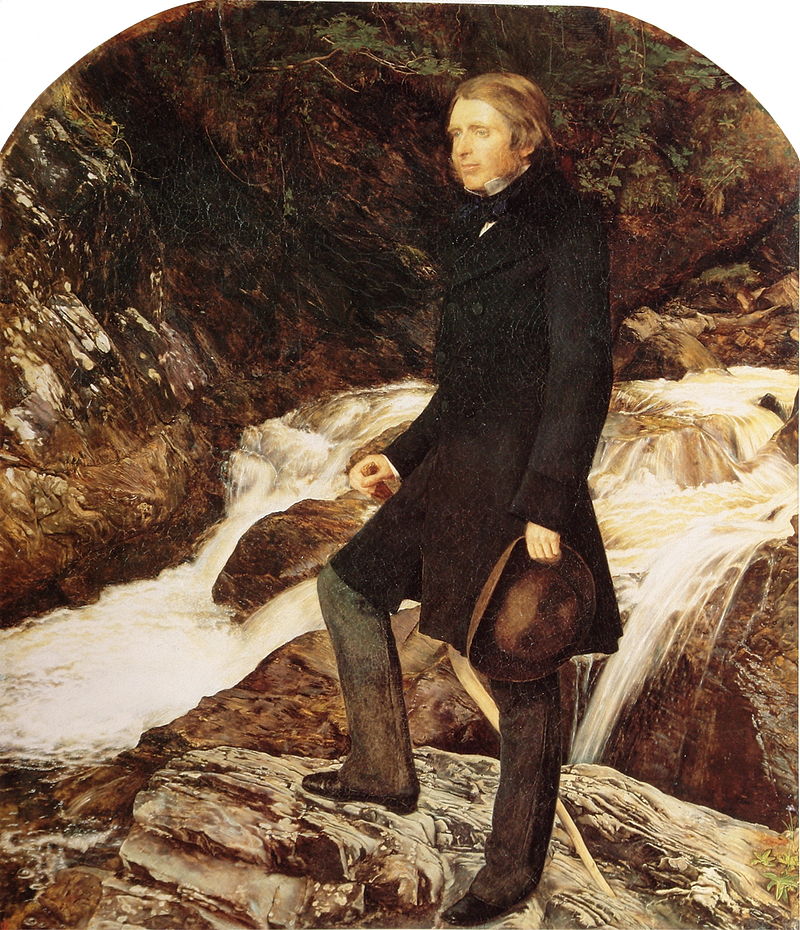
John Ruskin at Glenfilas by John Everett Millais 1853-4. He seems to have a narwhal tusk walking stick, thought mistakenly by some to be unicorns' horns.  

In 'Sesame', Ruskin was interested in the quality of education, rather than the quantity. He advanced the notion that education is in and of itself, beneficial, and does not have to have a function other than self-development. We come back to the Divine Oscar Wilde's truth: 'What you read when you don't have to determines what you will be when you can't help it'. George's love of all things Roman and Greek would fit neatly into Ruskin's concept - as would anyone who pursues any exploration of any challenging or intellectual interest in their free time. To Ruskin, learning is the purpose of life, and should be pursued as the highest level of human endeavour and achievement. Making money from skills and knowledge should not be the main purpose of education - we must be taught to appreciate learning for its own sake and not as a means to an end. And, because we meet so few geniuses in person, we have to rely on what they have recorded in books to develop our own intellects and widen our cultural horizons.

Ruskin would disagree with Oscar Wilde's assertion that 'there is no such thing as a good or bad book - books are either well-written or badly-written'; he would suggest good and bad books can make or break a mind. By 'good', he means books that are uplifting, sincere, beautifully expressed, inspirational. If enough of this sort of reading is undertaken, then low society will raise itself from the gutter and social improvement will prevail. We can find echoes of this in George's drive to 'educate' his first two wives, Marianne aka Nell and Edith. We know Nell liked poetry and was able to read for enjoyment - we know so little about the real Edith we can't possibly comment on her love of literature, but it would be likely that whatever George allowed her to read was not what she would have chosen for enjoyment's sake.
Lady Reading A Book 
by Attilio Baccani 1876

For Ruskin, reading is the great civilizing force required in a society that is developing in all other spheres at a pace that threatens its cohesion. As great writers commit their thoughts to paper, a healthy and wholesome society needs to improve its word power so the great ideas can be transmitted to all. What needs to be established is a shared sensibility that puts the Arts at its centre, and eschews the pressures of industrialization and money-making as the true purpose of existence. Because of this, books must be valuable and worthwhile in every way: Ruskin wants books to be beautiful containers for brilliant ideas, yet elitism is anathema to a fair and self-actualizing society, and so books must be beautiful, brilliant and affordable.

According to Ruskin in his lecture, there are 5 basic ways to improve the lot of all members of society:
1) Promote a love of reading and make it accessible for all.
2) Promote a love of science and not just in order to make money from it.
3) Promote a love Art and bring it to the masses via public exhibitions.
4) Promote a love of Nature and protect it from harmful forces.
5) Never underestimate the power of compassion to model the spirit of goodness.


He then goes on to tell this parable of modern life:
An inquiry was held concerning the death of a man, Michael Collins, 58 years old, who lived with his wife. Mary, a malnourished and prematurely aged woman, and his son, Cornelius, who had severe cataracts. They all scraped a living from recycling old boots, and selling them. There wasn't much money in the trade, certainly not enough to feed three mouths and keep a roof over their heads. Suddenly one day, Michael stood up at his work bench and declared he could not carry on, that someone else would have to finish the boots he was working on, as he was too cold and unwell to finish them. His wife took some boots to sell but received a few pence for them and could only afford a little coal and a small meal of bread and tea. But, it was too little, too late – next morning, Michael died. The family were starving and the want of food was dire. At the inquiry, she was asked why they didn't apply to the workhouse. She replied that they wanted to stay together and their home was what held them together; if they lost that they would lose each other. She was then asked ‘What comforts did you have? All you had was a dirty bed in the corner and no glass in the windows’ But Mary began to cry and defend her meagre possessions of a quilt and a few knick-knacks as worth keeping. Work was easier in the summer, and they earned a little more, and could stash some away; but winter was hard and these funds had run out. her son said he worked as hard as he could – just as his father had done – and working in poor light had ruined his eyesight. He felt sure he would regain his sight if he just had more to eat. He did not want charity – he told of his father’s previous experience at being turned away by the local church who had once refused him aid, and just gave him a loaf of bread. Finding himself totally destitute and worn out by it all, Michael had finally laid down and died.

One of the inquiry team asked the son why he did not go to the workhouse for relief as he was clearly starving to death, and Cornelius said he would never go to an institution for help as he would lose what fragile toe-hold he had on his livelihood and home if he did; he would never regain a roof or a means to earn a few pennies if he changed his situation. In evidence, Dr Walker, the attending doctor disclosed that the dead man had died from malnutrition exacerbated by cold weather, and for four months, had eaten nothing but bread, which had rendered him starved to the extent there wasn't any fat on his body. There was no sign of disease, and if medical help had been summoned, he might have survived. The medical record officially stated, 'The deceased died from fainting brought on by lack of food and basic necessities of life; also from lack of medical attention.'

Ruskin then goes on to describe why Michael Collins and his ilk prefer death to the workhouse - and suggests the poor live in horror of charity and are ashamed to ask for help. They do not have the luxury of pensions awarded by the state, and are forced to give up all that connects them to existence when they go into a workhouse - how much better it would be if they could have a form of state pension and stay in their own homes. He is critical of the church that does not act charitably but erects walls and stumbling blocks to prevent charity, doling out money with a tight fist and in such small sums as to promote dependency. He decries workhouses that grind down the spirit and treat inmates as criminals, when they should be beacons of noble compassion and seek to set their charges off once more refreshed by their stay in the clean, wholesome surroundings, strengthened in body mind and moral courage, and able to withstand the adversities of life. True nobility comes from the way society treats its least able citizens, and to regain this moral purpose, education and magnanimity must prevail.
Man Reading A Book by John Singer Sargent
1904
In his conclusion, Ruskin advocates that the money spent on unjust wars should be used to better the lives of ordinary people. He says just wars are cheaper - and one thinks of modern life where the boundaries between just and unjust are usually blurred.

So, what did George take from this? Not much of real worth. Maybe a few story-lines! He often facetiously mentions the workhouse as his natural destination in life, and even took a guided tour round his local one, the Marylebone (see above), but he would never have ended his days there. His poverty pose was just that - a fiction. But, how like Nell's death is the fate of the Collins family - did George lift the dreaded death scene he so carefully preserved at the start of his published Diaries from Ruskin? There is more than a whiff of fantasy about that death scene - but it added to the myth his first wife was a drunken waster, and he, the martyred husband.

How far did George stray from the influence of Ruskin? Well, he didn't believe in promoting education to the poor (or women!) - it was, he felt, casting pearls before swine. He didn't want the masses reading the books he had written, or his precious Homer, and he firmly believed very few of the working classes could appreciate poetry. He didn't like science and distrusted it. He thought Art was an activity that could and should only be appreciated by an elite, and would have cringed at free Art shows for all. He liked Nature and was fond of animals. And, he definitely did not believe compassion would save the day, or should be wasted on the 'undeserving'. He did agree that war is a bad thing, but that was never really tested under fire. If he had been on the receiving end of a Holocaust or an invasion, he might well have girded his loins for a fight, and justified his actions much like wars are always justified by their advocates, and sometimes, justly.

To read Sesame and Lilies for free click

JOIN ME IN PART TWO TO LOOK AT 'LILIES' AND HOW RUSKIN SAW THE ROLE OF WOMEN'S EDUCATION.


Saturday, 3 October 2015

Commonplace 114 George & Love. PART TWO

Beautiful Girl With Flowers In Her Hair
by Albert Lynch c 1890
With a mixture of flattery, lies and blatant emotional blackmail, George ploughed a desperate furrow in the untilled soil of Gabrielle Fleury's heart. As we have seen in the first toe-curling letter to include his declaration of adoration and intent, George was capable of saying anything to persuade his love object to succumb to his... charm. He wrote this:
But, - do you know how sensitive I am to kindness from anyone? And what can be the effect upon me of words such as these from a woman whose face has charmed me, whose voice has thrilled me, and in whom I divine something very like my ideal of womanhood?

Firstly, and without wishing to be unkind, if George hadn't marked her card as his last, desperate chance to secure a wife (despite the fact he already had one he was avoiding), and if he had met her in any social gathering, he would have lampooned Gabrielle's less than pretty appearance. He was always vocal about the shortcomings of womens' appearance and he always judged them by his ideal. We know he was a trichophiliac click because he mentions hair so often in his novels, and we know he cut off and retained some of his first wife's hair on her death bed. And, of course, he took great pride in his own mop, and, as Morley Roberts reported, when washing his face, kept it out of his eyes with a rubber band. 

Only a few days into their 'relationship' (which had thus far consisted of several hours together and a few letters) George asked Gabrielle to send him some of her hair:. Then:
August 8th 1898
This morning comes your letter, with the little piece of your hair - infinitely dear to me. It  has a sweet, subtle scent - it brings you here and for a moment eases the constant heartache from which I suffer. 
Weird.

September 9th sees George in fine form as a lover :
Yet, the more I think of you as you show yourself in your letters, the harder it is that any terms of admiration can in this case be excessive. Speaking calmly, I find myself obliged to use the same language as when I lose myself in a rapture of worship... In spirit I fall on my knees before you, subdued by such a revelation of exquisite womanliness...

In or around September 9th he drops the S bomb - that if she left him he would commit suicide. Not in so many words, but the meaning is clear:

If I lost you , I have a terrible certainty that despair would make an end of me - yes, in spite of my strong sense of the duty I owe my poor little children. To live without you, is very hard, to live without hope of you would be impossible. I have had a warning of that despair in the sinking of the heart which comes upon me when, after a few days, a letter has not arrived.
Alexa Wilding by Dante Gabrielle Rossetti 1977
September 14th, he apologises that his letters stink of tobacco and says he has given up smoking, but in the end, has had to obey his doctor's orders to recommence it for the sake of his health. Perhaps she believed this tall tale - I doubt it. His story (and he stuck to it!) was that he did it for the sake of his health. (Did Maman allow him to carry on with the habit?) The next day, he writes about his tricky start in adult life, and mentions what happened after his gap year in the States:
Returning, I began a life of terrible struggle in London. For many years I really lived by teaching (privately)... If my good father had lived, I should probably never have known hardship. In those early days it was my ambition to be a painter; but much more likely I should have followed an academic career, and have become a University professor! There is a great deal of the pedant in me, as you know, and I was always able to teach. 


Venetian Beauty On A Balcony
by Eugene de Blaas c 1910
No mention of why he went to America (following his time in prison) or the fate of his first wife, Nell, and how he abandoned her, or how he was never good enough or originally creative or inspired enough to be a professional painter, or how much he detested teaching, and being an ex-con, probably would never have found anything other than home tutoring. He was right about the pedant bit, though. However, I'm not sure it was the word George meant to give her, as it is a far from flattering term; here is a definition: a person who is excessively concerned with minor details and rules or with displaying academic learning. It's so true of him, but betrays his control-freakery and narrow-mindedness.


In late September, he is back on the charm offensive:
You think me guilty of great exaggeration when I call you the most beautiful woman living...
Well, first of all, remember every man has his own ideal of beauty; that beauty is a relative thing. Speaking with entire truthfulness (sic haha) I can say that, at the first moment of beholding you, I thought you were the most beautiful woman I had ever seen. This a mere simple fact. I hope you will believe me. Another man might not have thought it; I, who was destined to love you, naturally saw in you my ideal type of beauty... Loving you for the beauty of your face, I came to love you for the perfection of your mind...
A French exponent of Tromboning (!! look it up!!). Poster by Louis Acquetin 1899
So, what did George really see in Edith aka Gabrielle? And, why would he go to France, when he had made it clear he was never a Francophile?
1)Well, he needed a nurse - he knew his health was deteriorating. He scored points in the sympathy/pity league by coming the old soldier initially, but soon changed tack and presented himself as a bicycling athlete, who had only a few brushes with mild ill-health, and was basically robust. All lies, of course. Gabrielle already nursed her father and then, her mother, so she had proved her abilities. George underestimated how long Maman would survive (Gabrielle's father died early in the relationship), because the old bat outlived him.
2) He needed someone who had a home for him to go to - so, no more putting a roof over anyone else's head. According to HG Wells' son, Anthony West, George assumed Gabrielle was independently wealthy and she assumed he was. Both were disappointed.
3) He could move as far from his second wife, Edith, as was workable. She would have to negotiate the English Channel to find him, and that, he assumed, was beyond her.
4) He wrongly assumed European readers appreciated his books more than did UK ones. He was wrong.
5) He never really thought it was a long-term event. If he lived in France with Gabrielle, she would not follow him back to the UK when he got round to abandoning her - as he was planning to do, up until he realised he was on a death watch and he had missed his chance.
6) It would be unlikely the two boys, Walter and Alfred, would ever visit him in south France. George did not want them to come and live with him in France, even though they might have had a much better start in life there - but he did not want his boys, and so he could use geography as his excuse for abandoning them.
7) He could leave behind all the morally dubious things he had done, and all his dirty little secrets. Both Frederic Harrison and HG Wells (when comparing notes after his death) had gone off George by this time. Who else was on his side, apart from Morley Roberts (a man he had never respected)? ) However, he did assume the cavalry would arrive and rescue him - alas, he left it too late for that. He used his time in France to redact his Diaries and manage his legacy. As usual, he assumed all of us would be dumb enough to believe every word he allowed through. He was wrong.
8) He could live cheaply (assuming Gabrielle had her own money) and thus save enough to return to the UK and follow his dream of buying his own house.
9) He could slide into oblivion without having to bump into people who wanted to know what he was currently working on. His novels were no longer of the quality that New Grub Street had been, and so George, tied to making a living by writing, had to endure the critics pointing this out when they reviewed his books.
10) Gabrielle knew some associates and distant relatives of tenth-rate artists and writers, but never anyone in the top league. George assumed he would be a very big fish in a small pond in this group, but he really never found an intellectual home in France.

If he had lived another couple of years, he might have returned to the UK alone, and set up as a critic and given up the fiction. He might have lived down Veranilda, and written something better as his parting shot. And he might have abandoned his petrified attitudes to all the truly important things in his life - like his children.
Change of Residence by Paul Gauguin 1899

Thursday, 1 October 2015

Commonplace 113 George & Love. PART ONE.

'Love and marriage go together like a horse and carriage, This I tell you, brother: you can't have one without the other.' So says Sammy Cahn. But, which is the horse and which the carriage? Think about it: one in the driving seat with all the power; the other being forced to go wherever the driver wants, having to endure whatever is doled out by the one with the whip.

To those who see George as a hapless doofus with a heart of gold who sacrificed a promising academic career to help a young damsel in distress, then romantic love was his undoing. For those who accept what a manipulative, deceitful, self-serving opportunist he really was, doubt is inevitable when it comes to the quality of his attachment to his first, second and third wives. George did love  - dead things: dead cultures, dead languages, dead poets/philosophers; but things with heartbeats and pulses left him blank.
No Thank You by Roy Lichtenstein 1984
You have only to read his excruciating observations of his relationship with his son, Walter, to realise how alien a concept love was to him. Apart from some quasi-sociological guff about child development, and a few random observations written when Walter was a toddler, George doesn't even seem to like his first born until that moment when he gave him away to the Wakefield crowd. Then, of course, George has to manifest paternal love in order to deflect criticism for this cruel act - and then the focus becomes George's suffering, never Walter's or Edith's or baby brother, Alfred's. Here is the Carefully Constructed Legend: poor, pitiable George, missing his boy, sacrificing his own feelings and wants for the good of his first son. Which is, of course, rubbish. George got rid of Walter from the boy's family home to piss off Edith, because he hated her. End of. Anyone who thinks otherwise, is a fool. Did Miss Collet ever fall for it - this 'poor George what a self-sacrificer he is' malarkey? Did Miss Orme? Of course not - unless they were pretending to be dumber than they were (believe it or  not, some women do this so as not to present a threat to the male ego. I know - silly, isn't it??).
Ohhh, Alright by Roy Lichtenstein l964 
Perhaps Gabrielle Fleury, did believe it, but she doesn't come across as all that stupid. Perhaps needy, and lonely, kind and trusting - but not stupid.

In line after the shameless exploitation of friends and family; the abuse of two wives; the deceits, manipulation and lies; the shameless emotional cruelty inflicted on his two sons - of all George's grossest examples of the self-serving impulse is his wooing of Gabrielle Fleury. We know this because his letters to her were published in 1964 - in a shocking pink cover with gold lettering. 1964 was a good year for Beat Fiction books click, and a great year for Pop Art so a pink and gold cover would have sung out on the book store shelf. And, in between the copies of what are now, classic '60s novels, the soft porn cover would have tempted browsers to at least dip into the text inside - before delivering a comprehensive disappointment to all but the most strong-stomached fan of the middle-aged, lower middle-class George and his poor little French victim. er, girlfriend.
Pink Marilyn by Andy Warhol 1964
In order to understand George's modus operandi when it came to wooing a woman, we can turn to an entry in 'George Gissing's American Notebook, Notes - GRG - 1877', a collection of quotes and snippets of information gleaned from his readings. On page 36, George gives us this:
Of all the paths lead to a woman's love
Pity's the straightest.  
This comes from John Fletcher and his collaborators' play The Knight of Malta included in the Fletcher and Beaumont collection of 1647 click for a free copy.

So, this is how George set about wooing his women: passive-aggressively control their thoughts by getting them to feel sorry for you. As a naive and fresh-faced boyish nineteen year-old, this might have been cute; in a mature man, it comes across as manipulative and downright dishonest- if not a smidgeon creepy. If George ever stepped back and thought about it, he might have realised how peculiar it was to begin a relationship with a female by screwing sympathy out of her. And, if he had stepped back and wondered about the moral rightness of this approach, he might have had the insight to blush and stop himself from acting in such a feeble and emasculated way; but, of course, he didn't do that.
Gabrielle and friend
In the pink-covered edition of the letters to Gabrielle Fleury, we see from the start the extraordinary, embarrassing, deceitful, manipulative way he set about wooing his third wife.

The background to their initial meeting: In June, 1898, George's received a letter from Edith Gabrielle Fleury, who wanted to translate 'New Grub Street' into French. He replied to her letter on June 23rd, and the old Pity Ploy cranked into action:
Pardon me for replying to you in English. I of course speak French, but have not sufficient practice (sic, tut tut) either in writing or speaking it... I am sorry to be rather late in replying. This is due to a delay in the forwarding of your letter, which has reached me indirectly... I do not live in London, but about 25 miles away, here at the little town of Dorking, in Surrey. The uncertain state of my health forbids me to breathe the air of great cities, and I am able to see very little society. But if it were possible for you (if you cared) to come down to Dorking and have tea with me, I should be very pleased.   

Oh, paleeze! The uncertain state of my health?? Not according to the Diaries - he had an insect bite on his hand (naturally, George would make this into a serious health issue), he was writing (unproductively) a play, and evading poor second wife and second son, whilst Edith was desperately trying to find her first son, Walter. He did have a doctor's exam on June 26th, which confirmed what George already knew - he had a touch of phthisis and emphysema. He mentions eczema, and no doubt the heat was giving him gip and making him over-sweat - perhaps it was all nothing more than a touch of syphilis. Anyhoo, it was not something he complained of. And, able to see very little society??? By July 3rd, George was being taught to ride a bike by HG Wells, attended a party with Wells on July 4th, and was doing quite a bit of dining out in people's houses, too - this recluse whose parlous health required sympathy from Gabrielle, and who was virtually housebound. And, then in August, he went to London in the devilish heat to visit his tailor. So, he was fibbing when he said he wasn't well enough to travel to meet her and that he had to avoid big cities. (Incidentally, according to the Diaries, it took George three days to learn how to ride a bike! Pathetic!)
So, Gabrielle made the fateful journey to the dark suburbs and met up with George and then took tea with him. Of course, she wasn't Gabrielle at this point - she was 'Edith' - because that was the name she used until George changed it for her on account of you-know-who being a thorn in his side. Of course, this deception would come back and bite him in the bum because he had to back-pedal like stink to convince Gabrielle his health was excellent and he was healthy enough to survive marriage for a third time, though he accomplished this with another tranche of lies, when she queried it. This was just one of her many concerns - it can hardly be claimed that Gabrielle was in any shape or form, smitten with the stinky old geezer George was in 1898.
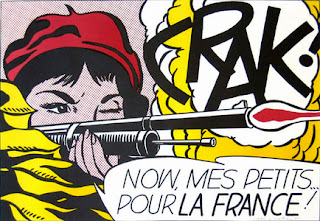
Crak! by Roy Lichtenstein 1963
So, he met with her and you can almost hear the wheels of his devious little mind whirring in the pages of the Gabrielle Letters. He writes to her at the end of July:
To say that I thank you for your letter is to give you little idea of how it has affected me. It is the kindest and sweetest letter I ever received. I know it by heart, and shall never forget one of its sentences as long as I live. But, - do you know how sensitive I am to kindness from anyone? And what can be the effect upon me of words such as these from a woman whose face has charmed me, whose voice has thrilled me, and in whom I divine something very like my ideal of womanhood? 

'...a woman whose face has charmed me'??

HG Wells described Gabrielle as having a mouth like a letterbox, thus betraying his own lack of knowledge of Freudian symbolism, and an obvious want of gentlemanly charm, especially when he was, as my old mother would have said, 'no oil painting' himself. Fortunately, women are not quite as 'lookist' as men and so even George, aged 41 and looking every day of 51, managed to break down Gabrielle's resistance with his persistence - and desperate neediness.

JOIN ME IN PART TWO TO SEE WHAT GABRIELLE MADE OF ALL THIS NONSENSE


Saturday, 26 September 2015

Commonplace 112 George & 'The Wheels of Chance: A Bicycling Idyll'


Possibly the only humorous anecdote ever told about George was the one where HG Wells taught him to ride a bike. Admittedly, it was more of a sight gag (in the style of the Keystone Cops!) and was probably funnier to see than to hear about, but it mentions George laughing uncontrollably, rolling round the floor with mirth, and so becomes a thing worth noting - a bit like rocking horse poop and hens' teeth. This was July 3rd 1898. HG was not afraid to take the mickey out of George - and if more folk had bothered to do that (to his face haha) then we might not have had to wade through Veranilda. Anyhoo, in his (mildly) amusing novel 'The Wheels of Chance', HG makes a reference to George in slightly piss-taking less than reverential tones, and so that is also worth noting. 

HG Wells was always a big fan of cycling. Did he take up the habit when he worked as an apprentice in the King's Emporium in Southsea? Portsmouth (Southsea is in Portsmouth) is one of the flattest places there is in England - in HG's time (as now), the steepest bits would have been the roads over the railway lines at what was called Somers Road Bridge and Fratton Bridge, and neither would present much of a problem to a cyclist because the main railway line is built in the excavations of the old canal system, and so are well below the road levels. Both are within easy reach of King's Road, where HG's store was then sited. The bicycle is almost queen in Southsea - here is a snap of the Portsmouth Annual Nude Cycle Ride click held in early summer, when the brave set out to amuse and delight
Strategically-placed railings a feature of Southsea seafront.
We also have a nudist beach.
HG's dedication to the two-wheel world went as far as to get the famous company Humber to design a tandem for himself and his wife Jane, where he would ride in the rear, and take control of the steering with special mid-section mounted handlebars - money being no object, obviously. And we will not make a Freudian analysis of it. At the end of his first ever extended cycling tour with Jane HG proposed to her and she accepted.

'The Wheels of Chance: A Bicycling Idyll' was written in Woking, in a small house with so little space HG had to use the dining room as a study. In this small room, he wrote this light piece, plus the The War of the Worlds, and the Invisible Man, all within earshot of the main railways trundling past.

So, we find the male protagonist, Hoopdriver, setting off for his life-changing trip, a bicycle novice, wobbly and unsure of himself, a mere beginner in the great bike ride of life. Wheels starts with this: Literature is revelation. Modern literature in indecorous revelation.
Indecorous because it deals with 1) the emancipated art of cycling; 2) it concerns a single man and a single woman, unchaperoned meeting up and enjoying each other's company; 3) it crosses class barriers; 4) it shows a humble chap, in trying to rail against his class and place in the scheme of things, abandoning, albeit temporarily, his moral compass. 
Hoopdriver sets off on his annual holiday, bicycling the English South: Esher, Ringwood, Blandford, Midhurst, Guildford, and bits of the The New Forest where the Rufus Stone click reminds we Brits that royalty is expendable. And Portsmouth - almost to the King’s Road Southsea Emporium where Wells had worked as a drapery apprentice himself.

He meets a Young Lady in Grey (not a Woman in White - the book name-drops popular authors and literary references all the way) who turns out to be a bicycling expert, and something of a ‘New Woman’ determined to live life her way - and that means with few social constraints and financially independent of her family. She outrides him, cocks a snook at convention and renders him smitten, mainly because she initially seems so far above him and out of reach (she rides faster and he has to work to catch her). They team up, and set off together. But Hoopdriver is ashamed of his origins, and adopts a fake persona (a wealthy South African diamond mining, lion-wrestling man's man) in order to appear to be a better social prospect. He mangles the English language with his pronunciation, but as this could also be an attempt to render the character's native London-ish sound, it is difficult to work out if you, the reader, are meant to hear that distinctive South African twang.  

Now, I'm not accusing HG of plagiarism, but the novel is a sort of light-hearted Born in Exile - trust me, the two novels share some basic themes. It is not at all 'serious' in any of them, as it was probably intended for the sort of readership that would not have found a home between George's densely-packed, existentially wrought pages, and so is intended to appeal to the library member or Mudie's devotee click. Wells makes light of the disastrous situation - maybe George's 'Our Friend The Charlatan' learnt something from Wells' treatment of moral dilemma meets social opportunism in the name of shifting units off the shop shelf? And, in regard to the likes of Mudie's strict 'Hays Code', Wheels plays it very safe. 


Here is Hoopdriver, ashamed of his humble beginnings as a drapery store assistant, forced to think about the moral implications of making up unbelievable stories to win a girl from a slightly higher class:
At first Jessie had been only an impressionistic sketch upon his mind, something feminine, active, and dazzling, something emphatically ‘above’ him, cast into his company by a kindly fate. His chief idea, at the outset... had been to live up to her level, by pretending to be more exceptional, more wealthy, better educated, and, above all, better born than he was. 

It is at the start of Chapter 10 that George is mentioned: Hoopdriver is pondering his place in the system of things and the injustice of being trapped in a lowly job that he hates:
Mr Hoopdriver was (in the days of this story) a poet, though he had never written a line of verse. Or perhaps romancer will describe him better. Like I know not how many of those who do the fetching and carrying of life, - a great number of them certainly, - his real life was absolutely uninteresting, and if he had faced it as realistically as such people do in Mr. Gissing’s novels, he would probably have come by way of drink to suicide in the course of a year. On the contrary, he was always decorating his existence with imaginative tags, hopes, and poses, deliberate and yet quite effectual self-deceptions; his experiences were mere material for a romantic superstructure. In reality, and in a nutshell, this contrasts the essential character and personality differences between George and HG - HG the one to not over-think a situation, and George, his own worst enemy. 


They rode on to Cosham and lunched lightly but expensively there… Then the green height of Portsdown Hill tempted them, and leaving their machines in the village they clambered up the slope to the silent red-brick fort that crowned it. Thence they had a view of Portsmouth and its cluster of sister towns, the crowded narrows of the harbour, the Solent and the Isle of Wight like a blue cloud through the hot haze… Mr Hoopdriver… smoked a Red Herring cigarette, and lazily regarded the fortified towns that spread like a map away there…then the beginnings of Landport suburb and the smoky cluster of multitudinous house (one of these Charles Dickens’ birthplace). To the right…the town of Porchester (sic - Portchester is correct) rose among the trees.
Fort Widley, the closest Portsdown Anti-Napoleonic Fort to Cosham. click
Hoopdriver, intent on impressing Jessie, attempts to portray his version of a socially, and therefore, sexually, emancipated sort of noble savage, primal, untamed, feral - as befits one raised in the Colonies. He claims to have wrestled with lions, ridden giraffes and been a diamond miner. This is for comic effect as it stands in stark contrast to the weedy, mediocre, ineffectual character of an apprentice drapery assistant. Then, in more Godwin Peak mode:
He discussed church-going in a liberal spirit. ‘It’s jest a habit.’ he said, ‘jest a custom. I don’t see what good it does you at all, really.’ 

It seems Jessie is a fledgling writer and disciple of Miss Olive Schreiner click which is an arch way of mocking her free spirit nature as a 'Modern Woman', as Ms Schreiner was known for writing books about women who broke boundaries - she was a friend of Edward Carpenter's (see Commonplace 8 for more on Carpenter - and Eduard Bertz, George's other bicycling fanatic friend). But the narrator's/HG's chauvinism shines through: There are no graver or more solemn women in the world than these clever girls whose scholastic advancement has retarded their feminine coquetry.

Of course, keeping up this act becomes unworkable and futile - Hoopdriver begins to find it a strain to keep up his pretence (much as George and Godwin did), and, again in Godwin mode:
On Sunday night, for no conceivable reason, an unwonted wakefulness came upon him. Unaccountably he realised he was a contemptible liar.

In the end, just like Exile's Godwin Peak, he owns up to his humble origins. 
‘Miss Milton - I’m a liar.’ He put his head on one side and regarded her with a frown of tremendous resolution. Then in measured accents, and moving his head slowly from side to side, he announced, ‘Ay’m a deraper.’  
‘You’re a draper? I thought –'
‘You thought wrong. But it’s bound to come up. Pins, attitude, habits – It’s plain enough… I wanted somehow to seem more than I was… I suppose it’s snobbishness and all that kind of thing…’

And, like Exile’s Sidwell Warricombe, Jessie tells him she would not judge him by his class, but by his innate good qualities. 
‘Hundreds of men,’ she said, ‘have come from the very lowest ranks of life. There was Burns, a ploughman; and Hugh Miller, a stonemason; Dodsley was a footman –.’ As a further prompt, she asks him if he has read ‘Hearts Insurgent’ – which is the subtitle of Hardy’s ‘Jude the Obscure’. The cruel harshness of Jude's fate seems lost on Jessie, thus rendering her a poseur at education for not realising it. 
No, he is not a serious reader, and Jude's trials are unknown to him but he has dipped into Besant, Ouida, Rider Haggard, Marie Corelli... a lot of Mrs Braddon’sThis is HG showing us his hero's so-called low brow tastes; referencing Mrs Braddon is intended to give the reader a deeper insight into Hoopdriver's sexual nature. Mrs Braddon's most celebrated novel is 'Lady Audley's Secret' click, a tale so charged with repressed, suppressed sex it should have had (for its time) an 18 or X rating. To read it was to transgress several moral boundaries and would give Jessie a sign he was a thrilling, daring and adventurous prospect, and a man not afraid to flaunt convention. Just what she was looking for, in fact. And, just to underline his modern man credentials, he is a cigarette smoker, not one of the fusty pipe-smoking or posh cigar-puffing sorts. Cigarettes were then a fashion statement of the bold and the brave, indicative of fearless individualism. And they have been marketed as that ever since. Incidentally, those Red Herring cigarettes are the same brand as used by Dr Watson... elementary, of course. (Wells knew Conan Doyle as a friend and they both had a Portsmouth connection.) 


But, Jessie - altogether better educated, better read, better bred - asks him if he only reads novels, and he tells her how woefully he has been educated, and how that is another area of shame. And how unhappy he is being a lowly draper - which is monumentally dreary as well as damned hard work. So she challenges him to rise to his potential, put in the work on his education (via night-classes and lectures, and books she can recommend), and then he can catch up. Here, we can see life is like a bike ride - you just have to pedal harder if you have set off on an inferior machine, but you can catch up and maybe overtake those lucky enough to afford a good quality cycle. But Hoopdriver is not rising to the challenge material yet. 

How does it end? Well, he doesn't do himself in, Godwin Peak style. And he doesn't get the girl - well, not straight away. Jessie, through a cunning plan set in place by her relatives, is forced back to the fold (women can't break out as freedom fighters yet!). She gives him six years in which to educate and better himself, they part and he goes back to work and the routine of his life takes over once more. It looks like the holiday will be relegated to a series of anecdotes he can tell his apprentice colleagues. But, the seeds have been sown... Jessie has promised to send him books... might he get back on his bike and start the uphill climb - this man who has done the long stretch past the Devil's Punchbowl at Hindhead click, or negotiated the South Downs click, or climbed Box Hill click and breasted Portsdown Hill click in pursuit of his True Love - might he use this exceptional drive to succeed in Life's cycle ride??? Reader, did she marry him?? What are the chances of that??

For a free copy of The Wheels of Chance click