Thursday, 5 November 2015

Commonplace 123 George & Money PART TWO


In February 1895, George's longest-serving friend, Morley Roberts, wrote asking if he could write a  
piece about him in the Fortnightly Review. Roberts liked to bask in what there was of George's glory, but, naturally, George needed to stage-manage the affair. He once said Morley Roberts didn't really understand him or his work, so that probably gave an urgency to compiling his own version for Roberts to use. But there was a more pressing matter of three fairly negative articles in the sort of publications that secured a wide readership (the Spectator, Sketch, and Illustrated London News) that was preying on his mind. Nettled, George grabbed at the chance to respond to all three (but especially the Spectator) making use of Roberts as his willing, and partisan mouthpiece.

Charon on the Shores of Acheron, from Canto III of 'Inferno' from 'The Divine Comedy' by Dante Alighieri (1265-1321) by Amos Nattini 1926
It is a masterly work, this reply from George agreeing to the request, and opens with a classic line of control-freak manipulation: 
My dear Roberts, - What objection could I possibly have - unless it were that I should not like to hear you reviled for log-rolling? (Logrolling is the practice of authors bigging up each other's work often to increase sales). 
So, George starts off making sure Roberts keeps his praise reasonably restrained and beyond the gushing that would give away his motives. George assumes Roberts would want to gush, of course. And no mention of how much fake logrolling he might have to do to reciprocate - after all, it takes two to logroll! 
click and translate with google translate 
George goes on:
But it seems to me that you might well write an article which would incur no such charge; and indeed, by so doing, you would render me a very great service. For I have in mind at present the careful and well-written attack in the current Spectator. Have you seen it? Now I will tell you what my feelings are about this frequent attitude in my critics.

There we have it - removing Roberts' freedom to write what he pleased. George could have written the piece himself and published under his own name, but that would have disrupted his cunning plan to be eternally aloof and seemingly indifferent to outside influences. And, Roberts, desperate to please and with the devotion of an unrequited lover, was happy to play the eternal patsy fully prepared to take a bullet for his hero if the response backfired. 

The Spectator piece published 9th February 1895 was Anonymous, but George commented that it was a careful and well-written attack. In fact, it is a very good piece, and gives an introduction and overview to George's main themes, whilst fairly critiquing his strengths and weaknesses. It sums up the central theme of the 'post slum ghetto' (or whatever George's early works can be termed) books as being preoccupied with middle class men with mediocre education, talents and expectations, who have aspirations to climb the greasy pole to the upper middle class but no big plan or motivation/options to achieve this. The author of the article makes the point that the lower middle classes and below had Charles Dickens as their champion - now the aspirational but dismal middle classes have George. (As there is a tinge of sarcasm here, we can take it this was not meant as a compliment!) But the author goes on to observe that, anyone from this class who reads about themselves as George portrays them (probably having borrowed a volume from a circulating library) will turn away from the finished work 'as if dissatisfied'... they will only feel in a vague, uncomfortable, resentful sort of way that the general effect is false, misleading, even libellous; that it is in essence caricature, though it has been produced without any of those obvious tricks of draughtsmanship which make ordinary caricature at once recognisable for what it is.

Anon goes on to say that George has a way of caricaturing his types by what they don't do or fail to say as much as what they actually do, and by the omitting useful information and insights into their motives and thoughts, rather than by delineating details that might make them seem real to the reader. The author (who could be male or female - I rather hope female) points out:

The artist who sees life steadily and sees it whole, never allows us to forget that whatsoever be a man's caste, or calling, or condition, he is first of all a human being, and only secondarily a courtier, a rustic. a lawyer, a publican, a barbarian, or a Philistine. The humanity which unites him to his fellows is really more significant, and should, in any serious art, be made more emphatic than the idiosyncrasies which distinguish him from them; but it is Mr Gissing's way to give distinctness and force to his delineation of a species by emphasising its special isolating features, which are frequently, if not generally, the features that indicate weakness or limitation.


So far, so true. In the Year of Jubilee was George's most recent fictional offering, so this comes in for some harsh but fair flak. In discussing the characters, this Anon author writes:
The seniors live a dull, colourless, vegetating life, unglorified by any fine emotion or elevating instinct; the young throw the energies of youth either into sham culture, which leads only to unlovely priggishness, into degraded pleasures which land them in still more unlovely profligacy, or into a sordid money-worship which, in the young, is perhaps the unloveliest, because the most unnatural of all.   


Satan Resides at the Centre of the Frozen Lake of Cocytus
from the Divine Comedy by Amos Nattini 1923


The insightful author goes on:
Now, no one will deny that such characters as these represent existing types, or that such types (at least some of them) are most frequent in communities where the materials of comfort are in marked excess of the resources of culture; but to paraphrase Matthew Arnold, even in a cheap suburb life may be lived with well, - certainly not less well in the main than in any other civilised human sphere. But in Mr Gissing's pages the brutish stupefaction of his men and women is obviously treated as the inevitable, unescapable (sic) result of their social conditions and surroundings; therefore, in so far as fidelity to the fact is essential to art (and to realistic art such fidelity in the one thing needful), his treatment may be challenged on purely artistic grounds by critics who would treat its fatalistic pessimism  as an indifferent thing for which they have neither approval nor condemnation. 

You can see why George was pissed off.

There's more:

Mr George Gissing must therefore be regarded not as a realist, but as an idealist of the new school... His acquaintance with certain social features is hardly less intimate than that of the Greek sculptor with certain anatomical features; but just as we know that there never was a living man or woman so physically perfect as the Apollo Belvedere or the Venus of Milo, so do we know that there never was a civilised community in which human nature was so largely denuded of its attractive elements as is the human nature of the community depicted in Mr Gissing's latest story. He has lately been the recipient of enthusiastic praise, and though we think that some of it has been extravagantly expressed, we do not grudge it to him. But it is in the interests of art that praise should be awarded on the right grounds; and praise can be awarded to Mr Gissing only for the vigour and vividness with which he renders his own vision - a most distorted vision it seems to us - of the vulgarity, sordidness, and ugliness of life.

George must have thought this piece of criticism was accurate or he never would have formulated a response - most of the time, he remained above any debate about his work. and was always happy to disregard what he didn't think much of in terms of understanding of his writing. Being misunderstood was George's thing, and he revelled in it. He added in his letter to Roberts, a clear manifesto for Roberts to repeat:
My books deal with people of many social strata. There are the vile working-class, the aspiring and capable working-class, the vile lower-middle, the aspiring and capable lower-middle, and a few representatives of the upper-middle . . . . But what I desire to insist upon is this: that the most characteristic, the most important part of my work is that which deals with a class of young men distinctive of our time – well educated, fairly bred, but without money.


This doesn't quite address the points raised in the Spectator piece, which charges him with accentuating the vile and sordid and failing to do justice to the good and uplifting in the lives of these well educated, fairly bred paupers. (Oddly, as George puts it, he deals with all social strata except the middle class and the actual hereditary aristocracy!) 

These young middle class poor people George so wanted to champion - when they received their fancy education, did no-one tell them about Charles Darwin and his Theory of Natural Selection? Did they not learn we all have to adapt to survive? This was where George might have given them hope. 
There was work, of course, for them to do, if they accepted it. Not middle class well-paid work, but honest labour in lowly trades - like teaching. 

George ends his letter to Roberts moaning about the cold weather: I write with a numbed hand. I haven't been warm for weeks. This weather crushes me. Poor George, as usual. 

The Spectator piece and the letter from George to Morley Roberts appears in the The Critical Heritage edited by Pierre Coustillas pages 238-245.

JOIN ME IN PART THREE TO EXPLORE THE DIFFERENCE BETWEEN MONEY AND CURRENCY - AND WHAT ANONYMOUS THINKS ABOUT IT TODAY. 

Friday, 30 October 2015

Commonplace 122    George & Money PART ONE

It was The Beatles who first brought to my attention the joys of having loads of money click. It was my secondary school that introduced me to St Francis of Assisi (my school was not a religious one, it was located in Francis Avenue) and his views on poverty. And, then my Pentecostal Sunday school teacher pointed out that money is not the root of all evil - it's the love of money that makes money so dangerous. Lessons learnt young, and I have been conflicted about the topic ever since.

George had money on his mind all of the time. All that he was to himself, depended on it. It was the chief reason he wrote - because he was the sort of writer who created until he had a large enough income to be able him to give up the work. The pursuit of money, the spending of it, the lack of it, the earning of it, the value of it to your self-image if you had it or lacked it, the doling out of it to 'dependants' were his major preoccupations. Any pleasure George derived from the imaginative creative process was offset by the misery of having to do the thing he found difficult, claimed he didn't much enjoy, and which was innately poorly paid.  Fear of Freedom meets Masochism - see previous Commonplaces! Drawing to himself financial burdens like his wider family ensured he was forced to keep at it, 'nose to the grindstone', which was itself a valuable thing as it gave him something to moan about, rebel against, and resent. He had contempt for women... he had contempt for women whom he considered 'wasted their husband's money' (I will let that pass just this once!) on fripperies and then himself went out and bought books by the tonne, tobacco and evening dress suits when he claimed to have no social life.
St Francis: one of the more lovely saints 

If you dabble in online quotes searches, George has three about money:
1) Time is money says the proverb, but turn it around and you get a precious truth. Money is time.

George enjoyed quite a lot of 'time' - if by the word he means bits of life spent not actually working. He may have lacked the funds to do all the things he wanted to do, but he never stinted himself on time spent reading; even time he could have spent writing things that made him more money (magazine articles, for example) couldn't entice him away from the solitary vice of reading books. In fact, it could be argued that he worked to pay for time to read. Nothing in George's life ever gave him the pleasure that reading did. Even when he was low in funds and living with Marianne aka Nell, he kept them both (he claimed) half-starved in order to buy books. This is not rational behaviour. Which is why it stinks of untruth. We know he greatly exaggerated his poverty - Austin Harrison (son of Frederic) blew this claim out of the water early when he described George as being reasonably well paid for his tutoring, and never really poverty-stricken - that his claims to poverty were 'a fiction of fictions'. Roger Milbrandt has made a study of George's bogus claims to poverty, published in the Gissing Journal of October 2007 click and makes the point that, even when George was as his lowliest paid (1877, newly arrived in London and working as a clerk for St Vincent Mercier), he was likely to be sharing wage-earning with Marianne aka Nell. She might have worked as a seamstress though we don't know enough about her to be sure of her source of income. It seems the only mention we have of her possibly being in the needle trade is the John George Blacks' letter telling George about the struggle he had moving a sewing machine - George was clearly not involved in this venture and there is no evidence this was Nell's sewing machine, and though Morley Roberts tells us George bought her a sewing machine, he is wrong on so many things, he should not be trusted on specifics, considering he never actually met Nell in the flesh, and so had no experience of her as a real person, and wrote his self-serving fake biography in 1912, nine years after George died. But, this alleged 'buying of a machine for her' is touted as evidence she sponged off George and forced him into becoming a thief, but, really...? As if...
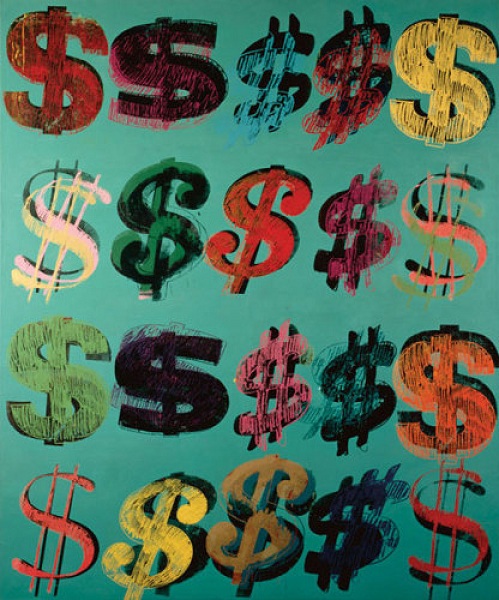
Dollar Signs by Andy Warhol 1891
Maybe Marianne did make money sewing - as ten of thousands of women had to and still do - but there were hundreds of factories in Manchester and London that needed employees to do piecework and make all manner of items, and work doled out on a 'first come first served' basis to those queuing outside factories at the start of the shift made earning a day's wage not too difficult, so it could have been employed at any sort of unskilled factory work. In fact, when George was working as some sort of clerk, there were probably a variety of jobs he could have taken, if he had parked his aspirations to be considered bona fide middle-class. However, he no doubt lacked the strength and temperament for hard labour and would have starved if all he had to rely on was manual skills, so presumably that will have impacted on his sense of masculinity. Not that we often associate him with that trait.

It is considered a bonus if you enjoy your money-making activity click - and being happy in your working life is still an aspiration worth advocating: 'it doesn't matter what you do as long as you feel fulfilled, enjoy it and by honesty, it pays the bills' it is not a bad bit of advice to give to young folk setting out on their career journey. Doing well in education is touted as a way to guarantee more options, and help avoid working as a toilet attendant, but being a toilet attendant who loves their work is a happier bunny than a university don who loathes her/his post. Choice is a huge part of happiness, it seems. Which leads us to this George quote:


2) Money is time. With money I buy for cheerful use the hours which otherwise would not in any sense be mine; nay, which would make me their miserable bondsman.
 
In fact, George did very little actual 'work' - if we take that to be activity involving mental or physical effort done in order to achieve a result. Most of his 'effort' went into walking around thinking over the detail, and the agonising about the execution, and then the grovelling to publishers to get the work to its final destination, the small, select, aristocratic (haha) reading public he craved.   
The Moneylender and His Wife by Quentin Metsys 1514

3) That is one of the bitter curses of poverty; it leaves no right to be generous.

On the surface, it's hard to know how he came to this conclusion - after all, he was raised in a Christian tradition and would have heard the parable of The Widow's Mite click. However, it is a line lifted from The Private Papers of Henry Ryecroft (Winter III); taken out of its context, it can be misread. George is talking about how, when he was poor, he had feelings of dread when giving to beggars because he might one day be in a position where he had to beg, himself. He rightly notes giving is an empowering enterprise, and in the rest of the paragraph extols his own generosity (as Ryecroft, he gives away £50 to a needy friend) and sings his own praises and declares 'I feel myself a man' when he gives. Freud would no doubt concur. However, George's view that giving is impossible to do when one is poor, is not borne out by the statistics click. This article suggests poor people identify with the struggling disadvantaged and so give more in order to distance themselves from the calamity of being identified as needy themselves. 

JOIN ME IN PART TWO TO TEST BOB DYLAN'S ASSERTION THAT 'MONEY DOESN'T TALK, IT SWEARS'.

Monday, 26 October 2015

Commonplace 121 George & Conservatism.

In the UK, Guy Fawkes click (1570-1606) and his ill-fated attempt to stage a coup and overthrow the state is commemorated with a ritual called (in the back lanes of George's home town of Wakefield in Yorkshire) 'Plot Night' but is more widely referred to throughout the land as 'Bonfire Night' or 'Guy Fawkes Night' click. Burning an effigy (in days gone by sadly filled with live cats), fireworks, special sweet treats click and spicy drinks are on offer. Gone are the days when ragamuffin children made effigies called 'guys' and stood on street corners asking for pennies, with their cheery cries of 'Penny for the guy, mister/missus'. The amount paid by the mister or missus was strictly commensurate with the quality of effort and creativity that had gone into making the effigy. In my day, we would have been insulted at anything less than a threepenny bit, and we occasionally aspired to a sixpence. Where you pitched your guy was crucial, and railway stations or the Dockyard gates were fought-over spots. Having a girl on your team is always a wise move - big blue eyes, and a winning smile and all that - but in a good way! Definitely not Maiden Tribute territory click.

Nowadays, the British state is allegedly opposed to children on street corners asking for money, though you would never know that from their unfair treatment of the poor or low paid (or asylum seekers, refugees etc) and their fight to smash the working class with their evil 'austerity' policies. As many members of the British working class don't vote, and state education rarely educates children about politics (which would arm them with the knowledge required to make a choice) it's easy to trample on their rights and entitlements.
From the 1920s - before my time!

Anyhoo, Bonfire Night is November 5th. In the Devon town of Ottery St Mary click, not far from Exeter, they celebrate this with a spot of tar barrelling - where the young men and women race down a hill with barrels aflame with burning pitch, after carrying these health and safety threats on their shoulders through the streets click. It is a time of tricks and japes - the last tar barrelling I witnessed resulted in the exhaust pipe of my car being stuffed full of bananas, rendering the car un-driveable! Hilarious (not!), and a very good way of getting revenge. For maximum effect, peel the bananas and insert one at a time - about half a dozen should do it nicely.

Ottery St Mary is a very pretty place. It has many historical associations and I recommend it to you for its beauty, quietude and for the fact that this is where Samuel Taylor Coleridge click was born. What has this to do with George? Apart from the fact he lived up the road in Exeter for a few years, US economist Russell Kirk linked George to Coleridge in his doctoral dissertation The Conservative Mind: From Burke to Santayana (1953), subsequently published and enlarged in book form. Kirk writes about both Coleridge and George as Conservative (with a large 'C') writers. 

In these post-Nazi Party days, most of us don't really know what a Conservative is; we are not talking smarmy Tory self-serving Daily Mail reading twits here. Well, we are, but it's bigger than that! Conservatism is a worldwide phenomenon that rears its ugly head in many Western states - chiefly, the USA, the UK, France, and many countries with self-aggrandizing ways. However, let us not be naive - as History and George Orwell have shown us, you can't get much more 'Conservative' than Joseph Stalin!

Kirk makes use of George's The Unclassed, but he makes the common mistake of assuming everything George wrote was autobiographical - whereas 'spin' might be more like it. George was writing The Unclassed when he was tired of caring for his first wife, Marianne aka Nell, and he was moving in elite circles cultivated to further his social and artistic ambitions. He did not want Nell but he couldn't divorce her. He wanted to turn his back on his feeble attempt at being a bohemian but how could he ditch the ailing wife and keep every decent person's good opinion? After all, her prognosis was an inevitable slow, lingering squalid death, whilst his trajectory must have seemed potentially stellar (George always thought he was a genius!) - it might seem a bit immoral, cruel and unheroic to walk away from a woman in need. And so he had to stage-manage perceptions of Nell in order to justify abandoning her. And he did this by demonising her, and that work has been carried on by most of his biographers ever since. He couldn't actually lie to anyone's face about her - because he might get caught out - but he could drop hints, claim he was in some way indisposed by his home life, unable to extend hospitality... you will recognise these if you are familiar with the Letters Volume I. Of course, if you haven't got true faults to write about, you make them up - and a good venue to showcase these is a novel. Harriet Smales is portrayed as a sordid mess of a woman, but how do we know this is this based on Nell? Epilepsy is all they seem to share, in my reading of the available detail. But George links epilepsy to vicious behaviour and a vile personality, and so that is applied to the real-life Nell. Epilepsy was (and still is in some quarters) a frightening and embarrassing condition, and in George's day, a source of shame. It's an insult to epileptics to portray it as vicious - and ridiculous, reductive logic in the macho minds of George's biographers to assume Nell was in any way a bad sort just because Harriet was. And, does George really want to be taken as Julian Casti - that spineless, under-achieving doofus who hides his light so successfully under a bushel? Poor Julian - sacrificing himself for his woman the horrible Harriet because he is decent and noble. What utter tosh! As we have seen in Commonplaces 120-121, there is nothing noble or heroic in 'Fear of Freedom' click which is what all the characters in The Unclassed seem to suffer. Heavens! Is George really Osmund Waymark?? Who goes to live on an island in the end, thus constricting his freedom even more!! Hopefully when Ida took up her pen at the end: Reader, she ditched him in the Solent haha!

The Isle of Wight - Osmund Waymark's existential Alcatraz. 
By claiming Osmund Waymark's thoughts were George's, we can see Kirk fails to realise how manipulative this type of alleged introspective self-revelation could be. George wanted to be taken seriously as a writer, but also as a thinker. In fact, he didn't have a wide enough peer group in which to debate his own ideas to their conclusion - which could be why he never comes up with solutions to problems, and is generally behind the times with his current affairs. So, what is it Kirk wants us to understand, and how does it fit with the George Gissing we know and love? From the wiki page click

Kirk developed six "canons" of conservatism, which Russello (2004) described as follows:
  1. A belief in a transcendent order, which Kirk described variously as based in tradition, divine revelation, or  natural law;
  2. An affection for the "variety and mystery" of human existence;
  3. A conviction that society requires orders and classes that emphasize "natural" distinctions;
  4. A belief that property and freedom are closely linked;
  5. A faith in custom, convention, and prescription, and a recognition that innovation must be tied to existing traditions and customs, which entails a respect for the political value of prudence.

Anyone who knows George and his preoccupations will recognise some of him in this. I am no political theorist, so I took guidance from someone who is: Aaron McLeod and this publication click which gives us a Kirk 'condensation' published by the Alabama Policy Institute.

This is lifted from Aaron McLeod's essay (pages 51-52) and I thank him/them for it:
That connoisseur of misery, George Gissing, is discussed in the second section of this chapter. Gissing once resided in the poorest, grimiest sections of London, and so to him Kirk looks to understand the currents of proletarian politics from this time. Gissing knew the poor—he had been one of them, and he knew the socialists because he had given their speeches. It was not long, however, before experience with the socialist agenda and its effects on the working class caused him to repent, and he became an eloquent conservative. The same man who wrote Workers in the Dawn, who aspired to be the mouthpiece of the Radicals, examined his folly four years later in The Unclassed, writing,
"I often amuse myself with taking to pieces of my former self. I was not a conscious hypocrite in those days of violent radicalism, workingman’s-club lecturing, and the like; the fault was that I understood myself as yet so imperfectly. That zeal on behalf of the suffering masses was nothing more nor less than disguised zeal on behalf of my own starved passions. I was poor and desperate, life had no pleasures, the future seemed hopeless, yet I was overflowing with vehement desires, every nerve in me was a hunger which cried out to be appeased. I identified myself with the poor and ignorant; I did not make their cause my own, but my cause theirs. I raved for freedom because I was myself in the bondage of unsatisfiable longing."
Now that Gissing had abandoned socialism, he began to speak of duty; the only reform possible and really worthwhile was reforming one’s character. Gissing saw no shelter from the harsh realities of life on the lowest rung of the economic ladder except that of stoic endurance and self-amendment. In the world of Gissing, the whole duty of man, Kirk relates, “is to stand siege within the fortress of his character.” Unlike his socialist counterparts, Gissing believed the only proper channel for real improvement in society was improving the character of the educated and the leaders of society. Unfortunately, he had little hope. 

Kirk finds a nagging doubt in Gissing’s later thought that the beauty in literature and philosophy would withstand the attack from modern secularism, and that the new collectivism, by whatever name, would fail to erase the variety and individuality that make life tolerable. Instead, his advice to those who would fight the good fight is to cling to what remains of a better world with the tenacity of men over an abyss. The chiefest protection against a fiery end in anarchy, he thought, lay in reconciling the British aristocratic ideal with the “grey-coated multitude.” But whether such reconciliation occurs, or is even possible, Kirk gives much the same counsel as Gissing: “Such of us as still are men, then, will hold fast by shaken constitutions and fading beauties so long as there is breath in us.”


So, George the Conservative is what he is often remembered as, but that is a shame because Conservatism is a perspective populated by such dreadful backward-looking specimens of life. History has been warning us to beware the influence of them since records began. Again from the Aaron McLeod piece: Kirk said that Christianity and Western Civilization are "unimaginable apart from one another" and that "all culture arises out of religion. When religious faith decays, culture must decline, though often seeming to flourish for a space after the religion which has nourished it has sunk into disbelief."


I salute Khaled al-Asaad: A True Hero click 


Saturday, 24 October 2015

Commonplace 120 George & Heroism PART TWO The Romantic Hero
Ossian Receiving The Ghosts of The French Heroes by Anne-Louis Girodet de Roussey-Trioson 1800-1802
In Commonplace 119 we looked at a definition of Classical Heroism, as practiced by the Greeks and Romans, and applied that to what we know about George. Classical heroism didn't seem to fit the 'heroism' given to George in the title of one of the biographies. Perhaps he might fit with the concept of the 'Romantic' hero - as in the likes of Byron and Thomas Paine. Again, from here click we find a guide to what constitutes The Romantic Hero:

Characteristics of a Romantic Hero:
1)Birth and class are unimportant: the individual transcends society
2)The battle is internal: it is a psychological war won by the “courage to be me”.
3)Moral codes are eccentric–heroes make their own rules
4)Passions are outside of individual control
5)Self-knowledge is valued more than physical strength or endurance
(physical courage is de-valued)
6)The hero is moody, isolated, and introspective
7)Loyalty is to a particular project and to a community of like-minded others


Self Portrait by Arnold Boecklin 1872
Let's run through these and see if George can be classified as a 'Romantic' hero:

1) For starters, George was obsessed with class and social ranking, making him cripplingly conscious of what others thought of him, which is why he was such a control-freak, if not open dictator to his wives and children, in particular. It's worth spending some time thinking about what is meant by this term, and from whence it might originate in a personality.
There are many closely woven theories of what leads to control-freakery in a personality, but the basic concept comes from the notion (partly derived from the work of psychologists such Winnacott and Fromm) that there are antagonistic forces at work in a personality that vacillate between freedom and restraint, with freedom being the more threatening to the psyche. From what we know of George's early life, there is a fit. Between his behaviour at Owens College, his gap-year in the States, and the early days in London, George does seem to suffer from a 'Fear of Freedom' in the sense that he did not make the most of the oyster that was his world. He had been handed free of charge advantages that he should have capitalised on, but we find he ballsed them up. He appears to work hard to succeed in his studies, but his shenanigans during term-time and his lack of respect for the learning experience, display a reckless streak that risked everything that he had going for him. 

Far from being a bohemian on the verge of a world of opportunity, he increasingly narrowed his options with bouts of self-destructive, if rather conservative, tame behaviour. He makes mention of this when he moaned about being let loose in Manchester as a youth with no supervision, and where some might revel in that freedom, George raced towards external restraints to feel safe - prison, being the most obvious manifestation of that. Poverty was another restraint he put on himself and choosing to write books few wanted to read was another. He knew a small readership would never make him money and he always equated money and freedom together, but he never adapted his snobbish tendencies to make a decent living from his work and reach a wider audience, which would have given him extra freedom. Marrying two women who were never going to live up to his expectations was one of the more destructive elements of this need to be restrained or constricted. Denying himself a social life by choosing what he considered to be socially inferior wives, whom he considered a social liability, which led to him keeping himself beyond the social pale, demonstrates how deeply-grained the process was in his make-up. It was only by focusing his drives on writing (where he had safe control over characters and events, by the means of a strict system - syntax and grammar) that he could emerge and feel free. And then there is class - he never felt middle class because he so closely paired that with income, but he would not have felt at all comfortable if he had been middle class in every way, because that would have freed him from restraints that being out of that class imposed.

In 'Fear of Freedom' (1941), Erich Fromm describes two states of freedom as 'positive' and negative'. This is paraphrased from the wiki page click:

Fromm distinguishes between 'freedom from' (negative freedom) and 'freedom to' (positive freedom). The former refers to emancipation from restrictions such as social conventions placed on individuals by other people or institutions. The second is to act spontaneously and with authenticity. In the process of becoming freed from authority, we are often left with feelings of hopelessness (he likens this process to the individuation of infants in the normal course of child development) that will not abate until we use our 'freedom to' and develop some form of replacement of the old order. However, a common substitute for exercising "freedom to" or authenticity is to submit to an authoritarian system that replaces the old order with another of different external appearance but identical function for the individual: to eliminate uncertainty by prescribing what to think and how to act. He characterises this as a dialectic historical process whereby the original situation is the thesis and the emancipation from it the antithesis. The synthesis is only reached when something has replaced the original order and provided humans with a new security. Fromm does not indicate that the new system will necessarily be an improvement. 
The Battle of Trafalgar by JMW Turner  1823
 2)Did George ever win this battle? I don't think so. He was never happy with his situation, circumstances or opportunities and right up to the end, wanted to move back to the UK from France - which would mean leaving Gabrielle behind to nurse her mother. In fact, this bout of 'itchy feet' probably started from the time he found out his second wife, Edith, had been locked up in a psychiatric hospital in January 1902, and therefore, removed from the streets and from access to annoying him. He would not have made a clean break with Gabrielle - he tried to make it when he entered the Nylands Sanatorium and allowed the Wells' to take the blame for insisting he stay in England a little while longer than planned. He would have told Gabrielle a relocation was for the sake of his health (and his Art!); that he would wait for her there and she could join him when her mother died; that he had no choice to do it.... but, of course, he would have been delighted to have given her the slip and then moved back to Blighty where he could roam free of any female - even the minions, Collet and Orme. Miss Collet would be clearly aware he was unavailable on the mating front because he was still spoken for, but she would have been kept on the back burner in case Gabrielle ever refused to cross the Channel. As he didn't really have the inner resources to be 'free' in this Fromm sense, he would have continued being miserable and blaming the world for his predicament, fussed over by well-wishers with masses of 'sympathy'.

3)George probably did believe this, that 'genius' makes up its own rules. (As this might also be a definition of a psychopath...!) He was wrong to think the quality of his own genius was robust enough or deep enough to mark him out as exceptional as a writer. George was a follower, not a leader, in the style of his writing, and the weirdness of Henry Ryecroft and the peculiarity of the short stories cannot save him from that. Of course, the term 'genius' means something different nowadays - in George's days, it meant something less grandiose and pretentious and referred more to a unique perspective in creative imagination, and not a mind-blowing ability to think out of the box (- what box? they ask) that transcends normal human abilities.

4)Passion, in George, was a secretive thing, and a force of threat. He claimed to value 'reasonableness'. When he though Edith wasn't being so, he tightened the screws on her, often refusing to answer her in discussions and intentionally winding her up with brute dumb insolence. This is not the behaviour of one who finds expression of any emotion easy or acceptable; it is the action of one determined to close down another's right to communication. What makes it so sinister is that he knew how much it upset her and he used it freely to undermine her mental health and give her opportunities to act like a madwoman. Miss Orme shared this cruelty - writing to him about Edith being upset over festivities at Christmas not going her way. The triumvirate of Gissing, Orme and Collet have much on their conscience where Edith is concerned. 

George's was not an expansive, generous nature (though he was giving with small amounts of money when it suited him - usually with people who might judge him for his generosity or lack of it); even what he wrote is not zestfully spontaneous or giving. Some of his early novels contain longer descriptive pieces that seem to use bile as their fuel, with a less than impartial sense he is decrying, rather than describing, what he wants the reader to see. We are sometimes aware he is disgusted by his own work; and this suggests he wrote the kind of books he would have hated to read.

5)George did have a lot to deal with in his physical health, but you could never say he bore this with grace or suffered in silence. We know as much as we do about his parlous health because he moaned about it all the time in his Diaries and Letters. That might sound harsh - he must have been frightened of the prognosis of his more serious complaints; syphilis, for example, generally ended very badly. It's impossible to gauge what personal enlightenment he achieved because his self-pity makes trivial things seem enormous and huge things he lays at the feet of fate or the 'accursed' order of things that really have no metaphysical cause but are always man-made. Such as Marianne aka Nell starving to death on his alimony of 15/- a week. 
Lord Byron in Albanian Costume by Thomas Phillips 1813
6)At Last!! Signs George was a Romantic Hero emerge!! He WAS moody, isolated and introspective. Always. Is there any point to introspection unless it produces insight? It seems George might have reached this very late in life - The Private Papers of Henry Ryecroft is an attempt to blur the edges of his many, many mistakes, self-pity, misanthropy and misogyny - unconvincingly. He was incapable of setting the record straight, confessing his shortcomings or admitting he was often wrong, but that is an ego state - admitting it would have been too threatening to his self-image.

7)Loyalty...? There is evidence George found this concept moveable, Eduard Bertz, Morley Roberts, HG Wells - he wrote some quite unpleasant things about them in his Letters and Diaries, and had no real respect for their work or minds. Henry Hick seems to emerge unscathed, but that relationship was not very close and personal. George's clanship with his family members is based on fealty, rather than affection - if we are to believe the things he told Mrs Gaussen or wrote to Gabrielle Fleury in his letters. This very complicated situation was never resolved, and he spent a good deal of time reluctantly, resentfully, filling their needs. Again, this is a choice of lack of freedom which he fails to take, because he didn't have to spend so much time with them or have as much contact via letters, or allow them to exert as much influence as they did over his life. He dumped Frederic Harrison, despite all the help he received from him; he abandoned wives and children when it suited him. It doesn't get much more disloyal than that! 
Class was where George allowed his capacity for loyalty to reside. Being thought of by the world as 'middle class' was of utmost importance to George. He could get away with his lack of social connections by assuming the mantle of 'artist', and from there, he could look down on the plebs and underline their shortcomings, whilst adopting middle class attitudes to reinforce the separateness, keeping his lower middle class son-of-a-shopkeeper roots a secret. He was way behind the times in many things, which is typical of the middle class love of all things past. Henry Ryecroft opines for a world that no longer exists and he can only survive by removing himself to a tiny world of his own in some godforsaken hole where he doesn't have to face reality. Like a coward. HOWEVER, George was loyal to one cause - Veranilda. But he had missed the boat of conquering the literary world via Classical History fiction; as others were looking to the future and all that it might be, George was rebuilding the sacking of the Roman Empire, and his history tale must have seemed out of synch with the times. If it had been finished, would it ever have found a publisher? It had a curiosity USP value after he died, because he had died - but would it have passed muster if he had been in the land of the living? Maybe George realised this book was going to bomb; which is why he couldn't get it finished. 

So, does George deserve the epithet 'Heroic'? And was that the way he conducted his life? Was he admirable, courageous, chivalrous, honourable, and true? I wonder what Nell would say to that. Or Edith.
Thracian Girl Carrying The Head of Orpheus On His Lyre 1865 by Gustave Moreau


Wednesday, 21 October 2015

Commonplace 119 George & Heroism. PART ONE The Classical Hero

As well as being the actual day Marty McFly and Doc turn up in their 'Back to the Future' travels, today (October 21st 2015) is the day Daisy died. It is also the 210th anniversary of the Battle of Trafalgar and the death of Horatio Nelson. Nelson is a British National Hero - possibly our greatest - and we should have a bank holiday to commemorate his life, and the sacrifices made by those brave boys who fell in battle. I am partial, of course, as I come from Portsmouth, and live a short way from where Nelson last sailed from England - which is a few yards from the place where Thomas Wainewright (see Commonplace 95) was ferried onto the convict ship Susan that transported him to Tasmania in late 1837 - the dockside is situated just opposite the corner where George Meredith's birthplace once stood.
Truly Heroic Horatio Nelson click
Nelson has never been featured on a UK banknote, but he should be. The tradition of putting heroic figures on banknotes here in the UK is relatively new - the first £20 note with a famous face on the reverse was the William Shakespeare issue from about 50 years ago click. Here is a list of heroines and heroes who have been featured:
  • Charles Dickens (writer)
  • Sir Edward Elgar (composer)
  • Michael Faraday (scientist)
  • Sir John Houblon (first Governor of the Bank of England)
  • Sir Isaac Newton (scientist)
  • Florence Nightingale (nursing and statistical s )
  • William Shakespeare (poet/playwright)
  • George Stephenson (engineer)
  • 1st Duke of Wellington (general/statesman)
  • Sir Christopher Wren (architect)
Currently on our notes, we have:
Elizabeth Fry (social reformer and prison reformer)
Charles Darwin (naturalist and author of On The Origin of Species)
Adam Smith (one of the fathers of economics)
Matthew Boulton and James Watt (worked together on the first steam engine)

A public vote was undertaken click this year to replace the famous face on the next issue of the £20 note (Jane Austen will appear on the next £10 and Winston Churchill on the £5 from 2016). I would like one of my heroes chosen - Georgiana, Duchess of Devonshire, Alan Turing, Edith Cavell, George Orwell, Rosalind Franklin, Thomas Paine, or William Blake would suit me. (Oscar Wilde was Irish, but he would be my top choice if he had qualified.) Of course, whoever is chosen might not last long as our queen makes way (one way or another) for King Charles III or even King William V. Whatever, when all the bank notes and coins have to change again, I will bet good money (haha) George Gissing's jolly old eek click will never appear on any of them - possibly to avoid any confusion with Rudyard Kipling, his doppelgänger - and probably because he was never heroic . 


Rudyard Kipling by John Collier 1891
Britain's favourite poet?
You may know of the biographies of George that are given the Title: The Heroic Life. Of all the English words I might consider to describe George, 'heroic' would be so far down the list as to be below 'vampiric' and 'necromancer'. What on earth did he do to win the title 'heroic'? And, what constitutes 'heroism'? I can't answer the first part of these (I've tried to, but I just can't explain how the words 'Gissing' and 'Heroic' could ever feature in a sentence - unless it was 'Gissing wasn't at all heroic in any shape or form'), but let's turn to the Classics and the Romans and Greeks to see what George might have used as role models, if he hadn't been using Schopenhauer and Darwin. 

We all know the Greeks and Romans wrote legends celebrating the achievements of their Heroes (they didn't have bank notes haha). This piece is lifted from this website and I thank them for it click, and I'm sure there are many interesting points they cover on other topics:

Here are the main characteristics of the epic classical hero of Greek and Roman literature:


He is of royal birth or even, like the Titan Prometheus, half mortal, half god.
He must perform extraordinary feats.
His is a noble character which is close to perfectly ideal but for a fatal flaw.
The suffering of the character is physical.
Death must occur in an unusual way.
The hero fights for his own honour; his deeds belong to the community only after his death.

The notion of virtue implicit in these characteristics is implicit in the philosophy of the time. Reading Plato’s Republic, Aristotle's Ethics, and the meditations of Marcus Aurelius, for instance, what comes through is that only the well born can be thought to be virtuous – heroism is only for the few – slaves, artisans, and ordinary plebs have no business studying ethics and cannot be successful at turning themselves into heroic types. The virtues include courage, pride, honour, justice, magnificence – things to watch out for are shame, cowardice, intemperance, foolishness...
The Oath of the Horatii by Jacques-Louis David 1785
How does George fare in this? 
Well, he was never a Titan of Literature but he did write a short story entitled 'Phoebe' - she was a Titan. He was not half mortal, half god - but he did suffer delusions of grandeur when he considered himself to be 'aristocratic'. Quelle absurdité!
He never performed extraordinary feats - well, not in a good way. In fact, he spent a good deal of his energy on avoiding any situation where he might be called upon to be 'heroic' - usually delegating the difficult tasks, or weaselling his way out of confrontation and responsibility. If that is heroic, I'll eat mon chapeau.
He did not have a 'noble character'. He was weak, self-serving, apt to excuse his own failings, envious, cruel and egoistical, only concerned with his own gratification in the areas he was concerned about. In trivial matters he could appear to be magnanimous, but this was a pose put on to manipulate people and situations round to his advantage. And he was a thief and a liar, a snob, a serial wife and child abandoner, and a man not afraid to exploit the weakness of others. In fact, he was the opposite of 'heroic' - il était un goujat!
Maybe these were the 'fatal flaw', as all the shenanigans culminated in him finding himself 800 miles from home with no decent medical care or. Quelle cauchemard!
The suffering of the character is physical - well, he was a martyr to many maladies, including syphilis. He tended towards introspection, and was never happier than when he was miserably examining his ,any small ills and whipping them up into big ones. Of course, iffy health meant no-one could expect anything of him. In fact, he was what was termed neurasthenic click as well as syphilitic. Pauvre Georges.     
Death must occur in an unusual way - he didn't throw himself off Niagara Falls or poison himself, or drown in a pool (except in his fiction) and he died at home in his bed. He was in the full-flow of paresis, and chanting and raving about Rome and the Barbarians just before he went.  
Did he fight for his own honour or did he make use of others to do it for him? Throughout his life, he moaned about being alone but he was surrounded by people - he told Gabrielle Fleury he had no emotional ties to his family, so that she would take him on, and so make her responsible for his care. George seems to regard his own honour as a moveable thing, and if a word might be used to describe this it would be opportunistic. 
Rosa Luxemberg (1871-1919)
click
As for the broader aims - 
...only the well born can be thought to be virtuous – heroism is only for the few – slaves, artisans, and ordinary plebs have no business studying ethics and cannot be successful at turning themselves into heroic types. This is the basis of George's hatred of Demos, but, as with most major negative reactions, it is the likeness to our real selves they represent that makes us over-react. Why else is George always described as the son of a chemist/botanist and not son of a shop-keeper? He wanted to be thought of as better than a shop-keeper, and spent most of his life trying to act like he wasn't. But, he was, at times, very working class - think of what he ate and yet he complained of the working class not knowing how to prepare decent food and stuffing their faces on cakes and treacle - when he stuffed his face on whatever was stuffed in the pot that he cooked over the fire when Morley Roberts turned up. And the lentils he made Nell eat - he no doubt kept up his tobacco quotas as they starved. 

They caution against shame, cowardice  intemperance and foolishness. Say no more.

George did not want to be a hero and he would have been highly critical if the term had been applied to anyone who did not warrant it. He was not one to want to deceive himself, even when he was striving to deceive others. As much as he wanted to be highly regarded, he would want it to be for the right things, for the things that were true of him. It is preposterous and patronising to apply a term so wide of the mark on anyone, and I'm sure George would agree with me on this. 
Last word goes to George Bernard Shaw: 
Every reasonable man (and woman) is a potential scoundrel and a potential good citizen. What a man is depends upon his character; what a man does, and what we think of what he does, depends upon his circumstances. Wise words, Mr Shaw; wise words. 

JOIN ME IN PART TWO TO CHECK OUT GEORGE'S ROMANTIC HERO CREDENTIALS.