Thursday, 12 May 2016

Commonplace 174  George & Veranilda PART ONE

 You can't get far into the land of George Gissing without tripping over Frederic Harrison (1831-1923. In spite of George's best efforts, Harrison was a permanent feature in the literary life of our man; there at the beginning, in the Workers In The Dawn days, and at the end, with Veranilda and beyond to helping with George's estate and looking out for the two boys, Walter and Alfred. According to his Wikipedia page:
Frederic Harrison photographed 
by Bassano  
As a religious teacher, literary critic, historian and jurist, Harrison took a prominent part in the life of his time, and his writings, though often violently controversial on political, religious and social subjects, and in their judgement and historical perspective characterized by a modern Radical point of view, are those of an accomplished scholar, and of one whose wide knowledge of literature was combined with independence of thought and admirable vigour of style. 
Which is a helluva sentence.

George's first doings with Harrison were via Auguste Comte, the originator of the Positivist philosophy. Aggrieved at the poor response to his self-published novel, Workers In The Dawn, which drew for some of its themes on Positivism, George sent a copy to Harrison enclosing a letter blatantly looking for approval, and, by extension, sympathy and the chance of some useful contacts in the world of publishing. (This is yet another example of that 'jobbery' George always claimed to despise yet never failed to make use of.) He even claimed it was Harrison's writings that led him to Comte and then on to writing Workers In The Dawn.

To anyone interested, here is the Wikipedia definition of Positivism:
Positivism is a philosophical theory stating that positive knowledge is based on natural phenomena and their properties and relations. Thus, information derived from sensory experience, interpreted through reason and logic, forms the exclusive source of all authoritative knowledge. Positivism holds that valid knowledge (certitude or truth) is found only in this derived knowledge.
The likes of Carl Jung, Sigmund Freud and Carl Rogers would not have agreed, but there we are - great minds don't always think alike. Two of the failings inherent to Positivism, as seen from a modern perspective: the notion that everything is only valid if it received via sensory experience - psychoses and brain disorders often bring malfunctions of sensory experience as in hallucinations and delusions; the second being that human behaviour can be reduced to a checklist of motivations and impulses. As George Orwell proved with 1984's Doublethink, reason and logic can be twisted by despots to create new realities. You only have to look at YouTube to understand this haha.
Eternal Springtime by Auguste Rodin conceived 1884, cast before 1917
Poor Harrison must have felt guilty about being held partly responsible by its author for Workers In The Dawn because he kindly responded and promised to pass news of the book to whatever useful contacts he could muster, and made several encouraging remarks, though, overall, he disapproved of such 'brutality' in a novel. One wonders what his thoughts were when George wrote back making the claim that the book concerned the very poor uneducated and ignoble people, and the utter apathy (with which) these natures regard the most horrible manifestations of mental and moral depravity. According to Pierre Coustillas in the fist volume of his biography of his hero, George truthfully traced his own hideous experiences of low life. Of course, George would have failed to mention his direct 'experience of low life' concerning the month with hard labour he did in Bellevue Prison for the series of thefts he carried out whilst a student in Manchester, and the syphilis he suffered from. George certainly knew a thing or two about 'moral depravity' haha.

But he had done well with this bit of jobbery, because Harrison also offered him a place as tutor to his sons. Eventually, George would be included in a modest way with their family life, which he would have taken as a sign they accepted his 'aristocratic' superiority - whereas in fact it was more likely to be the progressive-minded Harrisons demonstrating their liberal beliefs and tolerance towards the lower orders. The Harrisons were not aristocrats, but the benefactors of business empires established by their forefathers, but these well-heeled upper middle classes were very much living the dream so envied by George; they were rich, sophisticated, elegant, educated, influential, culturally important - above all, relevant. In fact, all the things George aspired to being.  
Fugit Amor by Auguste Rodin 1891
After a while, George fell out of love with Positivism and eventually, the Harrisons, and moved on. All those times he was on the receiving end of their hospitality and being included in on family events like day trips and walks, even meals after teaching sessions, will have eventually made him envious and chafed his social sensibilities. George was little more than a hanger-on who was indulged by socially progressive bone fide wealthy class 'nice people', the sort of invidious position George foisted on many of his characters who existed in situations they took to be a source of shame and condescension. The Whirlpool's Mrs Abbott, the odious situation in which he placed The Unclassed's Ida Starr, and Emily Hood from A Life's Morning come to mind. However, he returned to Frederic Harrison when he needed advice or wanted sympathy - always one for the sympathy, was our George haha. Harrison always treated him generously whilst not for a minute swallowing hook, line and sinker everything he had to say, as we shall see.
Leda And The Swan by Albert-Ernst Carrier-Belleuse c 1870
When George died, his family (not including Gabrielle Fleury, his common-law French wife, who was 'persona non grata') and friends were desperate to summon up some sympathy for him themselves. HG Wells, in order to make the posthumously published and not very marketable Veranilda a financial success (for the benefit the two Gissing boys) hit upon a scheme to make the book profitable. Wells, whose own literary stock was high and who was a 'coming man' of fiction (as well as extra-marital affairs haha) offered to write a preface that would do a good sales job but also a bit of a whitewash on George's reputation - rumours of prison, syphilis, adultery, wife beating and child abandoning were circulating. Partly from guilt at not being there right at the end of George's life, Wells offered to help sort out his literary legacy and see to it each of the Gissing sons Walter and Alfred received a proper middle class education. However, George's sister Ellen and brother Algernon didn't like what he wrote (which was not quite the unfettered eulogy they were expecting), and so the task was given to Frederic Harrison to put something together to present the work as a triumph of scholarly erudition.

After the debacle of HG Wells travelling to the south of France to be at George's death bed, and the abuse he had at the hands of Gabrielle Fleury, Wells was in no mood to pander to the Gissing family. He published his unwanted preface later, and never really forgave George's relatives for their public insult. In fact, he decided to research George's life, and got together with Frederic Harrison to compare notes. Harrison was one of the few people who knew George in his pre-1888 days, 1888 being the start of what remained of the Gissing Diaries. George had destroyed those up to 1888 so as to protect his image and impair his literary legacy by stopping anyone know how badly he treated his first wife, Marianne aka Nell. Luckily, we have the Letters to fill in some of the gaps. In later years, Wells told his son, Anthony West, that Frederic Harrison thought George was not quite as hard done by or as poor as he liked folks to believe, and was often a fantasist, and exaggerated his woes. It was no secret to Harrison or Wells - or to most of the literary world - that George had been to prison, and that he died of syphilis-related problems, that he drove out his first wife and allowed her to die in dire poverty, that he made his second wife's life hell and drove her mad; that he abandoned his children to take off to France with his mistress, and that he was capable of embroidering fact and tell outright lies in order to manage others' perceptions of his behaviour. Wells was of the opinion George physically abused his first two wives, and lured them both into relationships that would never be anything other than acrimonious and miserable. Harrison tended to agree.
Buste de Fantaisie, Marguerite Bellanger by Albert-Ernst Carrier-Belleuse 1866
Harrison's preface to Veranilda is well-intentioned, and, as such, doesn't really demonstrate the awfulness of the book. For a start, it races out of the gate with this: I judge it to be by far the most important book which George Gissing ever produced: that one of his writings which will have the most continuing life. As Harrison goes on to admit he hasn't read all George's books, you have some sense of how potty - or dishonest - this is. As it is clearly a real drag for anyone but the most ardent French fan to read, maybe Harrison had a high boredom threshold. Whatever books you are forced to read (for studies, for work) in your life, always thank the gods you aren't forced to be reading Veranilda. Anyhoo, Harrison spent half his preface talking about something completely other than Veranilda (or even George!), you can appreciate even he found it hard to remember any of it.

In a companion piece to the preface, Harrison covered the book in the Positivist Review, the august organ of that group. You can get a flavour of the magazine here click. In his article, he makes it clear George was 'an old friend', and that he has already written the preface to the book. Partiality declared, he goes on to say:
It is a most conscientious study of a time very little understood, by a scholar of rare and curious learning, something of a poet, and something of a philosopher.... In a book to compare with Hypatia, though entirely without the fire and pomp, the polemics or the moralising of that brilliant romance. Gissing writes more as a historian, as a sympathetic student of religious phenomena, old or new, gentle or fierce, fanatical or tolerant... I know no book in which all the elements in this vast cataclysm (ie the last days of Rome), the contrasts of race, of creed, of ideals of life, are  painted with more profound insight and more impartial sympathy.

JOIN ME IN PART TWO TO SEE IF EVERYONE AGREED WITH THE CLAIM GEORGE WAS 'A SCHOLAR OF RARE LEARNING'.


Saturday, 7 May 2016

Commonplace 173 George & Owens College PART TWO

With paintings by Boris Grigoriev (1886-1939)

As we saw in the last Commonplace, George was a big fish in a little pond when he was at Owens College, but his ambition to prove himself to be just as good as his middle class peers spurred him on to succeed. George's humble origins brought more than a lowly class burden; he was also relatively hard up. His father's business affairs were not set up for an untimely sudden death, and so the family were left in serious financial difficulty after his demise. As a student, George received money from his mother on a regular basis, but the amount given was dependent on a mother's assessment of his needs. She probably didn't factor in drinking in pubs, smoking, expensive off-curriculum books, gadding about to seaside resorts and the general mayhem George enjoyed as a student. To fund these extra-curricular activities, he turned to two time-honoured methods: competitions/games of chance and crime. The games of chance were the College's literary and Greek competitions that paid good money for success. The crime was stealing from the coat pockets of his peers.

Woman Reading 1922
When he was first at Owens, George still lived at Lindow Grove and commuted to Manchester. He earned extra money tutoring the boys in languages, including Greek, and keeping an eye on them overnight. But for reasons of either lack of time to go back and forth to Alderley Edge, or because his increasingly active social life was interrupted by having to catch the last transport home, he moved into digs of his own in the academic year 1875-76, so the tutoring money dried up. This move was to the legendary Grafton Street, still the heart of Manchester student life.

Of course, he could have searched out some honest labour - after all, Manchester was a massive city of industry, and work will have be available for those who applied themselves to the task of finding it. But George chose the lazy way out, showing a pattern he followed his whole life of refusing paying work in order to please himself with filling his time - reading and whatever he deemed worth doing. He had the sociopath's attitude that work (as in paid activity you don't really want to do) is for dummies, and bosses are an affront to one's primal need for freedom. Sadly, he lacked the millionaire's access to funding.
Self Portrait With Chicken and Rooster 1922-24
In his early days at Owens, George won poetry and composition prizes of books and modest amounts of money and was known as something of a prodigy. The College Shakespeare Prize, set up in 1864, was awarded every two years to commemorate Shakespeare's birth (1564). In 1874, sixteen year-old George entered. This was a very rigorous competition to demonstrate a solid understanding of history, philology, knowledge of and dissertations about the text. George researched his subject and immersed himself in the task of winning the enormous prize of £40 for each of the two years until the next prize, a total of £80. To get some idea of what this amount is worth, consider that George paid his first wife, Marianne aka Nell alimony per annum 52x75pence=£39 throughout most of the 1880s. You can see this was either a huge amount for a student to win in 1874/6, or George should have been paying his wife a whole lot more. You decide; I know what I think. As she died of poverty and scrofula, it's clear he should have paid more. Which he could have afforded.

Anyhoo, he didn't win this competition, and he wrote to a friend that the contest was very close, and the other entrants (all three of them!) were working on their B.A's, implying that he was up against unfair competition, not surprising considering his young age - perhaps he hoped his precocity would add a few points to his score and win him favour with the judges. Then, rather disparagingly, he writes that he does not begrudge the winner his triumph: I am not sorry the fellow got it that did, for he really is badly in want of money. (Obviously the winner hadn't thought of turning his hand to thievery haha). No mention made of the best man having won, of course. When George entered the next Shakespeare competition, he came first.

By 1876, George had won about £90 in prizes, with a promise of another £60 for the next year of the biennial competition, and the Shakespeare second year £40, so it looked like a reasonable, steady income could be made from studying. He had passed the first part of his degree, and was possibly on his way to one of the great universities. How he might have paid for this, is unclear. By this time, it seems he feared he had a reputation around Owens of a being 'pot-hunter' - one who is only in it for the money - so he cut back on his prize winning... actually, he probably netted enough money by now from stealing so he gave up the hard work and study associated with the literary competitions, in favour of dirty money and a life of petty crime. He stole from his peers' pockets when they had left their coats in the cloakroom. This crime wave carried on for so long that the authorities finally resorted to setting a trap. George got caught red-handed, and the jig was up. He was held on remand, then sent to prison, sent down from Owens, and stripped of any prize money outstanding. He was old enough to know better - but not half as smart as he always thought he was, because he was caught so easily; greed might have gotten the better of him. By doing it on a regular basis, the crimes were the talk of the College so he must have bluffed and bullshitted his way through gossiping about it to his chums, pretending that he was as outraged as they and as baffled, and that it was a sorry state of affairs. Was it that famous Frenchman Bonaparte who said we should never underestimate our enemy - the way George underestimated the authorities and the law?? It was definitely Bonaparte who said:
Great ambition is the passion of a great character. Those endowed with it may perform very good or very bad acts. All depends on the principles which direct them. 

Portrait Of The Artist BM Kustodiev
1917
George's success at Owens in the Shakespeare, poetry and essay competitions is presented by biographers as signs of a deep and abiding academic mindset. Real talent might have yielded more stamina for the enterprise, but was George exceptional? The frantic pace of his study could not be sustained on into Oxford or Cambridge, where he would have been a very small fish in a massive pond, so it is a matter of speculation that he would have done well there, surrounded by brighter lights and better intellects. Biographers seem to make two contradictory things of his success at prize-winning - either George was highly talented and he had natural amazing ability; George drove himself to the point of collapse with the punishing study schedule he set himself, crescendoing in a nervous breakdown. If he had found the work easy, because he was innately brilliant, would he have had to work so hard? Isn't it more likely that, as biographer Frank Swinnerton suggests, George had to drive himself on because he was less talented than his peers.

George's most ardent apologists insist it was a form of mental breakdown that forced him to steal. But, as the crimes took place over an extended period, these can hardly be termed as acts of an 'unsound mind' - every other aspect of his life was hunky dory and he was enjoying his social life. And, a good amount of low animal cunning went into them. Just not enough for him to get away with it haha. What happened after he got caught will have dented his ego and perhaps given him pause to think he had ruined his chances of future success, but what if the thefts, the getting caught, were an unconscious scheme to remove him from the possibility of having to apply for Oxford or Cambridge, where the competition from students much better than he would have been too much to endure? By failing at Owens not academically, but morally, he never had to be tested in a field of equal ability. This was a pattern George rolled out his whole life - using the cloak of an 'aristocratic'' sensibility to explain why he disdained popular success was just another way of admitting he was too scared of failing to compete with the likes of RL Stevenson or HG Wells or Conan Doyle. It was emphatically the reason he preyed on women he found inferior - and I am including Gabrielle Fleury here, because she would never have been his 'type' if he had been younger and fitter in health. By blaming his poverty for not being able to find a decent enough wife, he failed to display any insight or see how this underachieving was a comment on a fear of failure - failure to find someone because you are not seen as an attractive mate. Not in the superficial appearance way (George was reasonably physically attractive) but in terms of personality and ability to share emotional bonds and become a friend and companion.

His academic success also affords some the chance to incandesce with rage towards George's first wife, Marianne aka Nell, the one they blame for encouraging the thefts. Now, Nell is usually blamed for his crime spree because... because why? Because she is supposed to have been the reason he needed to steal. The typical biographer (low on imagination and evidence) claims that she was a scheming minx who made George break the law and betray the trust of his friends and that, really, the poor lad was just a pawn in her money-grubbing game. Two things: 1) there is no evidence to suggest this is true; 2) George was a free agent who made his own decisions and was never one to be forced in any direction he didn't want to go in.

Portrait of Maria Yasnaya 1917
'Love' is often offered as the explanation for his lack of judgement - or, as we ordinary folk call it, 'lack of morals' - but this is a bit of a hard one to swallow. It would be fair to say George was incapable of acknowledging any feelings that left him vulnerable and out of control. Even with his two sons, there is very scant evidence to suggest his feelings were those of a typical father, and his behaviour towards them both was cruel and selfish, mean-hearted and lacking in emotional warmth. A few guilt-ridden letters to his son Walter can't make up for the cruelty of what George did to the boy. In his letters to his son he mentions love, but that is self-serving as he needs to exculpate his responsibility for kidnapping and abandoning the boy. By claiming he has done it because he loves him make sit impossible for Walter to ever hold it against him. George was, if nothing else, a studied manipulator of others and a spin doctor for his own agenda.

In fact, after George was released from prison and until the day she left him, there is no evidence in his letters that Nell was anything but a woman who shared the financial burden as much as she could and who did her best to comply with his regime. All she seemed to want from him, was his time. And that was one thing George would not award to anyone on anything but his own terms. Of course, to make Nell out to be a whore, as most biographers do, is a very misogynistic solution to the problem of why Nell had a hold on George. It is also an exercise in class warfare. HG Wells' son, Anthony West, maintained his father understood that George took advantage of Nell's youth and vulnerability for his own ends, and was drawn to her because of her gamine appearance. Nell was an epileptic with serious medical issues, alone in Manchester, and with the parlous economic situation of the times, likely to have to resort at some time, to prostitution to make her way in the world, as thousands of girls had to. George sought to save her from this fate by making her his mistress, despite the fact that many - including his biographers - would see this as Nell prostituting herself. George made a similar offer to his second wife, Edith, who refused to live in sin with him; he made it again to his third significant other, and she accepted. None among his biographers ever refer to Gabrielle Fleury as a prostitute. Why? Might it be because Gabrielle wasn't working class and Nell was?


Wednesday, 4 May 2016

Commonplace 172  George & Owens College. PART ONE

The death of George's father in 1870 left the family in financial dire straits. Thomas Gissing had not paid more than interest on loans and so the chemist's shop had to be sold and the family had to move to smaller accommodation. Fortunately for the Gissing children, family friends arranged by public subscription finances for their education - a similar fate would be dealt to George's two sons, Walter and Alfred, who needed assistance from government pensions to fund their education - there's one rule for the rich and another for the poor etc etc. Through the sort of jobbery George later claimed to detest (though rarely failed to exploit haha) a place was found for him at Lindow Grove School at Alderley Edge in Cheshire (his brothers William and Algernon would follow in his footsteps a little later).
Three Clerical Scholars by Thomas Rowlandson 1789
Of course the loss of a father has a huge impact on a child, and George was no exception. He was overcome with grief, and so sending him away to school will have been an attractive prospect for a mother who needed to keep the other children on an even keel and herself afloat, emotionally and practically. But the impact of this fracture from all he knew on top of the experience of grief and its ramifications may have been responsible for three of his deepest-held beliefs: that he was always hard done by; that he was materially poor; and that his mother never understood his real needs or provided him with love. These three underpinned much of what happened throughout his life, and influenced many of his worst, most damaging decisions, both for himself and those close to him.

After academic success at Lindow Grove it must have seemed logical to place him in further education. It would have been apparent that he lacked the necessary chops to follow his late father into 'trade'. His pride would have chafed at the thought of becoming a clerk or a general non-entity pen-pusher, so a future in some higher profession probably looked to be a better option, more in keeping with his 'artistic', sensitive nature. George's ego was boosted by being academic Top Dog at Lindow, a feat of effort rather than of raw talent. Was it guilt at his father's death perhaps spurring him on to apply himself to his studies forcing him beyond what was a healthy norm for a youth in his developing years? Or, as some biographers suggest, his at best just above mediocre talents being boosted by the extra encouragement he received from the headmaster, conspiring to make George believe he was exceptional. It must be remembered the headmaster was ambitious to have academic successes to advertise to prospective fee-paying parents, so George's need to prove to a father-figure that he was better than the other boys was easy to exploit.

Scholars Attending a Lecture
by William Hogarth 1736
This 'hot-housing' did George irreparable harm, because it created in him a false sense of higher academic ability that perpetuated a general feeling he was better than others. This pattern had been established in childhood, when the Gissing family were forced to live above the shop in the heart of the industrial town of Wakefield, surrounded by the poorer classes and all the degradation that brought to a chemist's shop's door. Being good at study offset any claim that these lowly beginnings marked George down as socially inferior. Lifelong, part of his mental landscape depended on feeling superior to others, but we can see a pattern started at home, continued at school and on into university and young adulthood, always supported by an over-estimation of his intellect. In fact, George was always a 'big fish in a small pond'. He intentionally kept his list of contacts small, usually limiting his friendship group to those he thought intellectually inferior. You might argue that his choice of writing as a career was made precisely because it would always guarantee he was mistaken for being exclusive and above the ordinary, to be enjoyed by a few who were in on the secret talent he presented. It also offered something of a fall-back position of being able to claim he was the misunderstood artist whose critics were beneath him. And if his books didn't sell, that could be blamed on an ignorant reading public, and a facet of the hell-in-a-handcart times. Brain surgeons never have that luxury, do they?


Manchester's Owens College was where George had a greater opportunity to demonstrate his talents and an awful lot is made by biographers of his success there, but it is important to see the institution in its context to partly get an understanding of how George's success came about. Read more about the rise of the university here click. Manchester was the dynamic heart of the English Industrial Revolution, and the second wealthiest city after London. Science and cheap labour was what made the Victorian Age, and Manchester was full of both, but it needed a university to develop its potential as the pre-eminent centre of scientific exploration and research. Oxford and Cambridge universities both lacked geographic proximity to the factories and mills afforded by Manchester, and neither had access to vast numbers of cheap labourers, money-rich entrepreneurs and business-minded innovators.

Owens was a new college, started in 1851, firstly sited in what had been Sir Richard Cobden's House click. Cobden had been a successful cotton merchant and philanthropist, and a leading light in Liberal politics. John Owens was a wealthy merchant who left most of his fortune to build the college for the local young men. This website will tell you more click. Owens College set out not just to compete with Oxford or Cambridge, but also to rival the Manchester New College, which had been for some time based in York (also see the London establishment click) and which upheld the Unitarian faith, preparing candidates for its ministry; Owens was to be proudly non-affiliated to any form of organised religion. The emphasis was to be on high academic attainment, but there is no denying its prime purpose was to develop scientific breakthroughs through research and development in order to raise the standards of engineers and scientists countrywide and to make money for the capitalists who funded them. In this environment, the Arts must have seemed almost sissy-like and self-indulgent to the engineers and physicists. 
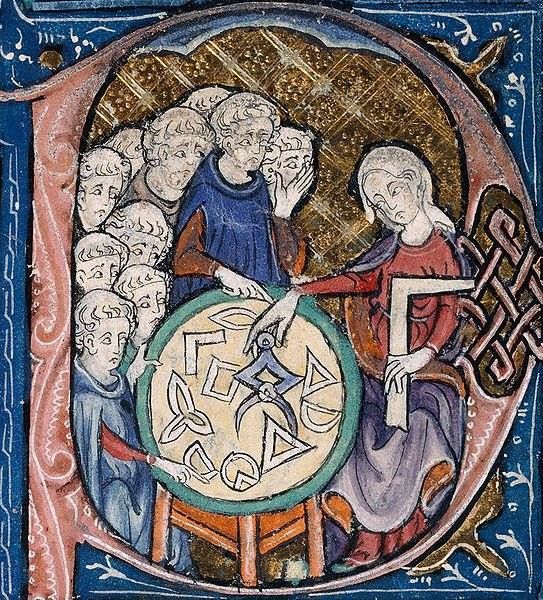
Medieval Woman Teaching Geometry 
George would have reacted keenly to this ready-made battle of Vulcan versus Apollo. This fey, weak and flimsy young man who saw himself as a refined, cultured sensibility, a fledgling poet, would have recognised the Industrialisation enemy from the Wakefield days, and known it to be formidable. He didn't mind benefiting from its technological advances, but he didn't want to know how they came about. Science, George always claimed, never interested him, but this was disingenuous because he always commented on this sort of thing - and he often researched scientific and pseudo-scientific topics such as nutrition, pharmacology, psychology, eugenics, phrenology, meteorology... he just didn't like admitting he was doing it. How best to demonstrate to the world your apartness from this oafish and oppressive force? Become a Bohemian; grow your hair; moon about reading 'precious little volumes' of arcane noodling, sigh a good deal, and pretend you are not made of mortal flesh and maybe deny your true nature, which is one of the precepts of all ascetic belief systems, along with 'know thyself'. In fact, 'know thyself then deny thyself' seems to sum up most faiths haha. 

We know that student George demonstrated talents for writing and for memorising great chunks of Shakespeare and the works of various epic poets, and he shamelessly showed these skills off at public speaking events. But, it has to be wondered if a science-heavy institution could attract the necessary humanities and Arts students to really offer George competition adequate enough to challenge his 'genius'. He later showed, via his Diaries, that story writing did not come easy, and that some creative projects were difficult enough to drive him to deep bouts of self-doubt, even depression, when they failed to ignite into finished flame. He was not a 'natural' at writing, and some of his early work (Workers In The Dawn, for example) drones on and preaches, and he often fails to self-edit when a descriptive phrase would have more power than a whole stodgy paragraph, but he had an almost forensic eye for detail, and boy, did he make use of it to describe the degradation of the poor! But, at Owens, was there the calibre of peer group to truly determine what his talents were? Again, when success came and the world of Owens saw him win cash prizes for his English studies, being a big fish in a little pond went to his head and convinced him he was better than others, maybe even that he was at least equal to his heroes, Dickens and Keats.
One of the Owens buildings around 1876
Anyhoo, Owens College was ground-breaking in that it did not provide residential accommodation. This meant students had to find digs and fetch for themselves for their meals, and every other kind of domestic arrangement. In later life, George laid the blame for his failure to succeed at Owens fair and square at the door of his mother (what did Freud tell us??) who in his opinion should never have agreed to this sort of malarkey - a youth let loose with no guidance (except for the teachers) and no form of support (except for the College). What was she thinking of sending a boy out into the world of Manchester's back streets, pubs and dance halls, all alone with few social skills for making friends? Why had she allowed him all that freedom? Had she no understanding of his tender, impressionable nature? She should have seen he was heading for a fall, shouldn't she, and stopped it before it started. That's what George thought, after it all went tits up.

In fact, George fit right in and was, from all accounts, a regular part of the social whirl, and enjoyed dances, drinking in pubs, mixing with girls, and spending every penny he had. He did just enough work to keep on the right side of the tutors, won lots of money in literary competitions and attended just enough lectures to show he was still alive and kicking. From his letters to his friend John George Black, he was often to be found skipping lectures and taking the piss out of his teachers, and doing all the things that would mark him out as a Rebel Artist Genius Bohemian and not one of those lumpen science student drones. But that impending fall was about to bite him in the bum.

JOIN ME IN PART TWO TO SEE WHAT HAPPENED NEXT.


Saturday, 30 April 2016

Commonplace 171  George & The Bard PART TWO.

George, a lifelong dabbler in writing poetry, took for inspiration several of Shakespeare's female characters. Some of these poems are to be found in the slim but valuable collection entitled 'Six Sonnets On Shakespeare's Heroines', all from 1876, the year he got rusticated from Owens College for the thefts and for associating (possibly cohabiting) with his girlfriend, served time in gaol for larceny and set sail to America for a gap year. This edition is taken from the Beinecke Library Gissing collection at Yale University. Who were these heroines and what significance is there in the choice of these women? 

First, a quick word in praise of a book George probably knew well. It contains many insightful studies of the women Shakespeare brought us and would have been a useful resource to a student of the Bard  especially one keen to impress his peers and college tutors. Here is the reference: Palmer, Henrietta L. The Stratford gallery, or, The Shakespeare sisterhood. New York: D. Appleton and Co., 1859. Shakespeare Online. 20 Oct. 2009. (accessed April 2016 at http://www.shakespeareonline.com). Or click. 

Some thoughts from 'The Shakespeare Sisterhood':

Imogen from Cymbeline (written in August,1876). Imogen was falsely accused of adultery by a man who spied on her whilst she was asleep. She was finally absolved of this. She was also the victim of rape plot.  
Imogen In Her Bed-chamber Where Iachimo Witnesses The Mole Under Her Breast.
by Wilhelm Ferdinand Souchon 1872 (which certainly makes you study her bosom!)


What is said about her:
To Imogen has been awarded, almost without a dissenting voice, the high distinction of being the most admirable of her immortal company - a woman in whom all perfections meet in rare harmony - who never cloys, never disappoints. 

Of all Shakspeare's wives -- and he delighted in shaping models of conjugal fidelity -- she is the master-piece; chaste, ardent, brave, devoted, and beautiful, she is indeed 'best of wives, most delightful of women'.
Cordelia from King Lear (written in August 1876). Cordelia is cast aside by her father for not swearing how much she loves him in return for a third of his kingdom (as her two sisters had done). It ends with Lear finally realising the symbolism of her gesture - she loves him without the promise of riches.
Cordelia Comforting Her Father by George William Joy 1881
What is said about her:
Compared with any less perfect, but not less charming, lady of this sisterhood, Cordelia will appear transcendently superior, by as much as she who follows the dictates of true religious principle must ever take moral precedence of the creature of mere impulses, whether of passion or caprice; but side by side with Goneril and Regan -- those diabolical creations, who are women only physically -- she shines an angel of light. 

It is only by careful study of the few master-strokes with which Cordelia is delineated that we can make out a faithful portrait of this matchless daughter; in fact, throughout the moving record of madness and crime, of which she is the heroine, her "heavenly beauty of soul" is felt rather than seen; although she is almost excluded from the action, her purity is ever present to the mind's eye, in dazzling contrast to the outer darkness of her surroundings.

Miranda from The Tempest (written September 22nd 1876 - in Nantasket, Mass.) Miranda was banished along with her father, Prospero, to live on an island with Caliban, their servant.Miranda has a pure heart and has led a sheltered life, as she lacks worldly experience. She is known for her compassion.
Miranda by John William Waterhouse  1916
What is said about her:
In body, mind, and spirit, Miranda is essentially virgin; her grace, her beauty, her self, are as guiltless of any meretricious suggestion as in the hour when she was born: "society" is a sealed book to her innocent eyes -- the world, a myth. Her quick susceptibility to a love as pure as it is passionate seems the one only quality she possesses in common with her sisters; she is the child of Nature and super-Nature -- belonging to humanity, but a humanity so free from base alloy that it is but a step removed from the pure spiritual.
Portia from The Merchant of Venice (written September 22nd 1876). Portia is the heroine who has to choose between three suitors, and who ends up with the best one - the one she really wanted. She is also the woman who disguises herself as a man in order to defend the best friend of her betrothed, Antonio, from Shylock. (There is a Portia in Julius Caesar, but she doesn't seem to fit the sentiments of the poem.)
Portia by John Everett Millais 1886
 What is said about her - she comprises a
"heavenly compound of talent, feeling, wisdom, beauty, and gentleness," we must confess that to us it seems well chosen. "Clever" does not, indeed, imply the possession of illustrious powers; but it does signify that nice "dexterity in the adaptation of certain faculties to a certain end or aim" which is eminently graceful and feminine, and exactly describes the mental characteristics of Portia, as most conspicuously displayed in the trial scene, wherein her success is achieved, not by the exercise of inherent wisdom, or an educated judgement, but by the merely clever discovery of a legal quibble. 

Perdita from The Winter's Tale (written in October 1876). Perdita - which means The Lost One - was born in prison because her mother was falsely accused of adultery. As a young adult she falls in love with Prince Florizel - his parents think it an unsuitable attachment because Portia has been raised by simple commoners and so they do what they can to keep them apart, The couple flee to Sicily, but it all ends well. 
Perdita by Anthony Frederick Augustus Sands 1866
What is said about her:
Perdita, perhaps, of all Shakspeare's heroines, is the completest exemplification of the intuitive lady, whose inbred daintiness no accident of life can affect.

Frequent mention is made of her rare personal beauty, and not by her lover only. Florizel says to her, touching her holiday attire at the sheep-shearing:
These, your unusual weeds, to each part of you
Do give a life -- no shepherdess, but Flora
Peering in April's front; this, your sheep-shearing,
Is as a meeting of the petty gods,
And you the queen on't.
Desdemona from Othello (written in October 1876). Desdemona is the wife of Othello. Her father considered Othello to be an unsuitable match and so the couple eloped. She is subsequently wrongly accused of adultery by the treacherous Iago, who is eventually thrown from a high window by her murderous husband. 
Desdemona by Sir Frederic Leighton 1888
What is said about her:
The type of all gentle and refined beauty - "O, the world hath not a sweeter creature!" - Desdemona by her rare simplicity, her childlike artlessness of character, wins her way to the hearts of all who have conned the story of her woes and mourned her cruel fate.
In our own mind we class her naturally with Miranda and Ophelia; but she is less purely ideal than either of these; her dramatic condition differs from theirs in being simply domestic; though highly picturesque, it is dependent for its interest on no more romantic accessories than are afforded by the privacy of a sumptuous household, to the skilful management of which -- notwithstanding that she was "an admirable musician," and of "high and plenteous wit and invention" -- she does not scorn to devote a considerable portion of her time. With whatsoever of intense effects her married life is produced, herself is never part of them -- she, indeed, constitutes their principal figure, but she is never involved in them, never understands them; her identity is preserved intact throughout.

Subordination, in thought and word and act, is the prominent feature of Desdemona's character: not simply the non-resisting humility of a weak, spiritless nature, but that honourable submission to one having authority (whether God, king, father, or husband) which, then, as in the later day of English Margaret More, formed an essential part of the education of the gently bred, only less important than religion itself, or, rather, included in that.


These six have been carefully selected - the likes of Juliet and Ophelia are left out, despite their suitability foe the project - to provide an opportunity for him to discourse on some salient at that time topics, concerning his relationship with his girlfriend, Marianne aka Nell Harrison. These are :- 
1) Women who have been wronged by society, often falsely accused of sexual impropriety.
2) Love between two apparently unsuited (by class) lovers.
3) The purity and innate goodness of the woman involved.
4) Naiveté and innocence in need of protection.

George's biographers assume that because Nell was described by the Owens College staff as 'unsuitable' they meant that she was a prostitute. Is that really what they meant? Wouldn't any working class girl be considered 'unsuitable' for a student at the college? If George had persuaded her to 'live in sin' with him - like he did with Gabrielle Fleury, his third 'wife' - did that make her a whore? If so, then Gabrielle should also be classed as that in biographies - at least Nell wasn't committing adultery, as was Gabrielle. It is a class-ridden affront to justice that Nell is regarded as immoral whilst Gabrielle is let off that charge. The same sort of emotional blackmail was used on both women, and both fell for it. In the case of Nell, George had the added bonus of crowing that he had 'saved' her from prostitution. But wasn't this because she was a naive and innocent girl being preyed on by the likes of George's friend, John George Black? Certainly according to Anthony West, HG Wells' son, writing from conversations with his father, it was Black who told George where he could find young and unsullied girls (Nell was 16 or 17 when she took up with George), emphasising how inexperienced they were. See Commonplaces 56-61 for more.

George was arrogant enough to think he had the strength of character and the unselfishness to deliver on his promises to Nell, but he was wrong, and Nell suffered for it. It's time his biographers made amends for their part in repeating the myth that she took advantage of him and that she was a working girl when they met - or at all, ever. There is no evidence for it, just their prejudice against the poorer classes, a lot of misogyny and a freakish need to explain the wrong deeds of George Gissing. Shame on them all.


Saturday, 23 April 2016

Commonplace 170   George & The Bard PART ONE.


Happy Bardsday one and all. It's April 23rd!!! It's the 400th anniversary of the death of the World's greatest writer - no, not George Gissing, but William Shakespeare. It is also St George's Day - no, not St George the Wakefield saint and martyr, but the Turkish or Roman or whatever chap often depicted fighting a dragon - the one that is England's patron saint. Her Maj is just getting over her 90th birthday party (gawd bless you, ma'am ) and we Brits are deliberating whether or not to remain in the European Union. It seems this is the hour - the planets are aligning (the 9th one hoving into view even as I type click) - and so there has never been a better time to think about the Glory that is the Bard of Stratford: the Glory that is England.

From Richard II scene I, spoken by John of Gaunt click:

This royal throne of kings, this sceptred isle, 
This earth of majesty, this seat of Mars, 

This other Eden, demi-paradise, 

This fortress built by Nature for herself 

Against infection and the hand of war, 

This happy breed of men, this little world, 

This precious stone set in the silver sea, 

Which serves it in the office of a wall 
Or as a moat defensive to a house,
Against the envy of less happier lands,- 
This blessed plot, this earth, this realm, this England.


Puck by Richard Dadd 1841
Now Let's address the George/Shakespeare connection. George often boasted of his familiarity with all of the Works. His father kept a Cambridge edition on his bookshelf, in later years, the memory of which gave George bitter-sweet pangs of nostalgia. One of George's party tricks, often performed for intimates was to recite great swathes of the text, or do impromptu readings to a captive audience. This was an age when reading out loud was considered a legitimate entertainment - Charles Dickens was a dab hand at it. George must have thought he knew the Bard's words well enough in meaning and delivery to perform them and risk the chance of looking a fool to anyone who knew them better.

St George by Hans von Hulmbach 1510


Alongside the Gissing family Cambridge Works of Shakespeare, George kept a Furnivall's edition (as mentioned in the Pierre Coustillas biography Vol 1). Furnivall was a Shakespeare scholar George could endorse. He produced a two-volume edition first printed at the start of the nineteenth century, as a response to the publishing phenomena that was 'Tales From Shakespeare' by Charles and Mary Lamb (1807), their take on some of the Bard's works. Furnivall was a man intent on re-igniting England's flagging love affair with it's Number One Literary Son, and he felt the Lambs' edition trivialised the works. 'Lambs' Tails', as it was affectionately known at my school, was intended to broaden Shakespeare's appeal and readership (not unlike the aims of a certain Commonplace Blog!) to include children and the likes of me, and it worked - for me. Furnivall's version included works left out by the Lambs, who excluded the likes of Coriolanus and Julius Caesar from their list.  

Now, anyone with half an iota of knowledge of the cosmos will know that the Interconnectedness of Everything spoken of by Douglas Adams permeates our World on a Quantum level. So it should come as no surprise that the name 'Furnivall' or 'Furnival' is closely aligned with works by Shakespeare. Mr and Mrs Furnival were famous players who gave their Shakespearean performances in, amongst others, the Goodman's Field Theatre with Mr playing the Earl of Gloucester in 'The Tragical History of King Lear' in 1746. And Frederick James Furnivall (1825-1910) click was a man of many parts, one of them being he started the New Shakespeare Society in London in 1873. The New Shakespeare Society concerned itself with interpretations of the original language, giving explanations and definitions of contemporaneous, authentic usage, and historical context for when the plays were written. The Society preferred the old form of spelling Shakspere to the one in modern usage which would have appealed to George's love of history and the quaint old- fashioned.
Teena Rochfort-Smith in August 1882
It was whilst working for this that Furnivall met his future muse, Ms Teena Rochfort-Smith (1861-1883), remembered for her unfinished 'Four Text Hamlet', in which she compares varying textual versions. Their relationship blossomed and he eventually left his wife and child to live with the much younger Teena. Sadly, she was involved in a terrible fire when her dress caught a flame from a match - not the new fangled sort made later on by the Bryant and May girls of Bow, but you could see why there was a need for a decent safety match. See Commonplaces 166 and 167. This horrendous accident eventually ended her life after a week of intense pain, and the terrifying notion she was doomed. Frederick was distraught, and wrote this little book in celebration of her life click.
This was before her great work could be finished and published, but the MS was passed on to the New Shakespeare Society. Her family established the Rochfort-Smith Shakespeare Prize at her old school to commemorate her life. 
The Four Text Hamlet
A bit of Hamlet that might have suited George:
I am very proud, revengeful,
ambitious, with more offences at my beck than I have
thoughts to put them in, imagination to give them shape,
or time to act them in.


Larry Oliver and his chum, Alice Poor-Yorick, deceased. Besties 4 eva. 


From Macbeth:

To-morrow, and to-morrow, and to-morrow,

Creeps in this petty pace from day to day,

To the last syllable of recorded time;

And all our yesterdays have lighted fools

The way to dusty death. Out, out, brief candle!

Life's but a walking shadow, a poor player,
That struts and frets his hour upon the stage,
And then is heard no more. It is a tale
Told by an idiot, full of sound and fury,
Signifying nothing.


It is a tale told by an idiot, full of sound and fury, signifying nothing? Yes! It's a Commonplace Blog. 
or an interesting tour of places associated with Shakespeare click:


JOIN ME IN PART TWO AND EXPLORE HOW SHAKESPEARE HELPED PAY GEORGE'S TUITION FEES.