Saturday, 9 July 2016

Commonplace 190  George & His Manifest Destiny PART TWO.

George travelled to the US in late summer 1876 several weeks after being released from prison, either because he was forced, or because he saw a world of opportunity open up before him 'in the extreme West', as he termed it in 'Workers in the Dawn'. Why did he 'Go West!'? Well, America was experiencing an economic slump and needed fresh victims to colonise the extremes of the country - like the legendary 'West' we see in cowboy films. Across the Atlantic in Liverpool, where George was working as a clerk, advertisements on hoardings offered tempting tastes of the 'land of opportunity' where a man (or woman) could carve out a niche for himself (or herself) - even a man (or woman) with a criminal record. And as 1876 was the centenary of American Independence, maybe he went there to soak up some of the celebrations - good copy for a writer.

The Good Old Days?
Horace Greeley click is credited with the phrase 'Go West!' when he said: Washington is not a place to live in. The rents are high, the food is bad, the dust is disgusting and the morals are deplorable. Go West, young man, go West and grow up with the country. It must have seemed like a chance to escape the control of the Wakefield Gissings, and to claw back some of the approval he had won from them by being a good scholar. The shame he brought on his family had been incalculable, and George never liked having his nose rubbed in his own mess, and we can imagine the state of mind he endured post Belle Vue gaol as one from the middle class who had been caught red-handed doing a working class crime, and having to pay the price for it. Seeing his mother's suffering would have been a constant nose-rubbing experience - and her a widow! And who knows how it impacted on his siblings left behind to endure the shame of having an ex-con for a brother. It had all the makings of a novel haha.

With no wiggle room available to bullshit his way out of his culpability and with a criminal record to his cv, a change of career path (from that of prospective Classics don) was inevitable. Writing for a living is the sort of job that doesn't require references; in fact, a little bit of a bad reputation may help book sales. That's probably the way Hitler saw it with Mein Kampf. This self-imposed exile in America offered a good way to make it look like he was punishing himself and that would ensure others would go easy on him. And so it came to pass, because biographers always blame Marianne aka Nell for his crime spree (multiple thefts, not a stand alone felony), thereby letting him off the hook of personal responsibility. As we know from time immemorial, it's always easier to blame it on a woman. But it paved the way for one of George's more spineless character flaws to become embedded. Lifelong, he would seek to attract pity/sympathy for similar actions - withholding himself from social occasions, living in dumps or out of the way places, and moving to France, to name a few. 

In his decision to emigrate, George will also have factored in the making of relatively easy money as another positive in favour of a career in writing. Because he had won money prizes at Owens, quite large amounts (for example, £40 for a year in an age when a loaf of bread cost a halfpenny) which was way beyond the annual salary of, say, a housekeeper or a seamstress, and won these with relatively small effort, he had realised he could dash off a few thousand well-received words without breaking a sweat. Money for jam, as they say. I suppose the prison experience of hard labour probably put him off real work because he managed to steer clear of that his whole life - with the possible exception of gardening in Epsom. Luckily for George, his tendency to intellectualise himself into being whatever he chose to be will have spurred him on. If he just clicked the heels of his ruby slippers and wished himself there, then there he would be.  
American Progress by John Gast 1872 
Look at this interactive resource for more click and wait for it to load.
George set sail on Tuesday, August 29th 1876, aboard the Cunard ocean liner SS Parthia. According to the often fanciful Pierre Coustillas biography, George was one of 149 'steerage' passengers listed on the manifest. He claims George's living conditions must have been horrendous; he writes:
The crossing must have been a trying experience. Travelling steerage, the lowest class of passenger accommodations, which derived its name from the large space, rather like a dormitory, in the stern of the ship, near the steering gear, signified travelling in extremely poor conditions. Invariably, the atmosphere was bad, the food poor, the air rank with heavy odour of spoiled food, seasickness, and unclean bodies. Lack of adequate toilet facilities made life degrading. The metal-framed berths, three bunks high, looked like rabbit hutches. Meals served in dining rooms with long tables set with dishes and utensils. On the older ships passengers still ate from a tin mess kit while sitting on deck. Even testimonies written down two or three decades after Gissing's American adventure make markedly repellent reading.

Where to start with this Hollywood 'A Touch of the Titanics' version? First, let's look at the  plans of the SS Parthia.

Here is a website that gives the facts click
1. SS Parthia was 6 years old when George sailed in her, and though small for an ocean liner, gained more internal space by having a new type of engine requiring less coal to take up storage space. This allowed more room for cargo. Parthia carried freight and mail (not 'English' mail as the French biographer claims, but Royal Mail from all the UK and from other countries sending mail through the UK), as well as a potential 1,181 passengers. By maximising the use of the vessel, Cunard could offer competitive prices on fares. 6 years is nothing over the life of a ship - Parthia was in commission, in one form or another, from 1870-1956. George sailed in a very modern vessel. She was still, in 1876, a jewel in the Cunard crown.
2. There were only two classes of passenger on Parthia - Saloon or First Class and Cabin or Third Class. George did not travel 'steerage' in a 'large space, in the stern of the ship'. The plan of the Parthia above shows 328 cabins, which allowed for a family of up to 3 per sleeping berth. The plan shows there was no large single dormitory full of 'rabbit hutches'. 
3. Bunks were not 'three high'. See the plan's legend.
4. Cunard had very high standards and a reputation to maintain, so the chances of this being a floating doss house are nigh on impossible to countenance. Just because people travel Cabin/Third Class doesn't make them common as muck, M. Coustillas. In fact, have a look at this list click of a similar voyage that shows many passengers were Europeans qualified in various trades, and most were young people under 50 yrs of age.
5. By 1876 the economic slump in the US brought the transatlantic emigrant trade to almost a trickle, which is reflected in the small number of fellow passengers George had on his trip. Parthia had 150 berths in Saloon/First and 1,031 in Cabin/Third Class. If George was 1 of 149, that means there were 882 empty berths. He will have had plenty of room to 'swing a cat' and enjoy relative comfort. 
6. How does M. Coustillas know there weren't enough toilets/heads? British ships like Parthia and her sisters Abyssinia and Algeria were specifically designed for passengers - that is, not converted for passengers - so there would have been plenty of opportunities to put in adequate toilets. And with such a large number of Cabin/Third Class tickets unsold, George would not have had to queue long for the loo should his customary travel-induced man flu gyppy tummy turned up.   
7. Cunard would not design a ship with inadequate hygiene facilities for fear of a scandal if there were an outbreak of infectious disease onboard which might affect offloading the passengers at their destination. Ships' captains had to sign documents guaranteeing the health of the human cargo click. Imagine the scandal and its impact on Cunard if what docked in New York or Boston was a ship displaying a flag announcing sickness on board. 

So, far from being herded like human cattle, George's voyage of 12 days' duration was probably a genteel affair not marred by overcrowding, foul stenches and manky passengers. And, as for seasickness... that month was an atypically quiet one for Atlantic weather. How do I know? I looked it up on Wikipedia, of course. Below is the entry click for 1876 and you can see it was a relatively calm and peaceful year for stormy weather, at least up until September 12th, two days after George docked in Boston, when hurricane San Felipe hit land, as in the Wiki page click. 
YearNumber of
tropical
storms
Number of
hurricanes
Number of
major hurricanes
DeathsStrongest
storm
1870111022,052Four
187186230Three and Four
1872540UnknownTwo
1873532626Five
1874740UnknownSeven
1875651800Three
187654219"San Felipe"
187783134Four
187812101108Seven
187986247Four
Making George look like he suffered is something of an industry amongst some Gissing biographers. They provide him with 'Get Out Of Jail Free' cards at times of his life when he behaved in particularly nasty ways - to his wives and children, for example. It's as if his unhappiness is a morally acceptable reason for his unpleasantness. The worst of the voyage for him on the way out (his return trip the following year is rarely picked apart) was that he was forced to share a small, restricted living space with other people, some of whom were from the working class of Europe, including the UK. Those middle class biographers who share George's abhorrence for all things proletarian probably shudder at such a thought, but, they can draw comfort from the fact that George had become somewhat desensitised to the intimate company of the poorer classes when he did his gaol time in Belle Vue. (His experience as a thief paid dividends haha.) As for sharing a dormitory if he had been forced to - isn't that what a private education had provided for him at Lindow Grove, the private school he attended? 
Trade card
So, what of his time in the States? JOIN ME IN PART 3 TO FIND OUT HOW THAT WENT DOWN.
Saloon Class 

Friday, 8 July 2016

Commonplace 189  George & His Manifest Destiny PART ONE.
George, in about 1884
America has a philosophy as old as the days of the prairie schooner crossing the plains. 'Manifest Destiny' they call it, and it still informs much of what they do today, except they now think more globally. To find out more see this click.

In the summer of 1876, after the Owens College debacle and one month hard labour in Manchester's Belle Vue gaol, George had pause to reflect on his Next Big Move. For the first time, his future was uncertain in a major way, and those personal qualities he'd perfected - knowledge of English literature and the Classics, facility with language, and an unfailing faith in his own superiority over others - were going to be the only qualifications he could carry with him on the road to greatness. Having disgraced his family possibly even more than himself, failed to maximise on the social advantages that had been handed to him on a plate, and proved beyond doubt he had a dodgy moral compass, there was only one place such a creature could insert himself: Australia. As it happened, he turned west instead of east, and took himself off to that other realm of the exile and social misfit: America. As he boarded the SS Parthia, a steam and sail ocean liner that went from Liverpool to New York City and Boston carrying passengers and freight, it looked like Wakefield's loss would be the USA's gain, and what a turn up for the books might that have been.

Of course, the plan did not go to... plan. Back then (not now; definitely NOT now) America was a lawless maelstrom of danger and privation, peopled by lovely, friendly and cheery optimists with a strong work ethic, side-by-side with disgruntled religious fundamentalists, all of them co-existing with outlaws and trigger-happy sociopaths... so why George thought himself equipped for that ordeal, is a mystery. It's a sign of the sheltered life he had led thus far which brought him to such an end - did he assume America was one big Manchester? (In some ways, it is!) But, it's that unstinting faith in his own superiority once more rearing it's egomaniacal, self-deluded head, coupled with a large dollop of 'in the land of the blind, the one-eyed man is king' thinking. Let's explore the clues we have, and get our heads round the choice he made.
SS Parthia in her glory days.
George set sail on August 29th, 1876


Henry Hick, George's childhood playmate from Wakefield, later supporter, friend and medical adviser, wrote in his little book, 'Henry Hick's Recollections of George Gissing':
George was sentenced to a month's imprisonment and was released at the expiration of his sentence. My father met him when he came out of prison and I expect got what help was to be had for him, but I know little of this, nor who gave him letters.
Anthony West, in his biography of his father, HG Wells, 'Aspects of a Life', tells us a job was found for George in Liverpool by Henry Hick's father:
On his release, Dr Hick's father had found him work as a clerk in Liverpool, but he hadn't liked that, and had soon cleared out, to go to the United States to try his luck there.
In that self-pitying and over-long effort, George's first published (albeit by his own hand) novel 'Workers in the Dawn', the under-achieving doofus, Arthur Golding (whom some take for an autobiographical version of its author, which to my mind, is a bit of an insult!) ends the book with a chapter entitled (in a stroke of inspired genius) 'The End'. Arthur has decided to leave all his cares behind and sail for America on the SS Parthia (I can see why they are fooled into thinking Arthur is George, honest I can, as Parthia was the name of the ship George sailed on - see Commonplace 190). Arthur is given this rationale:
He would go to the New World, not to its civilised parts, but out into the extreme West where in arduous struggle with the powers of Nature, he might forget all his past existence and - he could conceive it possible - in time, lead a happy life.
NB Only George would still refer to the US as 'The New World' nearly 400 years after Columbus, and 800-ish after Leif Erikson - and 100 after its Independence.

We don't really know why George he went to the States. His biographers tend to think he was given no choice but to emigrate to America, and that his decisions were made for him by friends of the Gissing family who stepped in to sort out the mess he'd made in order to ease the shame for his mother and siblings. Europe was a common destination for those who had fallen foul of the established way of British life, it being a place of cultivation and relative civilisation. But with no connections there, and very little by way of cash, that would have been a leap too far, psychologically, if not geographically, for George. In the age-old tradition of what he later described as 'jobbery' (aka 'advantage'), a bad thing in his opinion when others did it, but acceptable when it furthered his own agenda, making use of family connections to put him in touch with anyone who might help made sense. Having letters of recommendation would guarantee some sort of support network in his new place of settlement, and so the wheels of influence turned up William Lloyd Garrison, a legend of a man whose life had been dedicated to social reform (an abolitionist from the early days of the movement) who lived in Massachusetts. Money was raised from well-wishers and sympathetic supporters, and so George set off with much more than the average exile would have had in his gander bag.

What might he have found to interest him there? 1876 was the centenary year, and below is the flag used at the time, reflecting the number of states in the United States as 38. It's strange to think of George being in the States when the likes of Jesse James and Wyatt Earp were around doing their things, but he was. The US was in a deep recession, but that didn't stop the entrepreneurial muse bringing the world the first telephone call and Heinz ketchup, and the first Trans-continental Express train arriving in San Francisco 83 hours after leaving New York. This was the year of the Battle of the Little Big Horn. And it was the year Jack London, writer, adventurer and reporter back from the Abyss was born. George would never achieve as much or travel as far, but for a brief while Jack and George shared a country.   
The flag in use 1877-1890

JOIN ME IN PART TWO TO SEE WHERE THIS BRAVE STEP TOOK HIM.

Thursday, 30 June 2016

Commonplace 188  George & His and Edith's Son, Walter.

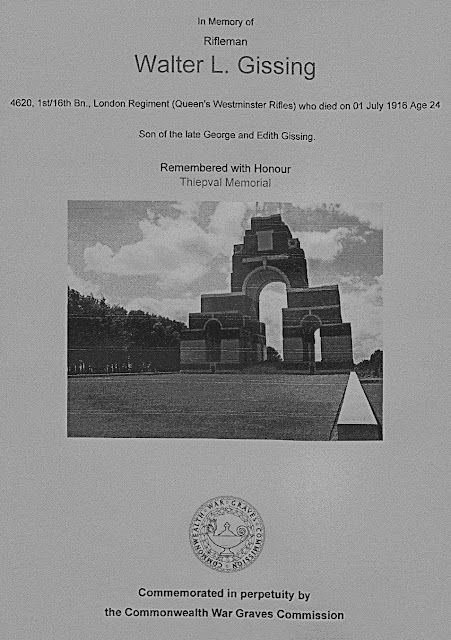
Today (July 1st 2016) is the centenary of the Battle of the Somme. George's son, Walter, serving with the Queen's Westminster Rifles, was killed there. Have a look at Commonplaces 19 and 27 to learn more about Walter.
Walter Leonard Gissing
1891-1916


The Soldier by Rupert Brook (1887 - 1915)

If I should die, think only this of me:
That there's some corner of a foreign field
That is forever England. There shall be
In that rich earth a richer dust concealed;
A dust whom England bore, shaped, made aware,
Gave, once, her flowers to love, her ways to roam,
A body of England's, breathing English air,
Washed by the rivers, blest by the suns of home.

And think, this heart, all evil shed away,
A pulse in the eternal mind, no less
Gives somewhere back the thoughts by England given;
Her sights and sounds; dreams happy as her day;
And laughter, learnt of friends; and gentleness,
In hearts at peace, under an English heaven.


Saturday, 25 June 2016

Commonplace 187 George & Demos (Again) PART TWO.

Oh, dear. The UK Referendum - I am sorry to say the wrong side won, by the barest of majorities. I voted to Remain; it seems the three Rs voted to Leave - that is, the Rich, the Racists and the Reactionaries - leading the way for the Far Right of Europe to step up its game. And for that odious slime mound of self-serving, conniving, unscrupulous egomania that is Boris Johnson to become the next UK Prime Minister. But, as post-French Revolution philosopher Joseph de Maistre once said: in a democracy, people get the leaders they deserve, so shame on us. On behalf of all sane Brits, European Union: I apologise. And to the up and coming generation of Brits who will suffer - I am ashamed of us, the older generation, who have let you down. A sad, sad, awful result.

Anyhoo, back to George & Demos...
Manor Park Cemetery in Newham, lies midway between the centre of London and Romford in Essex, 7 miles north-east of Charing Cross station. George wrote Demos in 1885/6, so he will have been familiar with the cemetery when it was new and still somewhat under construction. It was and still is, a private enterprise operation run by the family who started it. The cemetery website tells us one of Jack The Ripper's victims (Annie Chapman) is buried there; she died in 1888, the same year as George's first wife, Marianne aka Nell, who lies buried south of the River Thames.
The City of London Cemetery c 1855 
I am grateful to the E7 Now & Then website click for this snippet of information: in 1854, the Corporation of the City of London paid £200,000 for 12 acres of land to build a cemetery on. It opened 2 years later to accommodate 6,000 burials a year. Twenty years later this was developed into the Manor Park Cemetery. According to the website, the project went way over budget because the plan was to make it a pinnacle of beauty and restful repose, complete with decorative architectural features, statuary, well-laid out walks and lush planting.

The area had once been a semi-rural paradise of smallholdings and market gardens serving the needs of Londoners, but it was ripe for development when the nineteenth century economic boom arrived, and the demand for workers required to service such expansion saw the demand soar for accommodation for both the living and the dead. In nearby West Ham, the population increased by 240,000 between 1850-1900, thanks to an influx of immigrants and the development of both the London docks and the railways. In Demos, George likens this development to 'the spreading of a disease' (of course), because he hated new-fangledness and change.
Photo by Sue click
The industrial strength new-build of the area was everything George hated about the state of nineteenth century life. Rows of uniform houses all built to a repetitive configuration for people he considered drones. But wasn't it the ancient Romans and Greeks who liked their urban spaces neat and uniform? Town planning aspires to optimise the usage of space, and all those workers providing the likes of George with the trappings of his aspirational lifestyle had to live somewhere cheap and accessible to the workplace, in homes with comfort and security. But, George preferred those he considered his inferiors to be kept well out of sight, preferably well away from his own back yard, so that he could enjoy country rambles and appreciate its 'verdure' - his over-used archaic term for greenery - on those rare occasions he took himself out for a walk. In fact, houses throughout recorded history have been 'jerry built', by speculators who didn't expect their work to last forever. For every historic building we have a thousand others that have crumbled to rubble, and the new build replacing them welcomed as an improvement. The random nature of the historic parts of towns such as York and London testify to speculative schemes operated by anyone with bricks and mortar and a plot of land to build on. But, for George, such places were emblematic of the End of Days - industrialisation and homogeneity defacing the world forever, necessitated by the rise of the Proletariat with money to burn and no sense of aesthetics.

This much-feared blighting of some mythical Albion features in Demos. The working class hero, Richard Mutimer, sets his sights on building a new town for his, workers complete with factories, spanking new homes and loads of educational and cultural places for them to develop themselves - in contrast to the middle class hero, Mr Eldon, who has plans to return it all to rolling countryside when he gets his hands on his (rightful) inheritance, probably make it into a fox-hunting, pleb-baiting outpost, like all posh people want to when they get their hands on 'land'. There seems to be something mythic about owning ground that feeds into the souls of those who want power: a bricks and mortar house is not enough - it has to be the soil it's built on that satisfies them.
Modern map as found on this interesting website click known as Welcome To Manor Park
We know from George's shorter novels and some of his short stories that he had a horror of suburbia, which was at odds with the fact he opted to live in places like Epsom which couldn't have been more suburban if it tried. And, it has to be said, George was a suburbanite through and through, because he was unhappy in the centre of London, and in the relative countryside of Exeter. If the vile Henry Ryecroft is a manifestation of George, it is a portrait of the author, not 'at grass', but in his back garden, tending his roses and moaning about the state of his neighbours' greenfly.

The Woodgrange Estate in the Forest Gate area close to Manor Park was one of those suburban developments George so hated, but, it seems his assessment is unfair. According to the local council historical perspective:
The basic designs used on the Estate are repetitive, but the varied uses of standard details created an interesting variety while retaining the uniform overall character. These details include the use of different types of brick, iron front railings and gates and other ornamental ironwork, stucco and artificial stone decorative features. A distinctive feature was the glazed canopies to frontages (some of the larger houses also had canopies and loggias to the rear). These canopies, with their ornamental iron columns and valences, provided an architectural link to the railway stations of Forest Gate and Manor Park. Corbett was responsible for securing new and improved road bridges over the railway, the rebuilding of Forest Gate Station in the early 1880s and the negotiations with the Great eastern Railway for special "workmen's" fares from Manor Park Station. The larger houses to the west had servant's quarters attached, set back slightly from the main house frontage.  Corbett also attempted to landscape his "villas" by providing traffic islands in Richmond Road planted with trees and front gardens with hedges and lime trees were also planted. Added to these, 50 street trees were planted in Balmoral Road. Some of the shops on Woodgrange Road were also built as part of the development, adding to the already thriving trade on Woodgrange and Romford Roads. 'Corbett' was Thomas Corbett, a devout Scots land developer and architect of model housing schemes.

Frontage of the estate homes.  
So, we see a clear decision to bring a good quality of life to the area, with consideration of open spaces and well laid out thoroughfares, and the application of ordered principles of design. Shops and the sort of infrastructure all villages require were incorporated into the plans, an ideal setting in which the lower middle class could live and prosper.

And, so to the Manor Park Cemetery of George's Demos. This extract is rightly famed as one of his gems. Demos was written before George morphed into the dark, reactionary snob he became in the 1890s. Imagine what he could have produced if he had managed to retain this light. If you haven't read Demos, get you here click for a free copy. Notes: Jane Vine is the sister of the badly-treated working class angel heroine Emma, jilted by her fiance, Richard Mutimer, who has taken up with middle class girl, Adela. Jane has died of rheumatic fever brought on by poverty and over-work. A 'foss' is a ditch.
Jane Vine was buried on Sunday afternoon, her sisters alone accompanying her to the grave. Alice had with difficulty obtained admission to her mother's room, and it seemed to her that the news she brought was received with little emotion. The old woman had an air of dogged weariness; she did not look her daughter in the face, and spoke only in monosyllables. Her face was yellow, her cheeks like wrinkled parchment.
Manor Park Cemetery lies in the remote East End, and gives sleeping-places to the inhabitants of a vast district. There Jane's parents lay, not in a grave to themselves, but buried amidst the nameless dead, in that part of the ground reserved for those who can purchase no more than a portion in the foss which is filled when its occupants reach statutable distance from the surface. The regions around were then being built upon for the first time; the familiar streets of pale, damp brick were stretching here and there, continuing London, much like the spreading of a disease. Epping Forest is near at hand, and nearer the dreary expanse of Wanstead Flats.
Not grief, but chill desolation makes this cemetery its abode. A country churchyard touches the tenderest memories, and softens the heart with longing for the eternal rest. The cemeteries of wealthy London abound in dear and great associations, or at worst preach homilies which connect themselves with human dignity and pride. Here on the waste limits of that dread East, to wander among tombs is to go hand in hand with the stark and eyeless emblem of mortality; the spirit falls beneath the cold burden of ignoble destiny. Here lie those who were born for toll; who, when toil has worn them to the uttermost, have but to yield their useless breath and pass into oblivion. For them is no day, only the brief twilight of a winter sky between the former and the latter night. For them no aspiration; for them no hope of memory in the dust; their very children are wearied into forgetfulness. Indistinguishable units in the vast throng that labours but to support life, the name of each, father, mother, child, is as a dumb cry for the warmth and love of which Fate so stinted them. The wind wails above their narrow tenements; the sandy soil, soaking in the rain as soon as it has fallen, is a symbol of the great world which absorbs their toil and straightway blots their being.
It being Sunday afternoon the number of funerals was considerable; even to bury their dead the toilers cannot lose a day of the wage week. Around the chapel was a great collection of black vehicles with sham-tailed mortuary horses; several of the families present must have left themselves bare in order to clothe a coffin in the way they deemed seemly. Emma and her sister had made their own funeral garments, and the former, in consenting for the sake of poor Jane to receive the aid which Mutimer offered, had insisted through Alice that there should be no expenditure beyond the strictly needful. The carriage which conveyed her and Kate alone followed the hearse from Hoxton; it rattled along at a merry pace, for the way was lengthy, and a bitter wind urged men and horses to speed. The occupants of the box kept up a jesting colloquy.
Impossible to read the burial service over each of the dead separately; time would not allow it. Emma and Kate found themselves crowded among a number of sobbing women, just in time to seat themselves before the service began. Neither of them had moist eyes; the elder looked about the chapel with blank gaze, often shivering with cold; Emma's face was bent downwards, deadly pale, set in unchanging woe. A world had fallen to pieces about her; she did not feel the ground upon which she trod; there seemed no way from amid the ruins. She had no strong religious faith; a wail in the darkness was all the expression her heart could attain to; in the present anguish she could not turn her thoughts to that far vision of a life hereafter. All day she had striven to realise that a box of wood contained all that was left of her sister. The voice of the clergyman struck her ear with meaningless monotony. Not immortality did she ask for, but one more whisper from the lips that could not speak, one throb of the heart she had striven so despairingly to warm against her own.
Kate was plucking at her arm, for the service was over, and unconsciously she was impeding people who wished to pass from the seats. With difficulty she rose and walked; the cold seemed to have checked the flow of her blood; she noticed the breath rising from her mouth, and wondered that she could have so much whilst those dear lips were breathless. Then she was being led over hard snow, towards a place where men stood, where there was new-turned earth, where a coffin lay upon the ground. She suffered the sound of more words which she could not follow, then heard the dull falling of clods upon hollow wood. A hand seemed to clutch her throat, she struggled convulsively and cried aloud. But the tears would not come.

No memory of the return home dwelt afterwards in her mind. The white earth, the headstones sprinkled with snow, the vast grey sky over which darkness was already creeping, the wind and the clergyman's voice joining in woeful chant, these alone remained with her to mark the day. Between it and the days which then commenced lay formless void.


Thursday, 23 June 2016

Commonplace 186 George & Demos (Again) PART ONE

Today, we Brits (well, us lot who have the vote) go to the polls to decide to either Remain or Leave the European Union. I am confident we will vote to Remain. Why? Because, as demonstrated so eloquently in WWII, we Brits are not a nation of quitters. And, because the sometimes apathetic working class, socially engineered to feel powerless by a ruling class determined to keep them ignorant, will rise up, get off its arse, switch off the tv, put down the lager bottle, and march to the polling stations to ensure its Human Rights are not removed. A vote to Leave plays directly into the hands of our despotic rulers, amounting to a coup designed to bring on a silent revolution against the interests of the working class and poor. The primary function of any political party is to counter the effects of want, before any other agenda rises up. Sadly, we nowadays have returned to the scaremongering of the 1930s, and racism is once more centre-stage on the political hustings. As we saw in the twentieth century, the poor can be manipulated into conflict by those determined to divide and conquer and ultimately dominate, the working class, that most valuable resource of any economy and nation. We must resist the tyranny of the rich and support each other by sticking together, regardless of race, religion, sexual orientation, gender or skin tone - or nationality. As ever, the fight for freedom from any form of oppression starts with a war against poverty.
Rosa Luxembourg daughter of the Revolution click
It's at times like these (and entirely for the purposes of this blog post) that I stop and ask: 'What would George do?' Would he vote to Leave or Remain? To save the suspense, I suspect he would vote to Leave. He was a modern thinker in terms of literature, and he deplored blind nationalism, but his Conservative mindset would have prevailed, and he would have agreed with those who think Britain should remain aloof, and continue to think of itself as an elite. In his later years, he had grown too cynical to have faith in any agency but his own power of mind, but in his youth, for a brief time, George followed the path of Socialism. He was not a conspicuous political animal, but his father had been somewhat left of centre in matters of local politics back home in Wakefield, so maybe George felt he was honour-bound to appear to make a contribution to a cause. He attended meetings and explained himself in correspondence with his brothers, and tried to convince himself that Socialism was the best path, but it all fizzled out. George was never what you might term a 'joiner' of anything that did not serve his ambitions, or reflect well on his curriculum vitae, and he did not support any cause in particular, save that of his own self-service. Perhaps he saw that the battle lines had finally been drawn - the rich versus the poor - and he didn't want to end up on the wrong side, because most social revolutions tend towards meeting out harsh treatment to collaborators on the losing side.
John Tenniel's cartoon published in Punch. Tenniel also illustrated Alice In Wonderland and
Alice Through The looking Glass click. The battle was between party leaders Benjamin Disraeli and William Gladstone - Tories versus Liberals. 
In George's day, very few British people had the vote. The Reform Act of 1867 was a milestone as it introduced the right to vote for some of the male working class - those wealthy enough and in careers stable enough to enable them to be home owners and thus, rate payers. But the Act's lack of precision meant it was still a many-flawed piece of legislature, open to exploitation by unscrupulous politicians. No-one knew if there would be anarchy following the implementation of the Act in a time when monarchy was not popular (Victoria was in deep mourning for her consort and had withdrawn from public life) and Revolution was in the air. In fact, the Act let down the ordinary person because it introduced the need for politicians to pick a side (previously, parties had worked together) and then spend vast amounts of money on campaigning, thus excluding the poorer classes from putting themselves up for candidature. However, it produced a surge in numbers eligible to vote, almost trebling in the fist ten years of the Act. George was a potential rate payer, so would have had the right to vote if he had ever owned a house or a flat of his own.

Demos is George's 1886 novel about Socialism and the vileness of the working class when compared to the holiness of the genteel middle class. Actually, many of George's books include his thoughts on the dreadfulness of the poorer classes, but Demos sets out to put any notions that the working class could ever be elevated to an order of gentility themselves firmly into place as a socialistic pipe-dream enjoyed by well-to-do enlightened folks - like William Morris - who lived in a world of unreality fuelled by wealth and privilege. For more about the novel see Commonplaces 12 &13.

Mary Harris Jones co-founder of the Wobblies -
the Industrial Workers of the World group click.
Demos is one of my favourite George novels, because it reveals the author's real self as a backward-looking snob and passive aggressive paranoid Tory. He doesn't bring us imagined biographies of complex, fully-formed characters: he provides us with taxonomies of stereotypical types classified to demonstrate his strongly-held point of view. The whole thing is annoyingly didactic and shallow in its understanding of psychology - it is definitely no Crime and Punishment!! It seems unable to make its mind up about what it wants to be remembered for - too many subplots, is one of my memories haha - but it moves along at a brisk pace, which must have been a boon if you were reading the three volume edition hot off the press. But George is not reaching out to a readership of the oppressed; he wants to speak to those in power, to reassure them the working class couldn't organise a piss-up in a brewery because 1) they are incapable of working selflessly for a common goal; 2) they are essentially venal and would drink all the beer; 3) the natural order would prevail and the rich would win in the end. It is an ambitious work, and because it is his third novel, it is still full of bits of authentic George, before he covered over his soul and turned into that odious creep, Henry Ryecroft.
The Belgian Revolution by the splendidly-named Egide Charles Gustave Wappers 1834
In Demos, everyone is pulled in to serve a purpose - the trophy bride bought as much as wooed; the scheming mother intent on arranging a good marriage; the dumped, innately saintly true love who really believes love means letting his woman go, the ambitious worker with an intriguing, entrepreneurial, skill-set but a hole where his moral compass should be; the dumped girlfriend with the heart of gold; the flighty girl seduced then broken like a butterfly on a wheel by being too free with her favours; the middle class girl whose inner grace is tested but always rises to the occasion; the common man a shallow step up from the beasts always returning to type at the drop of a hat; the undeserving baddie inheriting riches he is not entitled to at the expense of the man who should have them; the innate, lack of integrity at the dishonest heart of the common man (skating on thin ice for an author who'd done porridge with hard labour for stealing haha); the mob intent on mayhem for no good purpose; the stupid grasping nature of the poor; the amalgamated mass of meat that is the lumpen proletariat; the jealousy of the grasping have-nots intent on dragging their betters down into the mire; the violence held deep inside the average man's heart; the chance of redemption only possible through death, or religious conversion, or public humiliation... Demos has all of this, and more. It's Dallas and The Forsyte Saga and King Vidor's movie The Crowd all rolled into one soupy tale where the hero gets offed for no good reason and the wrong people prosper. Inevitably, the moral tones of the thing drag it down to the floor, but there are luminous moments - such as the famous 'Manor Park Cemetery' scene.

JOIN ME IN PART TWO TO EXPLORE THAT.

Friday, 17 June 2016

Commonplace 185  George & His Childhood Holidays In The Lake District.

Cumbrian coast St Bees 
A house above/behind a shop in Wakefield was not the ideal place to raise a family of five children, but Mr and Mrs Gissing had enough money to provide them with a good education and enough money left over for holidays to the seaside and trips to London on the train.
George had a reasonably comfortable childhood until the age of thirteen when his sense of security was changed forever. His father died, leaving the family rudderless; without the leadership every stable, productive lower middle class Victorian household required. George was forced to become the Man of the Family - never his most comfortable, natural, role. His resentment at having to abnegate his own needs to those of others was a trait that festered throughout his adult years, and when he had a family of his own, all that rancour quickly surfaced and blighted his relationship with his sons.

Anyone interested in poetry - as was George's father, something of a poet himself - is drawn to the majesty of the Lake District, if only to pay homage to William Wordsworth who was born in Cockermouth in 1770. Wordsworth is a god of English poetry, and no one should go through life without a working knowledge of at least The Prelude, which, in my youth, was a staple of the English Year 9 curriculum. To read it, click.
Dove Cottage in Grasmere, where Wordsworth lived with his sister, Dorothy. Thomas De Quincey moved in when they moved out.
The holidays the Gissing family enjoyed (often without father as he was too busy in the shop to take time off) were to genteel, modest, salubrious, countrified places, like Seascale and St Bees at the coast side of the Lake District, in what was then known as the county of Cumberland (now called Cumbria), a journey of about 200 miles from Wakefield. Nowadays, the Lake District is a National Park click attracting tens of thousands of visitors, but travel was more costly and more protracted, with far less transport links in George's day. The journey there and back by train, with a couple of changes along the way, would have been an adventure in itself, passing through the splendour of the Yorkshire Moors, some of England's most beautiful landscape. George was, at this, impressionable age, a dedicated artist and watercolourist, hoping to eventually make a living from it. George was always a sincere and very focused competitor in any enterprise he undertook, though he covered up his failures by pretending he didn't care about the outcome; in his teens, he entered his paintings into competitions that he occasionally won. (He would later make money at Owens College entering literary competitions.) A holiday in the Lake District will have delighted him, as Artists had been visiting there since the Romantics discovered the wonders of mountains and waterfalls, secluded valleys and precipitous rock outcrops. But, thanks to the often violently changeable weather, it is the light playing on the verdant hillsides, and the often louring and oppressive skies that galvanise the Artistic temperament into producing visual celebrations of the Sublime.
William Wordsworth (1770-1850)
often depicted deep in contemplation, as here. 

If you haven't heard of the term 'Sublime', consider this, from Wikipedia, complete with their links:
A Philosophical Enquiry into the Origin of Our Ideas of the Sublime and Beautiful is a 1757 treatise on aesthetics written by Edmund Burke. It was the first complete philosophical exposition for separating the beautiful and the sublime into their own respective rational categories. It attracted the attention of prominent thinkers such as Denis Diderot and Immanuel Kant.

In short, the Beautiful, according to Burke, is what is well-formed and aesthetically pleasing, whereas the Sublime is what has the power to compel and destroy us. The preference for the Sublime over the Beautiful was to mark the transition from the Neoclassical to the Romantic era.

To further explain - there is a difference between enjoying a nice view from a high place and the sensation of unreality that brings on an urge to jump from it. The sort of state of mind engendered by Edvard Munch in that famous Scream painting, when he was trying to depict the effects on his consciousness of Nature's threatening presence descending through the darkening shadows of twilight. Or, as Munch put it:
I was walking along the road with two friends – the sun was setting – suddenly the sky turned blood red – I paused, feeling exhausted, and leaned on the fence – there was blood and tongues of fire above the blue-black fjord and the city – my friends walked on, and I stood there trembling with anxiety – and I sensed an infinite scream passing through nature.

West door to St Bees Priory

George, the young artist and lover of all things Sublime/Romantic, will have swanned about looking dreamy and preoccupied, stopping to capture the fleeting light and the way it fell on natural forms, probably with a large drawing board and easel, and a more subtle little pocket sketch book. Impromptu visual notes, a few drawn lines swiftly committed to paper as an aide-memoire for future meisterwerks - JMW Turner, an artist not thoroughly appreciated by George (ever the one to have pedestrian Artistic taste) used to make notes and drawings and colour studies of particular things he wanted to include in his paintings in a series of books that are a delight to behold click. Turner used to tie himself to ships' masts so that he could capture the light of storms at sea on canvases strapped down with weights, ever delighted at a near-death experience in the English Channel, or around The Solent, exulting in downpours and Force Nine gales. The German Caspar David Friedrich (1774-1840), a prominent painter of what we know as The Sublime, produced canvases so large and detailed that the Sublime slaps you in the face and overwhelms, even in an Art gallery space click. Albert Bierstadt (1830-1902), a German working in America, did something similar when he gave us the archetypal Sublime picture in his epic...
Among the Sierra Nevada Mountains 1868

Another influence on George was John Ruskin, a Lake District aficionado who wrote about the immense beauty to be enjoyed in secluded walks among the hills and dales of the Lakes. He wrote: An architect should live as little in cities as a painter. Send him to our hills, and let him study there what nature understands by a buttress, and what by a dome. click

Ruskin poured scorn on the painter John Martin who almost single-handedly put the willies up anyone not used to a nice view with his The Great Day of His Wrath, a colossal 11x8 feet canvass depicting the pessimism of eschatology. If you ever get to see it at Tate Britain, stand really close to get the full shock and awe.
1851-3
To gentler stuff.
The coastal village of St Bees in particular, will have appealed to George's interest in old buildings, particularly churches. By the time he visited the village, the theological college housed in the Priory had been in operation for  fifty years, churning out Church of England clergy, who enjoyed lectures inside the restored chancel, made over as a lecture theatre. A small village adjacent to the sea and at the foot of the Lake District fells was not/is still not the most exciting of holiday destinations, but if you like long walks on the beach, collecting flowers, sketching, picnics, tea shops and yomps over hilly ground, then this part of the world is for you. And me.

The Gissings enjoyed the quiet life on their holidays, and we know from George's travels in Italy that he more or less visited all destinations as if they were St Bees and the Lake District. All aspects of architecture seemed to interest him and he often visited churches to admire the history and the buildings, if not to take advantage of the spiritual offerings. As George was living in the time just after the full impact of Gothic Revival (largely thanks to the efforts of  Augustus Welby Northmore Pugin 1812-1852) you couldn't move through England (and the World) without bumping into some sort of Gothic erection, from the UK Houses of Parliament, to the more modest church Pugin designed for the congregation of St Xavier's in Berrima, New South Wales, Australia. Gothic and The Sublime go hand-in-hand to impress us with their power and might, but they often both lack that one essential factor that sustains us: joy. George's childhood holidays were times of joy for the family before the disaster of Thomas Gissing's untimely death took the sheen off it all. George never really recaptured those carefree moments spent idling among the rock pools of Seascale, though he tried. The closest he came to it was walking the byways of The Ionian Sea, his account one of his precious Italian holidays. If you read nothing else of his, do read it click because it's the closest he gets to happy.
Pugin's St Xavier's wouldn't be out of place in Penrith.