Tuesday, 21 April 2015

Commonplace 62   George & Syphilis PART ONE  Sooner or later, with George Gissing, all roads lead to Syphilis.

One of the most contested notions in the whole realm of Gissing studies is that George suffered from venereal disease. To say the camp is divided is to say a mouthful. As ever with George, there is a lack of hard evidence and a lot of supposition, but no overview of his life and works can escape the issue, because, if he suffered from it, much will be explained (and even forgiven); if he didn't, then that's a whole new Gissing to consider. Of course, we have no way of knowing for sure either way, but we do have tantalising clues and some documented information to help us make up our minds - or leave us sitting squarely on the fence.

Iris by John Atkinson Grimshaw 1886
Sometimes, the Victorian age seems to be little more than an endless parade of autistic savant detectives, midnight throat slashings and Hannah with her banner - and where would English literature be without them? But, there is a special place in nineteenth century popular culture for syphilis. This is because it was (and still is) such a monster, producing visible horror and decay, with the added terror of being, for long stretches, a silent invasion force capable of fatally overwhelming its host at any given moment, either a swift end or a long, drawn-out and truly terrifying slow meandering slog to madness and disability. Neurosyphilis, the most destructive form, can eat a brain in a couple of years, and on the way, render you blind, insane and immobile. And, then there is the pain it can cause. Some of George's real-life heroes suffered from the 'French disease' (or, the English disease', if you lived the other side of the Channel haha) - Alphonse Daudet, Fyodor Dostoevsky, to name but two. Daudet suffered very badly - read Julian Barnes' account of poor Alphonse's struggle with it: In The Land Of Pain.

As ever, the Wellcome Collection is an invaluable tool for anyone seeking to know more on the subject click  (strapline: The free destination for the incurably curious). However, anyone thinking syphilis is a thing of the past, would do well to take their misguided arse off here click.
 
Lady of The Lilacs by Thomas Hughes
1863
Let us explore the evidence that might lead us to confirm or disconfirm that George was syphilitic. You will have to make up your own mind. Let's gather information.

In order to appreciate the challenges of treating the disease in George's time, we have to accept there was no way then for science to identify the bacterium treponema pallidum responsible for it and still no worldwide clear consensus on what constituted the disease or how it progressed throughout what was termed the 'economy' - an old-fashioned term for the body and its systems. Much of the work towards understanding disease was carried out by individual doctors who dabbled in medical research as a sort of hobby - many specialists were self-taught or picked up what tuition they could along the way. Take Arthur Conan Doyle. He qualified as a general practitioner in 1882, worked as a GP, then went to Vienna to study ophthalmology in 1890 - just in case the writing career didn't last (notes to Gissing: proper day jobs are not a threat to creativity and writing books people want to read is not a thing of shame).

Because there are so many computations to an exact prognosis - ranging from a long life free from overt disease, then a swift decline into immobility and madness, to a raging secondary phase that ate the brain and killed you quickly, to a full life lived with the disease in remission - you begin to appreciate how tricky this disease can be to diagnose, especially in the days before effect blood tests and powerful microscopes. The more a physician came into contact with sufferers, the better able they were to make accurate diagnoses. Needless to say, doctors in towns with a high population of serving armed forces personnel were likely to have good knowledge of venereal disease, as were those doctors who worked in inner city areas. 
Girl With Golden Rod
by Charles Courtney Curran 1915
 The London Hospital was considered England's best place for cutting edge research and regularly staged symposia to train doctors in diagnostic techniques, as well as supporting its physicians to publish works on their studies. Of particular note is the work of Frederick Treves, he of the help to and support of Joseph Merrick, the Elephant Man. Paris possessed a strong contingent of expertise - Jean Alfred Fournier, for example - but, as ever with medical advances, disease recognises no borders and so all countries produced their experts, and their own approaches to treatment.

In the 1860s, the fear of syphilis as an engine of social disorder prompted a particularly savage approach in the form of the Contagious Diseases Act click. The London Lock Hospital had been instituted in the eighteenth century to treat sufferers - but it was the Victorians who made the worst use of it by forcibly incarcerating and treating women if they became infected. Only a woman could truly appreciate the hypocrisy of locking up sick women while infected men roamed free. This is a fascinating story, and anyone who wants to know more should look up WT Stead click and Josephine Butler click. For an overview of how France reacted to a rise in incidence of syphilis click

Syphilis is a very clever little fellow. The old saw is that syphilis was considered to be 'the great imitator' because, its signs and symptoms were easily confused with other severe ailments. What was presented by a patient's condition could be baffling to all but the very experienced physician, and so cases often went undiagnosed, misdiagnosed or inadequately (even iatrogenically) treated - which often resulted in a set of problems of its own. The main challenges to accurate diagnosis were: the various signs of infection could be visually mistaken for similar conditions; a new infection quickly went 'underground' (creating the mistaken belief it had cured itself), often before the sufferer sought help; it presented without pain and so went unnoticed; the seat of infection could lurk out of sight - in the mouth, rectum or vagina, for example, and so only became apparent when severe damage was done; embarrassment kept people from seeking help, and drove them to seek out useless do-it-yourself remedies from chemist's shops or even by mail order. An obvious, but not very accurate way of diagnosing syphilis was trial and error dosing with the treatments (note: not cures) available, then waiting for a result. What made this less reliable for diagnostic purposes was that the alleged cures, such as mercury and iodide of potassium, were toxic even in small quantities; much of the damage done to bones and teeth, the nervous system and in particular, the brain, could be laid at the door of mercury, strychnine, antimony and arsenic - all used in patent syphilis cures. Something for you to think about: as so many cases of syphilis went misdiagnosed or undiagnosed in the late nineteenth century, there could be a much higher incidence of the disease in the population than we generally think. There is every chance your antecedents suffered from it! Here is a letter published in the British Medical Journal of December 1913, which relates to military personnel, not civilians, but it gives some idea how difficult it still was then to identify a cure even when the famous 'magic bullet' of Salvarsan click had been developed.
THE ROYAL COMMISSION ON VENEREAL DISEASES. SIR,
I have noticed in the JOURNAL of November 29th certain extracts from the official report on the above subject in which it is stated that Colonel Scott gives the following statistics of venereal disease from 1888 to 1912 - namely:
1888 - Admissions into hospital  224.5 per 1,000
1912- Admissions into hospital in 56.6 per 1,000
and in India the reduction had been still more marked. Colonel Scott attributed this diminution to greater temperance and care of the soldier, etc., with which I in part cordially agree, but surely there must be something more to explain this extraordinary decrease as shown by statistics, which can so often be fallacious. Let me suggest one explanation. I believe I am correct in stating that before I left the service in 1891 the practice l had begun of not always admitting men into hospital with primary diseases, but treating some of them in barracks with subcutaneous injections of mercury, etc., whilst doing light duty, or, if admitted in the first place, were, later on treated in barracks and not readmitted. If this be true such action must considerably affect statistical returns. Whilst I am on this subject, with a past experience of thousands of cases treated by mercurial inunction and otherwise, it is a source of great regret to me to find that salvarsan is becoming so much adopted by the profession in preference to mercury, although I have no right to express an opinion on the new treatment, having no personal experience of it. But mercury has stood the test of generations whilst arsenic has yet to stand the test of experience, and, already, I see antimony suggested in its place, and my firm belief is that the day will come when mercury will regain its well-merited position in the past as the best treatment for syphilis in its primary stage.

So much for progress.

Back to George, in particular. To tease out the facts, we have to appreciate George's health was always a preoccupation for him, but in an age with few cures for many diseases, many people would have worried about their twinges and lumps and bumps, and rushed to the doctor at the first sign of a sniffle - if they could afford it. The poor had to struggle on with their folk remedies but the fear of starvation kept them upright. In a time of advertising freedom, any ridiculous claim could be made in order to sell a medicinal product, and patent medicines were often shamelessly marketed as cures for all sorts of incurable diseases. Like his younger brother, William, George always followed health trends - for a man so unimpressed by science, George showed remarkable interest in the latest developments in cures. Of course, a preoccupation with health is not necessarily proof of chronic, incurable disease, but it is an indicator that something was worrying him. As an impulsive sort of chap (after periods of drawn-out contemplation, George often then went off and did the first thing that came into his head) we can imagine him window shopping in the local chemist's and then popping in to buy whatever took his fancy, healthwise. Maybe this is why he hated street advertisements so much - he knew they did their job and did it well! We know he enjoyed the fads of the time for creosote and cod liver oil; the nastier it tasted, the more efficacious the result! For a diverting overview of why we choose what we buy click

We can confidently claim George had two recurring themes in his medical record: what appeared to be neurosis, and the pulmonary form of tuberculosis. The 'neurosis' took many forms, one of which was the manifestation of seemingly trivial ailments - man flu, breathing difficulties, stomach problems, diarrhoea, insomnia, skin rashes, excess sweating aka hyperhidrosis, malaise and chills - all could have been psychosomatic in origin - certainly Gabrielle thought so. We must not assume psychosomatic disorders are a form of malingering. The mind (for want of a better term) seeks to defend itself from perceived threat by any means necessary. Deflecting the stress of a threat you cannot run from has to be sublimated into a survivable situation - minor illness concentrates the conscious mind and relieves the pressure of built-up anxiety. As the impetus to do this is deep in the unconscious, the sufferer is unaware the symptoms might be auto-generated. Neurosis is a survival mechanism, and a very good one, democratic and reliable. However, all of the above listed manifestations of it are also typical symptoms of real physical disease: latent stage syphilis.

We know George had phthisis - which we now call tuberculosis - and claimed to have suffered from it for most of his life. TB as we know it, was not fully understood in the nineteenth century in terms of aetiology or progression through the body, and so no specific, reliable cure had been developed - that wouldn;t come along until the rise of the antibiotics during WWII. We now know it is a system-wide infection caused by mycobacterium, usually mycobacterium tuberculosis. Pulmonary TB - which is located in the lungs and respiratory tract - was what made George so short of breath, and William, his brother, and Marianne spit blood (haemoptysis) - and George checked his sputum every day (every cough?). TB may have caused him all sorts of associated problems, including, if the infection became system-wide, heart disease, brain disorders, skin lesions, reproductive problems, bone decay, cachexia and, eventually, multiple organ failure. More things to confuse with syphilis.
The Flower Girl by Emile Vernon 1904

TB was more likely to be mistaken for syphilis (and vice versa) than any other disease. To differentiate TB and syphilis was tricky and fraught with potential error. A serious threat to accurate diagnosis was lack of continuity of care in medical supervision - George and Marianne had frequent changes of address and used different physicians and, in Marianne's case, hospitals. Consistency of medical opinion might have provided a medical history - consulting with random doctors would just produce medical notes, which were not shared with other professionals. This often allowed different doctors to makes different diagnoses yet based on the same medical evidence. And, as patients don't always know how to accurately explain what ails them, and rarely know the correct jargon or appropriate medical terms, they can fail to do justice to what they are trying to describe. When the causes and prognosis of both TB and syphilis were virtually unknown quantities, is it any wonder they were so often confused with each other?

So, what do we have that points to an undifferentiated diagnosis of syphilis in our man? Well, we have the letters of John George Black. The first letter describes JG's physical reaction to being caught fraternising with the girl George fancies - he is overcome with embarrassment. He talks about how ill he feels. He mentions how weak and feverish he's been, how debilitated, and how he had to confine himself to bed. In a second letter, he asks about poorly penises. John George writes to his 'Adonis' (his pet name for George - bless his cotton socks; George does so often bring out the bromantic in a fellow!):

The irritation continued growing worse, & on examination, I found the prepuce swollen, & on turning it down, I found the whole of the inside salmon-coloured, as you would call it, only little spots as though the skin had been eaten away so as to show the flesh, & almost looked as though were bleeding. I applied a little of the subtilissimus, but the end continues to be irritated. The prepuce is a little hard as well; & there was a drop or two of yellow matter near the red spots. I don’t know what an ulcer should look like. Are these anything like the symptoms of soft chancre? Or, is it like your inflammation? Or do you think it is only balanitis? 
He then adds: Should the subtilissimus go a bright green?*
*I have a theory about this. Many patent cures were thrown together to appear to work - visually - as much as to effect a cure. Copper, often used for its cleansing antibactericidal properties, can turn skin green. click In a patent medicine, one of the advantages to a green colour on the skin, is that it cancels out the redness of the irritation - thus making it look less inflamed - in the same way green make-up works on flushed complexions to reduce the pinkness.  

Thanks to the power of google images, and with your own innate curiosity, you can look at pictures of the above venereal conditions (warning! google images search results are quite scary and will involve cocks and suchlike). As I have done (I'm fearless). It would seem - from the above quoted section - that John George is not describing balanitis click (as claimed by one of George's biographers - who does not mention this second letter at all in his biography of George, which is an odd editorial decision - he includes some utter claptrap he can't prove but leaves out some primary evidence  It's as if he doesn't want to be impartial haha. You have to go the the first volume of the Letters of GG to find the John George Black letter,  or to the John Rylands click collection in Manchester), which has no blebs (the correct term for weeping red spots). Soft chancre (also known as chancroid), you will see if you look click, is a more or less round or ragged hole, Soft chancre is the non-syphilitic version of a chancre, caused by the bacterium haemophilus ducreyi - not syphilis. Syphilitic chancre click produces round ragged holes. Chancres seems too large to be mistaken for spots. From what is described (red spots forming crusts) - is JG describing condylomata lata, a common feature at the secondary stage - see these images: click

Some things about the John George letters leap out: 
1) In the first (apologetic) letter, John George seems to be describing the typical symptoms of secondary syphilis - fever and malaise and a general feeling of unwellness are not features of primary syphilis.   
2) John George does not mention pain at the site of the problem - lack of pain is typical of the symptoms of syphilis and atypical of other venereal diseases 
3) blebs are typical of secondary stage infection, however, gonorrhoea can produce something called penile pyodermal lesions - pus-filled spots on the penis. And herpes produces crusty blebs. My own feeling is that the latter two are unlikely candidates - based on what John George goes on later to share 
4)  'I applied a little of the subtilissimus' - this was a herbal ingredient often used to offset the irritation of mercury on delicate skin, and to soothe irritation
5) After the anxious first two letters, the tone of the last two is quite perky. It's almost as if nothing has bothered JG about his health. The secondary stage of syphilis sometimes passes quickly and leaves few visible signs it was ever present, which can lead to the false belief it is cured, frequently with some sufferers abandoning treatment or failing to follow medical advice
6) he mentions George's 'inflammation'. There is no way to diagnose George from JG's symptoms!! Inflammation, when the term is used correctly, is a localized physical condition in which part of the body becomes reddened, swollen, hot, and often painful, especially as a reaction to injury or infection.

Girls Putting Flowers In Their Hats
by Auguste Renoir 1893

From this we can deduce that John George Black was probably suffering from secondary stage syphilis. But - this was contracted long before he visited the lodgings where he had some sort of encounter with a girl George was interested in - who is presumed by biographers to be Marianne (despite a lack of evidence), the girl whom they wrongly suggest passed on a venereal infection to both boys. The symptoms John George describes are not consistent with a picture of primary syphilis, but do fit a picture of secondary - which means he will have contracted it at least a month before his visit to the place Anthony West refers to as Mother B's. Anyone who has read Commonplace 60 focusing on Anthony West's biography of his father, HG Wells, will recall how he was told by HG that John George Black said, apropos recommending George visit Mother B's house: he would find a beginner there who was hot stuff. This is a predatory statement, if true; it has the sense of a man promoting the defiling of innocence - and of pimping. 'A beginner' presumably means either a virgin or a girl with limited sexual experience. It takes the business of paying for sex to a particularly low, immoral state, especially in our modern social climate where we are sensitised to child exploitation - but, the age of consent in 1876, was 12. (Imagine the misery of this in real terms - and how easy it would be for a vulnerable child to be seduced into sexual exploitation. In the UK, we know only too well how this happens.) And,, let us not forget, then, as now, there is a myth that sleeping with a virgin cures syphilis - but this was probably not what JG had in his mind when he passed on this useful nugget of information to our man, because he didn't realise he had the infection. He claims.

The girl John George visits in lodgings is not seen by him as George's exclusive girlfriend, and so this suggests George's relationship with her is new and still tentative at this stage. As John George clearly states, in mitigation, George has mentioned an interest, but not strongly enough to be taken seriously. George staked an exclusive claim to the girl in the boarding house with his letter to John George - this letter elicited the guilty, apologetic response from JG - so George must have only recently met the girl. This means George could not have contracted a disease from the girl in Mother B's - because the timeline is all wrong. His infection had been or was still being treated and that indicates infection going back some weeks, possibly months. An important point here: John George having syphilis does not mean our George had it - JG is comparing and contrasting, not claiming the two problems are the same. But, if George had contracted syphilis during his time in Manchester it is clear he caught it much earlier in the academic year - John George Black's first (apologetic) letter was written 1st March 1876, and George is already familiar with the treatment and so must have had his disease for a few months, at least. My own view is that he contracted it in around November or December 1875 - join me in Part Two for an explanation of why I think this.


Tuesday, 14 April 2015

Commonplace 61 George & His Alter Ego: Bad George Gissing PART SIX - The Last Part of Anthony West's version of George's life.

Anthony writes that, when researching our man's life, the more his father (HG Wells) found out about George, the less he liked him. HG struggled to reconcile the man he thought he knew, and the seeming stranger other associates described. Anthony's words are in blue.
Untitled Film Still (#30) by Cindy Sherman 1979
The Gissing he had known had, for instance always been firmly on the right side on the increasingly important woman question. He had recognised that women were potentially men's peers, and that their appearance of being something a good deal less than that was a product of their gross abuse by the law and the mores of Victorian society. He had written with sympathy and understanding of their disadvantages. It was difficult to relate the Gissing who argued on this side of the great question with the man who took pride in having learned, in the course of breaking in two wives, that a man who found himself short of a cane when he wanted to give a woman a good thrashing need never be at a loss in a house with a carpeted staircase - there was nothing to equal a stair rod for that purpose. The Gissing who had made this discovery had also been capable of passing the tip on to a friend as one that any married man would be sure to find useful. 
Club Night by George Bellows 1907 click
This issue of George being a wife-beating abuser of Marianne aka Nell and Edith is not news. It is generally dealt with by biographers as being a misreading of a reference George made in a letter to Algernon, of stair rods still being in place on the stairs. Algernon had been to stay and noticed the stair rods were missing or loose on some of the steps. After an anecdote about how generally awful women/landladies are, George mentions the rods and the stairs. But, in Anthony's account, we find someone closely linked to the Gissing circle making the same claims and making a very specific reference, long before the wider publication of George's letters in the 1990s. Was George a wife beater? We know his mother made use of corporal punishment and there is a link between what a child experiences and what that child grows up to do click. He locked Marianne in the house to stop her going out, and experienced extreme anger towards both her and Edith. He treated them both with cruel contempt, and his relationship with Walter was fraught with conflict. Edith is supposed to have beaten the boy - but was it really George who used violence against him? George made good use of his knowledge of psychology on Edith and Marianne. As previously mentioned in Commonplace 60, he claimed both women were mad. This is the way many difficult or inconvenient women were dealt with, though, as ever, George was behind the times, as public attitudes to mental illness by the 1880s were turning in favour of the sufferer/victim and it was becoming difficult to institutionalise a person without good reason (more of this in a future post). However, by constantly undermining and criticizing Edith, by lying to her and passive aggressively refusing to speak to her, stealing her child away and generally making her utterly miserable, did he eventually manage to drive her insane - with the help of his do-gooding spinster minions, of course? Or, was she also blighted by the disease he caught when he was at Owens?
The Giant aka Colossus by Francisco de Goya 1814-1818
In Commonplace 26 we looked at George's tendency to masochism. It is worth recalling that masochism is not nowadays seen as a stand alone state but forms a union with sadism, so that the term sado-masochism is the more appropriate nomenclature.

My father began to feel the sane and healthy Gissing of his first impressions had been an invention of his own. It had been Gabrielle Fleury's great offence that she had tried to tell him so. In more than one of those infuriatingly mannered letters that he had dreaded, she had done her best to make him see the darker reality. 'I know how impossible it is to feel absolutely sure and safe with him,' she had said in one of them, 'on account of ... an extraordinary, terrible, and perhaps morbid unstability (sic) in mind, views, decision (and) feelings'. My father had rejected all such formulations out of hand at the time, assuming that they rose from nothing more than an emotional woman's tendency to make the most of trifles. All that she had truly been aware of, he had thought, had been an absolute incompatibility of temperament. He could now see that she had been on the right track. 
Is this a reference to George beating her? Or, is the inability to feel sure and safe with him referring to his tendency to run away or drop with man flu at the first sign of a challenge?
Summer in the City by Edward Hopper 1949
His new-found knowledge of the coldly considered cruelties that had been the staple of so large a part of Gissing's transactions with his women, put beside the latent sadism of so many of his imaginings, had brought my father a desolating sense that his friend had been badly damaged somewhere along the line of his development - the eagerly and joyously sensual being that he could so easily have been had been crippled and transformed into something devious and crabbed, a man who could only deal with a woman who was at a disadvantage, and who was compelled, even then, to teach her, by the most brutal possible means, that he was not to be counted upon for anything.

Biographers may not like this description of George, but it fits with what we know. George, being short on friends, uses his writings to have a conversation with himself about his ideas - and his characters are the manifestations of his inner jaundiced world view. They are all punished in some way for wanting something; they die, kill themselves, get rejected, never reach their goals, never find happiness, have to compromise and settle for less, get abandoned, orphaned, ripped off, humiliated, betrayed, usurped, persecuted... and the babies are wished to have never been born. This is not the writing of a man who isn't afraid to abuse his woman. Of course, he claimed to Gabrielle that he was ironic but irony is a manifestation of a passive aggressive mindset. It is designed to tell truths by the back door - and not cleanly, assertively or authentically. It is a weak way of speaking one's mind but it allows you to think anyone who does not agree with what you say is inferior. I am not sure George used irony much in his fiction, at all. So much of what he thought was even in late Victorian times, considered reactionary and unpopular, so he rarely wanted to fully state what his thoughts were - after his climb downs from movements like Positivism and Socialism, he did not want to have a label others could know him by. He was an adept manipulator of other people's perceptions, particularly of himself. Irony is a trick used to make sure you can tease out other people's reactions to what you say but without doing damage to yourself in their eyes, because you can then retract your point of view if they don't like it, and then claim they don't see the joke. This kind of semantic legerdemain is tantamount to dishonesty and would have confounded anyone with a simpler way of communicating - Marianne and Edith, for example, perpetually condemned to feeling inferior. Sadly, irony is a very British art form.
Pornocrates by Felicien Rops 1878

The usurpation of his mind by this new image of Gissing made it difficult for my father to write the wholeheartedly enthusiastic tribute to the man and his work that he intended the introduction to Veranilda to be. He did his best to be tactful and to avoid all mention of Gissing's darker secrets, but the burden of his knowledge could not be cast off and the essay came out as an apologia for a gifted writer whose promise and potential had not fully been realised. This was not at all to the liking of Gissing's family, whose members were united in their expectation of a eulogy.

HG's version was dumped and Frederic Harrison was brought in to replace him. Harrison praised Veranilda so much that whatever he said in George's biographical favour would easily have been overlooked - he describes Veranilda as George's best book. This was a great shame because, if you recall from the last post, HG Wells wanted to secure a better financial future for the two Gissing boys, and having a run on the Gissing back catalogue might have garnered more royalties. Being directed to Veranilda as George's best offering would have put the uninitiated right off the canon!

Gabrielle Fleury was also upset by the memoir, even though she was never to read it. Gissing had been selectively secretive with her as with his family, though about different things. He had never told her of his expulsion from Owens College, or what had occasioned it, for an instance. When a version of the memoir, purged, as he thought, of everything that had offended the Gissings, at length appeared in The Monthly Review, someone was kind enough to tell her that it was still loaded with transparent references to such matters. It was then that she declared she would never be able to bring herself to read anything that my father might write about either her husband, as she was still firm in calling him, or his work. He (George) had, she said, told her, not just once but several times, that he had never thought much of my father as a critic, or believed that he understood what his literary intentions were.

HG was not going to miss friendship with Gabrielle, and he was not surprised the Gissings were not keen to have George revealed as a different person and not the misunderstood genius they thought they were harbouring. My father had foreseen these reactions, but he was surprised when he found that he had given grievous offence in another quarter altogether. When Dr Hick saw the revised preface in The Monthly Review, he blew up. He read its references to Gissing's persistent ill health in the light of his own intimate knowledge of the case, and took it that anyone else who came across it would be able to do the same - the article then would be as good as a public announcement that Gissing had been a syphilitic... His fury knew no bounds, and under its influence he not only denied ever having said that Gissing had become infected by the disease but even went so far as to deny the fact. His surviving correspondence with Gissing shows that he was not in a position to do so, and my feeling is that the violence of his anger stemmed in part, though only in part, from guilty knowledge - he had indeed been indiscreet in talking of Gissing's private affairs with my father. (Remember, HG and HH discussed George's marriage etc when HG was staying with HH at New Romney.)
Allegory of Sculpture
by Gustav Klimt 1889

My father had liked Dr Hick, and was much wounded by some of the things that he felt called upon to say in his anger. He was particularly hurt by the doctor's observation that the memoir was just about what he should have expected from a man with my father's background. 

This is a fine place to stop and pause - because these thoughts about class and biographical accounts might well sum up the reaction to Anthony West's account of George from hard core Gissingites. In January 1985, the book was reviewed by the Gissing Newsletter click to read and it did not go down well with the fans. However, that was thirty years ago, and perhaps it is time to review all the monomaniacal outpourings of a single biographer and inject some fresh thinking into Gissing studies. Just sayin'. Like, ironically haha.

Syphilis! Dash it all! I have run out of space!

JOIN ME IN COMMONPLACE 62 FOR A FULL ACCOUNT OF GEORGE AND HIS LEGENDARY PENIS INFECTION AND THE WHAT WE KNOW NOW COMPARED TO THE WHAT WE KNEW THEN OF IT ALL.


Monday, 13 April 2015

Commonplace 60 George & His Alter Ego: Bad George Gissing PART FIVE - More of Anthony West's version of George's life.
Garden in Shoreham by Samuel Palmer c 1855
We have been looking at the Anthony West biography of his father, HG Wells: Aspects of a Life (1984). We have seen how HG Wells came to realise George was not the tragic figure tossed around by Fate that George himself claimed to be; he was, in fact, a ruthless, cruel and selfish man with a tendency to lie in order to manipulate others into serving his purpose, and in order to control their perceptions of him.

To recap: HG Wells started out somewhat hero-worshipping George, and made the first move towards their friendship by inviting the alleged poor, long-suffering one to spend time with the Wellses. As their friendship evolved, HG was brought into the story George told about the trouble he was having with Edith. HG saw no reason to doubt his word - gentlemen don't lie, do they? When George abandoned his two children and ran off with Gabrielle Fleury, HG disapproved and said as much; but he was there when George was near to death, and took it hard when he realised he had not handled the end like a friend should have. To make amends, he decided to write the introduction to Veranilda, George's posthumous (unreadable and irrelevant) historic novel of the Goths doing the Grand Tour (as only real Goths can - with the mayhem dial turned up to 11 haha).
Self Portrait (at age 21) by Samuel Palmer 1826

Soon after hearing of George's death, Frederic Harrison had contacted HG to ask for information about it. The two got together and compared notes; Harrison shocked HG with what he revealed about George's early years. This was what started HG off on his quest to find out all he could about the Owens incident and, in particular, George's first wife, Marianne aka Nell or, Mary Ann, as Anthony West refers to her. Frederic Harrison suggested George could not be trusted in his account of his first marriage; HG had already concluded George had lied a good deal about his second. Harrison suggested he speak to Morley Roberts. Remember, this was 1903, long before Roberts' own 1912 biography of our man.

Morley Roberts knew George at Owens, and was a more or less lifelong friend, though they were never 'soul mates'. Roberts did not have a crush on our man the way Eduard Bertz did, and even seemed, at times, ambivalent about George - they often spent many months without communication. George was often dismissive of Roberts, especially as a writer - Morley Roberts' tales are a cross between Algernon Gissing on a typical day and Robert Louis Stevenson on a bad day when his TB is playing up and the creative flux is stagnant. However, Roberts was a man of action (in a small way, and as compared to George) and had come to France to be with George at the end - but missed him by a day, through no fault of his own. Roberts was known to Wells through the Omar Khyyam set, as well as through George, but Wells and Roberts were not close friends. HG hoped to be able to include some of what Roberts told him in the Veranilda introduction. Anthony West's own words are in blue.

To say that my father was upset by what Roberts presently told him about the first marriage and its origins is to put the matter mildly. There was no way in which he could extract a romantic story from the information he as given, and the crassness of its broad outlines as well as of its detail was abrasive. Gissing had not been an innocent wandering out of his depth when he formed the connection. He had already been going to prostitutes for some time when he came across Mary Ann in the front parlour brothel run by a procuress known as 'Mother B'. 


A Church by Samuel Palmer c 1830

He then goes on to reflect that George was dealt with harshly because of this link to a life of vice, and that his prison sentence was harsh because of this piece of information. I disagree with this. Presumably, on being caught red-handed, George confessed and probably admitted to all the thefts; this mini crime spree had been going on for months - in fact, all the academic year 1875/76. It wasn't 'stealing by finding', or an opportunistic crime committed in the heat of the moment. This seems to be forgotten when biographers choose to excuse George for what he did. Remember, he was a serial offender. If he had been stealing (or realising from fencing his stolen goods) even as little as two shillings a week, this is a considerable amount of money. A typical weekly wage for that time was about fifteen shillings for an unskilled labourer working 60 hours; a Bryant and May match girl click earned four shillings for the same amount of hours worked. And. let us not forget there must have been quite a bit of planning and deception involved in the crimes, and a prodigious amount of lying to peers when they complained of missing money or stuff. And the play-acting of pretending not to know anything about it... that was a skill that would come in handy in future life haha.
George got off lightly and got to keep his ill-gotten gains. In fact, it was probably his class that prevented him being punished more harshly.

Anthony says George was introduced to the brothel by John George Black, who had told him if he went to Mother B's he would find a beginner there who was hot stuff. This tip had been fatal to Gissing for two reasons: it had been given him, incredibly enough, in a letter; and he had kept it, as he had kept all Black's letters. Now, Anthony could be making use of the actual letters here, as much as recounting what HG told him. (The John George Black letters were first presented to us by Pierre Coustillas in 'Etudes Anglaises' in summer 1963.) He seems to mix up their contents and give an overview of them, rather than exact quotes. However, Anthony suggests the content most damning to George (in HG's eyes), was the visiting of brothels and the catching of a venereal disease. This notion of George: 1) contracting syphilis and 2) contracting it from Marianne, needs to be addressed. As I covered the Black letters in Commonplace 47, I will just state that there is no conclusive evidence that, at this stage in his life, George had venereal disease. And, John George Black may not have suffered from any STD, either. What is described in the letters is not sufficient evidence to make a conclusive diagnosis, but, if the two men were suffering from any form of sexually transmitted disease, there is no reason to think they caught it from Marianne - because the girl in the house may not even have been Marianne. If, as Anthony West suggests, they both went to brothels regularly, there is no reason to assume either caught anything from the girl in 'Mother B's. And, George has already been quoted as saying her met Marianne in the street and wanted to save her from a life of vice. However, there is every reason to suspect George did indeed contract syphilis at some stage in his early adult life.
Girl Standing by Samuel Palmer  c 1826


We read in Morley Roberts' account of George's life (The Private Life of Henry Maitland, 1912) that George once showed him a photo of a girl with long dark hair falling down her back whom he was going to marry - and as she was obviously 'not a lady', Roberts tried to talk him out of it. The accepted line given us by biographers is, that George was overwhelmed by Marianne's sexuality and her gold-digging ways and the poor sap couldn't help himself - he fell in love. However, Anthony says HG told him Roberts said something else: He (HG) asked how this Mary Ann had managed to get such a hold on Gissing, and was given no clear answer. Roberts was not at all sure that it had been like that. He doubted if the girl had been the agent in the disaster. He thought that her role could have been a purely passive one. He couldn't really say, however, because he had never known her. He had sometimes been with Gissing when she was in the same house or flat with them, and as close as the next room, but he had never spoken to her, and he had not seen her until after her death. Gissing had sent for him one day in February 1888, asking him to come to his lodgings. When he got there he found Gissing in a wildly excited condition. He had received a telegram telling him that Mary Ann was lying dead in a house in Lambeth, and asking him to go there at once to make the necessary arrangements for the disposal of her body and her things. He couldn't altogether believe it, and was afraid it might be the bait to some kind of trap. He begged Roberts to go to the address given to find out how the land lay - he couldn't bring himself to go near the place until he had the word of somebody he trusted that the woman was really dead.
Roberts had found a corpse in the house in Lambeth. Whatever chronic ailments the dead woman might have been suffering from, the actual cause of death had been starvation. The body was terribly wasted. This is the account that (almost) opens George's Diaries. The cause of death on the actual death certificate is 'acute laryngitis'. Some biographers insist this is wrong - but they are arrogant fools who think they know better than the attending physician. Marianne died of acute laryngitis exacerbated by underlying tuberculosis (probably in the glandular form, scrofula) and poor physical condition - which is, as we know from George and the feeding up cure at the Naylands sanatorium, a frequent concomitant of TB.

The scene had been a pitiful and disturbing one, but what struck Roberts was the number of elements in it that were discordant with Gissing's account of the woman as a drunken virago, lost to all sense of decency, who had hated him. In the bowl along with the pawn tickets Roberts had found a number of temperance pledge cards signed at the proscribed monthly intervals, evidence that Mary Ann had been fighting against her worst failing to the last. Other things did not jibe with the specification. She had kept every letter she had ever had from her perplexing husband, and along with those letters, his photograph, and two engraved reproductions of portraits of the poets he had idolised in his youth, Byron and Tennyson. It was the presence of these things that had made it possible for him to make a positive identification of the body. There had been nothing about the thing itself to relate it to the lively-looking young animal of sixteen or seventeen, with her mass of glossy hair tumbling down her back, whose photograph Gissing had shown him, to give him an idea of what she had been like. Gissing himself was faced with the same difficulty when he had at last been convinced that he could safely come into the room. The mummy-like cadaver, so small, so slight, had not reminded him of anyone - but there were his letters, and that was his photograph - and he recognised the engravings. The body, or so it seemed, had to be hers. In the course of this macabre recognition scene, Roberts' suspicion that however great a disaster his first marriage might have been for Gissing, it had been an even greater misfortune for poor Mary Ann, became a certainty. 

The Lonely Tower by Samuel Palmer  1879
HG then compared what Frederic Harrison and Morley Roberts had told him about George's first marriage, and matched this to what had been told him by George about his second. HG concluded how much they had a lot in common. In each case Gissing's choice had fallen upon someone who might have been specified as hopelessly wrong for him, and in each case he had started to treat the girl as if she had done him some monstrous wrong by becoming his wife as soon as the knot was tied. To avenge it he had inflicted a kind of social death on each partner, keeping her out of sight of the world at large and of his intimates. He had spoken of his wives to some of his closest friends, but it had only been to complain of them, and of their behaviour. 

Gissing had developed a formula that provided, in his eyes, a perfectly reasonable explanation for his extraordinary treatment of these unlucky women. Unpresentable as they had been to start with, they had become very much more so after he had married them. The trouble hadn't had its origins in their obvious defects, indeed it might have given rise to some of them. It wasn't just that he had picked on ill-bred, uneducated, and uncouth young women to marry... they could easily have overcome these handicaps once he had lifted them from the squalid surroundings in which they had been brought up if they had wanted to - the horrifying truth was that it had been his misfortune to be married, twice, to women who were teetering on the brink of madness...  Or, so Roberts said.

HG thought this didn't add up. My father's feeling was that there was something suspicious, if not altogether unlikely, about this case of lightening striking in the same place twice was in the back of his mind as he immersed himself in the body of Gissing's writings before settling down to the task of writing the introduction to Veranilda. He was surprised to find how much plainly sadistic and paranoid fantasy had been blended in with the sober realism of most of his work
A Hilly Scene by Samuel Palmer c 1827
Anthony then goes on to explain how HG was beginning to doubt everything he knew about George, and what he found out for himself, he didn't like. Despite consulting with 'experts' who claimed they knew George well, there were so many discrepancies that he didn't know what to believe. For example: In the space of the relatively brief period in which he had been at work, my father had been told with assurance that Gissing's original meeting with his second wife had taken place in the Marylebone Road, in Oxford Street, and in a tea shop. This small point bothered him, since he had a perfectly clear recollection of having been told, and by Gissing himself, that the encounter had taken place in Regent's Park. Anthony goes on to say: These discrepancies, while unimportant in themselves, added up, little by little, to a startling total. In the end, my father found himself confronted by two largely unrelated characters - one of them the candid, good-natured and thoroughly likeable man he had known, and the other a veiled and secretive fraud who had, for whatever reason, been virtually incapable of telling anyone the truth about anything more important than the state of the weather.

JOIN ME IN COMMONPLACE 61 AND FIND OUT WHAT GEORGE REALLY THOUGHT ABOUT HIS WOMEN. AND THAT CHARGE OF BEING A SYPHILITIC. 

Wednesday, 8 April 2015

Commonplace 59 George & His Alter Ego: Bad George Gissing PART FOUR - More of Anthony West's version of George's life.
The Witches' Sabbath by Francisco Goya 1798
We have been looking at the biography of HG Wells written by his son Anthony West - HG Wells: Aspects of a Life. HG was George's best friend for the last several years of his life, but had to review his opinion of George when he found out some pretty horrible things about our man, first from Frederic Harrison, and then from Morley Roberts - both of whom had known George from way back when.

First, Frederic Harrison. George's old employer and sometime friend - contacted HG for information about reports of George's death, after he received a mourning card from Gabrielle. HG and Harrison compared notes - in Commonplace 58, we saw how Frederic Harrison filled HG in on some of George's darker secrets. Here is Anthony West's account of what HG was told by Harrison. This is the version Anthony said Fred Harrison was told by George, himself. It is the only account we have of the Owens incident that purports to come directly from George. Direct quotes from the book are in blue. 


Mrs Luke Ionides by William Blake Richmond 1882
One day when George was working as a tutor to the Harrison boys, a former Owens student turned up and recognized him and then told Fredric Harrison about the thefts and the subsequent prison career. When Harrison asked George if it were true, he admitted it and explained it like this: 
When he was in his seventeenth year, he had said, he had fallen in love with a light-hearted girl very close to his own age who had allowed him to pick her up in the street. It had not taken him long to realise that this was not her first such adventure, and that she had innocently embarked on a course that could only become a steady drift into outright prostitution if someone didn't take charge of her. He had liked her too well to find the prospect bearable and had set out to save her from it by taking her into his own keeping - he hadn't had the wit or the experience to know that the allowance that his widowed mother was giving him, though generous enough, in relation to the needs of a bachelor student living in digs on his own was nothing like enough for a couple to live on - especially if one of the pair liked to drink and have a good time. He hadn't realised until late in the day, that the girl liked drink more than she liked men, and when he did come to that understanding he was already in deep trouble because love had come into the picture. He hadn't wanted to face the truth about the girl or about his situation, or to admit to himself that it was beyond his power to break with her. He had done his best to pretend things might come out all right if he could, somehow or other, just keep going for a few more weeks, or a few more days. Under that pathetic illusion he'd resorted to the desperate shift of stealing. He'd begun by lifting anything pawnable that he could find lying about the college looking ownerless, and had ended by dipping into the pockets of clothes left hanging in the changing rooms in the hope of finding money. The college were soon told a thief was working the place, a trap was set by the police at their request, and Gissing was caught

Points to consider:
1) George makes it clear he was saving Marianne aka Nell from descending into prostitution - he is not saying she was a working girl. Remember this for later when we look at Morley Roberts' version of this part of George's life, in Commonplace 60. 
2) George was not poor at Owens. He won money from his literary competitions and indeed, made enemies because of it - he was only in it for the money was a claim made against him at the time. If he teamed up with Marianne to share expenses, he will have used her income from the needlework she did - remember, he is supposed to have bought her a sewing machine which will not have been used for fun. My own view is that he stole because he could get away with it, he was under the illusion he was smarter than his peers and so would not get caught - but he obviously didn't factor in the low animal cunning of the average working class police detective, miles more intelligent than any undergraduate haha. I mentioned in Commonplace 26 that George was a masochist by nature - stealing and then wallowing in guilt before rationalising and justifying his actions would fit this personality type to a T. We know George often did bad things then much later gave good reasons why he did them. 
Portrait of a Young Merchant
by Hans Holbein 1541


Anthony says that, on release from prison, Henry Hick's father found George work in Liverpool but he hadn't liked it and soon George made up his mind to go to the USA. As success in the States eluded him, he borrowed money from Algernon and returned home - to be with Marianne. 

Gissing had been disingenuous in his account of what had followed. With an air of generosity he told Harrison that none of it had been the girl's fault. It could not be said that she had been bad, it was that she had been ignorant, foolish, wilful, and disobedient. And she was a drunk - once she started drinking there was no way of controlling her, and if she was denied money with which to buy liquor when the fit was on her, she would go back to the street. She would do anything, no matter what, to get the drink she had to have. And when her bout was over she would become herself again, to tell him remorsefully that he had seen her drunk for the last time, and beg him to give her another chance. He knew, even as forgave her, that it was not in her power to keep any such promise, but he could not bring himself to turn her off, and each time he would forgive her. The worst of it all was she didn't really like him very much. He was the wrong sort for her, and she took what little pleasure she had from keeping low, boisterous company. He knew what he should do in common prudence, but he had married her, and he couldn't bring himself to turn his back on someone he had promised to love and cherish. The Harrisons had taken this at its face value and had believed that Gissing was doing his innocent best to save a dreadful woman from herself.

Points to consider:
1) 'ignorant, foolish, wilful, and disobedient' was exactly how he described Edith.
2) A woman driven to alcoholism in Victorian melodramas is such a cliche! In order to present her as deserving of his cruel treatment, and to justify abandoning her, George had to present Marianne as a wretch who was beyond the pale. If she was such a drunk when he met her... she would have been about 16 when she met him, so will have had to put in some pretty hefty drinking binges to become dependent on alcohol. Could she have afforded this level of boozing, being as how she was a needleworker? Had she lived long enough to become so damaged by drink? This theory that she was a drunk is riddled with illogical holes - and none of the subsequent records substantiate the claims. See Commonplaces 32-34 for a deeper exploration of the lack of evidence for it. 
3) The phrase 'but he had married her, and he couldn't bring himself to turn his back on someone he had promised to love and cherish' is beneath contempt as George Gissing abandoned two wives and two children for his own selfish reasons and didn't honour any of his marriage vows. Especially the 'in sickness and in health' one.
4) Nothing in the Collected Letters - particularly those between George and his two brothers - supports George's contention here that Marianne was a drunk.
Mata Mua by Paul Gauguin 1892
Anthony tells us the Harrisons were supportive and kept encouraging George to bear his burden, and George ...rewarded them by keeping them abreast of the developing story of the marriage. But he had made sure that they never met his wifeBefore long he was telling them that she had taken to brawling in public places when 'under the influence', and, not much later, that he had been forced to have her shut up in a home for inebriates in Battersea. The storyline up to that point had been simplicity itself, but it now took an incomprehensible turn. Gissing told the Harrisons that his wife had escaped from the home, and had come back to him. She had talked him into a resumption of marital relations. Gissing saw that the Harrisons had found it difficult to swallow this one, and seemed to realise he had gone too far. But his interest in his game with them began to flag, and his next instalment was slackly invented: he had lost touch with his wife, he told them, she had taken herself off and he had no idea where she had gone. 

Points to consider: 
1) Isolating his first two wives from his social set was how George maintained control over them. How demoralising it would be to be made aware you were such an inferior, your husband wouldn't want you meeting his friends! And, by keeping these two women locked away, no-one would be able to judge him by how he treated them - which was appallingly. This ensured the version his peers had of him was managed by George himself, and not the product of their independent thinking processes.
2) Marianne was not institutionalised in a home for inebriates in Battersea - if George told Harrison this, he was lying. I suspect he was trying to get her institutionalised much as he succeeded with Edith (thanks to his minions' handiwork) - and I suggest in Commonplace 37 that he even considered a home for Marianne in Scotland, just after the incident with the police detective in 1883. Not because he cared, but to get her as far as he could away from him. It is possible he tried to use her epilepsy as justification for having her 'put away' in single patient care - as in, the various lodgings he rented for her being used as mini mental institutions. 
3) Harrison is right to smell a rat with George's account of Marianne running off, getting drunk and then coming back begging for forgiveness. Nothing in the letters he wrote to Algernon describe this. The absences from home - until it is clear he has made her know he does not want her any more - are down to her many illness-related hospital trips and periods of convalescence. He insisted she leave the house and he rationalised by saying he couldn't work with her competing for his attention and time by needing him to care for her. It is worth noting there is nothing in the letters that refers to Marianne drinking - there is one mention of George finding an empty gin bottle and then, when he wants her character blackened, he starts to say she is mixing with women who drink - even then, he does not say Marianne is drunk! 
4) Marianne was forced to leave the marital home because George did not want her there - he did everything he could to discourage her from cohabiting with him. He forced her to live in situations where she was not happy, and then threatened to withdraw the alimony or reduce it substantially, if she failed to comply. As he was legally obliged to pay her alimony, he is not entitled to any moral high ground such as is given him by some biographers. He had abandoned her, and he could have been taken to court over it - and he would have lost! Even if she left him, he would have been forced to pay - as per the law in the 1880s.
5) George always knew where Marianne was because he paid her alimony every week - and I suspect for some time after their final split he saw her regularly (possibly for sex), but then withdrew contact, possibly as her illness worsened and her appearance suffered. 
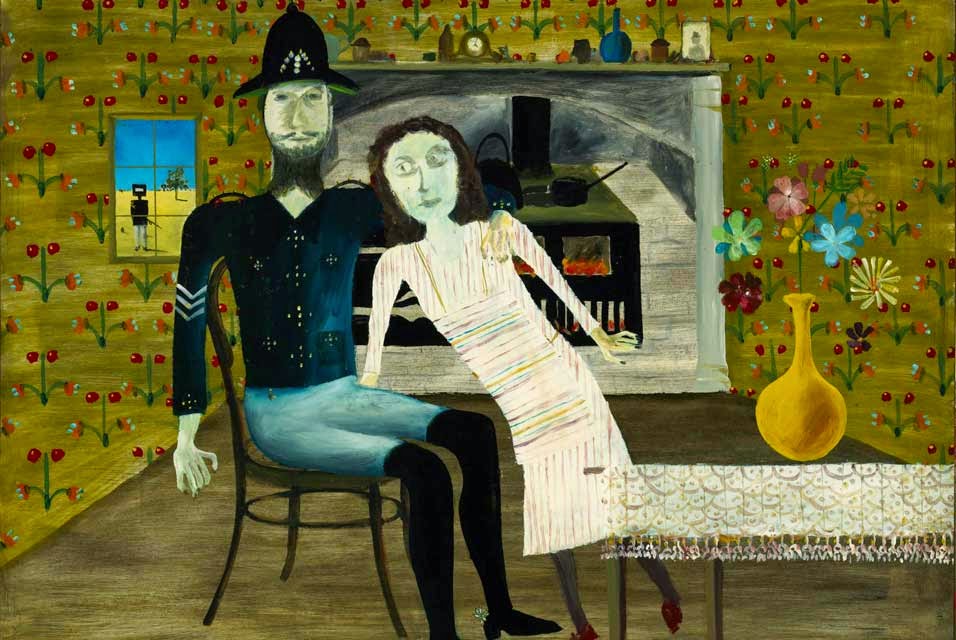
Constable Fitzpatrick and Kate Kelly by Sidney Nolan 1946
Anthony says the story Harrison was told was left at this for a year or so, then George brought up the subject of his wife again. A police inspector had visited to tell him she had been involved in a closing-time brawl outside a public house and that she was now known to the force as a common prostitute. In the circumstances, the friendly officer said he would be well advised to institute divorce proceedings: the magistrates came down very hard on men who had come under suspicion of living on the immoral earnings of their wives. George, HG was told by Frederic Harrison, hired a private detective for two weeks, but he could not move towards a divorce because the detective had seen nothing that could by any stretch of the imagination have been interpreted  as evidence of misconduct. (If you want to read my posts on this incident, cancel all calls and appointments and turn to Commonplaces 35, 36 and 37.) It was this small point that had made Harrison, whose confidence in Gissing had been slowly oozing away, lose faith in him altogether. The detective's report was simply unbelievable if the woman was really earning her living as a streetwalker.

This version is at variance with the letter of September 24th 1883 that George wrote to Algernon:  'I have very loathsome matters to write to you about. I address you as my legal advisor. Bad as they are, they may prove the beginning of a day of freedom for me.
  I was visited this evening by a sergeant of police, who informed me that my wife had preferred a charge of criminal assault against three men, two of whom had been taken into custody, - the other escaping. These two were remanded until next Thursday. He came to ask me what light I could throw upon the prosecutor's character.
  As it proved, the light came rather from him. He told me she was described in the neighbourhood, as an habitual drunkard, well known in all public-houses, & generally regarded as in all respects a bad character. The assault took place at 1.30 am., in a place where business could not possibly have taken her. At the station she wished to back out of the charge; but of course was not allowed to. The officer told me he very much doubted her innocence. In any case, her bad character will go against her. Either the men will be discharged on Thursday, or committed. Of course the case will be in the papers.
Now, you see what all this points to. I think there is little doubt that the man called on me in the idea that I might employ him to collect evidence, with view to a divorce. He smiled at my folly in allowing her a pound a week. Doubtless he will call on me again, &, if he does, I shall certainly make enquiries to see whether I can afford to employ him. He said that he thought the matter would not be very difficult.'

Points to consider:
1) You will see that, in the original letter version, Marianne was assaulted - she was not 'involved in a brawl'.
2) There is no mention of her being outside a public house in the letter. Did George make up this detail to win Harrison's sympathy and poison him against Marianne, by implying she was a drunk? After all, he wanted Harrison to endorse the divorce notion (which is reminiscent of him imagining Henry Hick suggested he divorce Edith (see Commonplace 57). 
3) The detective's report was simply unbelievable if the woman was really earning her living as a streetwalker  - as I have always said, myself.
Floating Iceberg by Frederick Church 1859
George then gave up on mentioning Marianne until he announced news she had died, and that he had saved her from the disgrace of being buried in a communal grave as a pauper by having her put away at his own expense. Harrison fast forwarded his tale to the famous reply George gave to an invite to a dinner.. Gissing's reply informed them that he had given up attending that kind of function. He was no longer living in London, and he was systematically breaking off all his links with educated and monied people... In future he was going to limit himself ... to the lower social level on which he belonged (HG Wells??) . He had found a girl of the artisanal class who was willing to face life with him on the sort of money that was all that he seemed to be able to earn, and he had been married to her for some months. Anthony then goes on to say Frederic Harrison claimed Edith was fourteen when she married George - but we know this isn't true. But, he hinted at more even darker dark secrets - and directed HG in the direction of Morley Roberts for more of that. Morley Roberts was at Owens with George, and so knew him well, HG was told.

Points to consider:
1) In fact, Marianne did not qualify for a pauper's grave as she was married and her husband had means enough to pay for a burial. Again, George claims to be the hero - still, I suppose some might say if he kept claiming he was heroic, why, then it must be true haha. 
2) George moved to Exeter to make sure Edith lost contact with her family and her social group. He was horrified one day when her brother visited unexpectedly because the family were worried about her. This was early on in the marriage - had she written to them about how miserable she was, and how lonely?
Cat on a Clothesline by Jeff Koons 1994-2001

Now, we must remind ourselves that this information exchange between HG and Frederic Harrison happened in 1903 - in the months soon after George's sad death. HG Wells felt (rightly) he had let George down at the end, and he hoped to do some sort of penance by: 1) helping to secure a pension for Walter and Alfred; 2) adding to the Gissing boys' inherited wealth by making Veranilda marketable. He would do this by writing an extended introduction, hoping to sell more copies of George's last book by attaching the Wells (very popular man of the moment) name to it, and hopefully, get people to read the Gissing back catalogue as well. HG had already written a glowing report to Edmund Gosse (to pass on to the prime minister) saying what a good fellow George was, slightly misguided and naive but, deep down sound as a pound.

At the time he wrote the rough draft , he was almost sure it was all true. He consciously employed a certain amount of creative flair, but he was trying to secure that pension and royalties for the boys to see them get a decent education. He did not give a full and honest account because he was doing a favour for a friend - though it was the sort of  'jobbery' George said he despised (!). But, after Harrison gave him the deeply unsettling version, HG wanted to write a more authentic account for the Veranilda introduction. It was with this in mind that he sought out Morley Roberts. (You might recall, much later - 1912 - Roberts was to produce his own account of George's life in 'The Private Life of Henry Maitland'.) Anthony West has some very interesting things to say about Roberts' version of George's life, which is of huge interest to us, because it varies from the version Roberts subsequently offered up in Maitland. Remember, many Gissing biographers rely on Roberts when they want to portray George as a victim of circumstance - whilst deriding Roberts as a fantasist literary wannabe getting fame on a greater writer's reputation. These biographers cherry pick details from Maitland to support their contentions that George couldn't help himself at Owens - him stealing was all Marianne's fault because she was a drunken whore who did her best to ruin his life but he heroically rose above it to reinvent himself as a flawed genius. Guffaw!

Anthony writes: To say my father was upset by what Roberts presently told him about the first marriage and its origins is to put the matter mildly. 


JOIN ME IN COMMONPLACE 60 - FOR PART FIVE AND WHAT MORLEY ROBERTS REALLY SAID ABOUT GEORGE AND MARIANNE. AND SYPHILIS.


Friday, 3 April 2015

Commonplace 58 George & His Alter Ego: Bad George Gissing PART THREE - What HG Wells Told His Son.

We've been looking at Anthony West's biography of his father, HG Wells: Aspects of a Life (1984), which gives a unique insight into George's life as seen from the perspective of one who knew him well and 'in the flesh'. It is a fund of recollections of things his father said about George - about how HG reconsidered the basis of their friendship after hearing of how George lied and deceived some of those who considered themselves to be his friends; at learning how secretive he was, and how selfish - and perverse. HG was a much simpler soul than George had ever been and so it came as a shock to realise he didn't know George all that deeply - and the person he got to know in life wasn't much to his taste, after all. All direct quotes from the West account are in blue.
Deer's Skull With Pedernal by Georgia O'Keeffe 1936 (a pedernal is a mesa/hill) 
HG's famous line about George having: 'spent his big fine brain deprecating life, because he would not and perhaps could not look life squarely in the eyes.' is a good, and even-handed, description, but somewhat lets George off the hook.

The friendship between the Wellses and George was about a year and a half old when Gabrielle Fleury arrived on the scene. Wells, at first, disapproved of this complication to George's existence - after all, he already had a woman in his life - a wife he was trying to drive insane - and he had already abandoned his two sons to indifferent situations, with one living where he wasn't wanted, in Wakefield; the other in the care of his allegedly mad mother. George and HG fell out (the exact letter from HG's side of the debate is lost - on purpose, no doubt recycled into the waste-paper bin!). But, the friendship survived and George did a flit to France and turned his back forever on his boys and his family. Running away from responsibility was always a Gissing favourite ploy - some might say he ran away from success for the first time by stealing from coat pockets at Owens - and then just kept on running.

HG disapproved of the flit, not on sexual/moral grounds (that would have been a bit hypocritical!), but because he wanted to know how George was going to pay for it all - two sons, a wife and now a new household in France - he was concerned George was being reckless with the lives of so many people who relied on him. It was clear George was no longer at the peak of his powers, and was not exactly all the rage, so future income was uncertain. HG strongly disapproved of the way George had virtually abandoned Walter and Alfred, especially when their mother became increasingly mentally unwell. Did George see the irony in HG's 'Mankind in the Making' - the reference to what HG would do to the parents of 'neglected children' - a footnote in the Letters of GRG & HG reads: 'In respect to the problems of neglected children Wells recommended that parents be made debtors to society for the adequate care of their offspring for twelve or thirteen years. In case of parental default the children were to be removed, and the parents were to be billed for the cost of suitable maintenance. If parents failed to pay, they were to be put in 'celibate labour establishments' to work off the debt'.
Ram's Head With Hollyhock by Georgia O'Keeffe 1935
Anthony writes that the relationship George had with Gabrielle was based on a huge misconception on both their parts - he thought she was a monied minor aristo and she thought he was a internationally renowned writer. Anthony claims his father told him Gabrielle - being a single woman of a certain age - was desperate to marry a writer and spent her days collecting autographs of famous writers - asking for their John Hancocks by post. In fact, George was a very minor writer already heavily out of fashion (was he ever in fashion before he died?) and largely unread; Gabrielle was a female version of George - poor but with middle class pretensions, brought up wishing she was more connected than she was, desperate for some sort of life she thought she might get if she just wanted it enough. According to Anthony, she lied about her cultural credentials and pretended contacts with the French intelligentsia and even laid claim to being 'semis-aristocratic'. George, being the snob he was, took it all as fact. As he was lying to her about most of his life too, he was in no position to moralise! He told her he was a literary legend well known by the likes of Turgenev, Thomas Hardy, George Meredith, Henry James... He wanted to be famous in France and on the Continent in general to cock a snook at the English who had failed to appreciate him. And, though he would not have admitted it to her, he needed a nurse because his health was abysmal, and Gabrielle was obviously a good little carer to her father. Gabrielle appeared to be an easily-manipulated gullible sort who seemingly fell for his downright bizarre cringeworthy attempts at wooing her - some of George's best-penned literary feats are to be found in the letters to poor, desperate-not-to-be-left-on-the-shelf Gabrielle. I say 'seemingly fell', because she obviously wasn't taken in - George's letters to her are so full of  beggings to not be misunderstood, illogical rationalisations and fantastical lies, any woman who could read would see through it and cringe. In fact, to respectfully misquote the Divine Oscar, one would need a heart of stone not to laugh at them click.
Red Tree, Yellow Sky by Georgia O'Keeffe 1952
According to Anthony West, George soon came to see he had made a hideous mistake - It had taken Gissing a little more than eighteen months to realise how thoroughly he had been fooled. By then, Monsieur Fleury (Gabrielle's father) had died, and Madame Fleury (Gabrielle's mother) had dropped into the vacant slot of family invalid, a tactical move that allowed her, or so it seemed to Gissing, to absorb virtually all of Gabrielle's time and energy. It had become clear to him at last that the two women had very little money between them, and that it had never been in Gabrielle's power to win him the recognition in France that England had denied him. He had put himself in a box, and all for nothing. He had also become aware that an avenue of unappetising and possibly humiliating experiences lay ahead of him.
Flower Of Life by Georgia O'Keeffe 1925
This is how George came to arrive back in England in a malnourished state and desperate to get some sympathy (!) from his old friends. After a week with the Wellses, George went to the Suffolk sanatorium where he received the over-feeding treatment, one of many dietary-based cures offered to counteract the 'consumption' (tuberculosis). The term 'consumption' refers to the way the disease 'consumes' the body's flesh and fat, making the sufferer emaciated. Death comes quickly when this process reaches a tipping point and becomes irrevocable - leading to multiple organ failure. You may remember William, George's brother, was a firm believer in 'feeding up' and helped get Marianne aka well when she stayed with him in Wilmslow - by feeding her more than lentils. However, Dr Walker - a TB specialist - found no evidence of phthisis. Weird, no?

Anthony tells us his father, at the time, accepted what George said - which was, that he was suffering from tuberculosis contracted in adolescence and exacerbated by years of poverty and poor diet. As we saw in Commonplace 56, Frederic Harrison lifted the lid on that for him, by saying George was exaggerating... well, lying. He did not live in the direst of poverty - we know in the early days he had an inheritance to live off and a good deal of financially rewarding teaching to occupy his energies - in fact, he turned down more teaching because he wanted to concentrate on writing, Besides, George spent so much time at the Harrisons' meal table, he couldn't possibly have been starving. (Harrison did not say George took home a doggy bag for Marianne - in fact, as we shall see, Harrison hardly knew she existed.) Gabrielle, Anthony says, disagreed with this diagnosis and said she thought George was neurotic and suffered from psychosomatic symptoms including the old Gissing man flu of sore throats, breathlessness, difficulty with sleeping, over-active imagination, all variations of impotence, obsessive fixations, general malaise at the first sign of sun/wind/cold/damp, fear of sand/clay, altitude/lack of altitude, people/loneliness....
Red Hill, White Shell by Georgia O'Keeffe 1938
Anthony also suggests Gabrielle had the wit to realise George was about to do a bunk and leave her. When she returned to France, leaving George in the care of Dr Jane Walker at Nayland, she set about writing long letters to HG to prove George should return to the best place for him - which was by her side. Notoriously, HG eventually grew tired of these letters and subbed out replying to them to his wife to answer on his behalf. HG never really 'got' Gabrielle - he once rather cruelly said she wrote on 'thin paper' - meaning she was common. I have the feeling with Wells he didn't bother himself with women who didn't want to have sex with him - or, women with whom he did not want to have sex - so his opinion of females will always be a bit suspect - to a woman. According to Anthony, HG resented the fact Gabrielle seemed to know George better than he did himself. My father could never, in the end, bring himself to forgive her, not for having had the hardihood to claim that her understanding of his friend was better than his own, but for having been right in thinking so. At the time, nothing could persuade him to the contrary, he had been absolutely certain that no woman could understand Gissing as he understood him.
Cow's Skull With Calico Rose by Georgia O'Keeffe 1931
Anthony says his father and Jane Wells were surprised George went back to France and Gabrielle. but they had already begun reforming their opinion of George, and so did not put up much of a struggle to rekindle the intimacy. George and the Wellses met up in Paris, and Anthony reports: They both thought that Gissing looked seedy and uneasy, and that he eyed them with a mute appeal, as if he was regretting his mistake. The Wellses were doing very well and enjoying their life, and Gissing was not. A gulf was opening between them. Gissing's letters were becoming progressively more guarded and restrained, and on his side my father was beginning to wonder how he had ever had quite such warm feelings for a man who could really believe that the case for thinking of Bacon as the man who wrote Shakespeare's stuff for him needed answering; describe Carlyle's stupefying 'Sartor Resartus' as one of the most important books of the century; and, worst of all, speak of Ruskin - yes, John Ruskin - as the last of England's really great men. To have a go at Sartor Resartus yourself click. Here is a typical line: "Are we Opossums; have we natural Pouches, like the Kangaroo? Or how, without Clothes, could we possess the master-organ, soul's seat, and true pineal gland of the Body Social: I mean, a PURSE?' Which, you will have to agree, is a sound point.
As for Ruskin - maybe George meant some other John Ruskin - and not the one who wrote this Demos-loving sentence: 'The first duty of a state is to see that every child born therein shall be well housed, clothed, fed and educated till it attains years of discretion.' click 
Oriental Poppies by Georgia O'Keeffe 1928
When HG rushed to be by his side at the end, we know he was too late to make much difference to George's state of health - he couldn't kidnap him and repatriate him back home. HG was very critical of what Gabrielle was doing - and not doing - to help, but Anthony makes the point she was worn out with looking after him and Maman, and she was not up the job before that. The more Gabrielle wailed and mourned her own predicament, the more HG seethed at her. HG arranged for a nun to come and nurse George; he tried to take over and forced food on George - countermanding the doctor's instructions to Gabrielle that this would prove fatal. While the two rivals for his love were hissing tensely at each other in whispers, Gissing stared straight up through the ceiling into Gothic Ravenna and holding muttered conversations with its notables. That George died soon after this feeding up was on HG's conscience forever.
Cow's Skull With Red, White and Blue by Georgia O'Keeffe 1931
HG left the death scene on December 27th, because he couldn't stand the grief of George being beyond reach and and beyond help. It was, according to his son, one of the worst moments of his life and one of his deepest regrets to have not been there for George - and for making a hash of things when he had travelled there hoping he might be able to save him. HG wrote this in Tono-Bungay, of Uncle Ponderevo's death scene: 'For a time he struggled for breath.... It seemed such nonsense that he should have to suffer so — poor silly little man!'   My father, present in the narrator's person, behaves very well this time around. He is coolly competent in his organisation of the dying man's sickroom, and he stays with him to be a pillar of support and comfort until he has drawn his last breath.
From The Lake by Georgia O'Keeffe 1924
Anthony gives an account (as covered in Commonplace 56), of being contacted by Edmund Gosse about a pension for the boys: My father's enlightenment came by way of his remorse. He wished to atone for having failed Gissing in his last hours, and it seemed to him that he might go some way towards doing so if he were to volunteer his services as literary executor to the dead man's estate. It was then that Frederic Harrison contacted him with the 'I knew George better than anyone else' letter (see Commonplace 56). HG and Fred Harrison got together to compare notes. Anthony was told that Harrison said: All went swimmingly until, one day, chance brought a young man to the house who had been a fellow student of Gissing's in Manchester. This former student saw George there and told Harrison about the Owens incident. 

JOIN ME IN PART FOUR TO SEE WHAT ANTHONY WEST SAID ABOUT GEORGE'S FIRST MARRIAGE.