Sunday, 28 August 2016

Commonplace 203  George & The Woman Question PART TWO

With images from Leonardo. All direct quotes from George are in blue.
Leda and the Swan 1508
George is often mistaken for an emancipator of women, despite evidence to the contrary in his writing, and the way he treated two legal and one common-law wife. The problem with George is that the evidence is so spread out in various sources - biographies, collected letter, diaries, mostly edited by one person whose love affair with George is so deep and so tunnel-visioned that any objectivity seems impossible. We have the written works and the biographical stuff but who is going to trawl though it all for a truth when a potted overview is offered with the same old half truths repeated ad nauseam for the casual reader to take at face value?

Take his writing on Dickens, specifically, 'Charles Dickens: A Critical Study' (1898). In chapter VII we have George's thoughts on how Dickens dealt with women and children. I urge anyone who wants to know what George really thought about women to read it. He starts innocently enough with an accusation that women are not able to appreciate Dickens. But, in his characteristic lack of insight style, it is actually an interesting insight into what feminists and women with fully engaged critical thinking processes find hard to like in Gissing himself. That is, the disconnect between his claim to be for women and the way he portrays them in his writing. This is not to be taken as a modern world disconnect felt by women who read Gissing now as a Victorian oddity. Gabrielle Fleury had trouble with the things George wrote about women and we find him telling her in one of his letters, not to judge him by his writing: Gabrielle, let me tell you that I recognise no restraint whatever upon a woman's intellect. Don't judge me in this respect from my wretched books - which deal, as you know, with a contemptible social class, for the most part.  Of course, here he is trying to convince her to live in sin with him, so he was desperate to reassure her he was no misogynist, and that he was just misunderstood by a gormless reading public Was she so gullible as to believe him?? It seems so. 
Lady With Ermine 1489-90
In the Dickens book, it is the vehement projectile explosion of bile that George exhibits when talking about women that is most shocking. He kicks off in his unconscious way by labelling this chapter as 'Women and Children', as if the two are joined at the hip. In fact, George regards women as large children - he certainly infantilised his first wife, Nell, and got rid of her when she tried to assert her full-grown self. He became a martinet of such cruelty to his second, that the image of a school bully running unchecked flickers into the mind's eye. Many times, he refers to women as 'undeveloped' and the women he puts centre stage in his stories are very often, to their creator, half-finished creatures requiring severe constraint and instruction - remember, he is the man who said women are not as intelligent as the average male idiot. And so they must be punished. In his stories, we have acid in the face of a beautiful flirt with attitude; suicide for a mother racked with guilt; the death of children following a moment's lapse of duty; fatal disease for a talented singer; unjust prison for a grissette who had the cheek to try and rise above her lot in life - it's George's way of punishing women hard because they both tempted him and shamed him, and never accepted his dominance.   

In the Dickens book, George sees women as superficial, grasping, ignorant and intellectually inferior. He starts out saying that Dickens' women are never fully formed and so this makes it clear Dickens was writing for a predominantly male readership, who are more interested in the doings of the male characters. He elaborates that women, can't 'get' Dickens, based on his assertion that Dickens included humour, and very little of what is conventionally called tenderness, and a good deal of bloodthirsty violence. He reminds us that George Eliot couldn't fully revere Shakespeare because of what he did with and to his female characters, and so women will judge Dickens similarly because his women characters are nondescript, ludicrous and grotesque, and he doesn't flatter them. 

George goes on: we need not be surprised that average members of her sex should see in Dickens something like a personal enemy, a confirmed libeller of all who speak the feminine tongue.  And there we have it - George however facetiously, creating a chasm between men and women by claiming women speak another language to men. And, we know he means an inferior language, don't we? It's this kind of casual misogyny that undermines anyone's claim that he sported pro-feminist credentials.   
Belle Ferronniere 1493-4

He goes on to consider the gallery of foolish, ridiculous or offensive women and says Dickens places them in the lower middle class social strata. This was George's own class, it must be remembered, because his father was a petite bourgeois shop-keeper and the Gissing boys - and later, George's own sons Walter and Alfred included - would never have been as well-educated as they were if not for public funds being made available to pay for their schooling. George goes on to write: ...it is obvious that Dickens wrote of women in his liveliest spirit of satire. Wonderful as fact, and admirable as art, are the numberless pictures of more or less detestable widows, wives, and spinsters which appear throughout his books. 

George is assuming that these Dickens women are rendered as figures of fun because their creator is looking down on them. But Dickens was a friend to the lower, and lower middle class and the grotesque men and women he mingled with in his childhood and early adulthood were what inspired him to write his books - so we have in Dickens, but never in Gissing, an affectionate tribute to the awfulness of human nature, much as the television soap opera and sitcom give us characters who are exaggerated for comic effect. George had very little humour in him (a sure sign of a stunted intelligence) and he certainly very rarely saw the funny side to anything. Dickens, however, knew that people love to laugh at the worst in themselves as long as it is presented as being in other people as well. George may not have wanted to take a side on any big social or political issue but his prejudices leak out in his misreading of Dickens' homage to the gruesome and grotesque because he, unlike George, never makes his observations female-centric - all his grotesques are gender-inclusive grotesques. For George, his misunderstanding is that he sees Dickens' women characters as grotesque because they are female; for Dickens himself, it is because they are human, and we are all, male and female, sometimes a little bit grotesque.  

Of course, we must consider that George was really, first and foremost, afraid of women. He was scared of his mother both physically and emotionally - she was a believer in corporal punishment of children and she seems to have been emotionally indifferent to him (according to him). He was afraid of his first wife, Nell, because she was sexually attractive and he was powerless to resist either her real charms or the charms he conjured up and foisted upon her; the only way out of that was to kill her off by neglect, slowly, relentlessly, heartlessly, un-heroically. He was afraid of his second wife Edith because she knew his secret - he had syphilis - and because she was not the shrinking violet he had tried to make out of Nell. Edith stood up to his bullying and cavilling, but eventually was driven mad by it. He was afraid Gabrielle would not accept his proposal of faux marriage and told her a pack of lies to convince her to make the ultimate sacrifice for literature (and his nursing needs), whilst failing to deliver the goods in the literature and the marriage bed departments. He was afraid of Gabrielle's mother because she ruled the roost - a roost he saw very much as his and his alone - and whined on about the power struggle he hadn't the balls to win. The only time he isn't afraid is when he conjures women up out of thin air, and that is why he treats these characters so mean - revenge, with no consequences! 

George will have been familiar with the 'woman question' Charles Dickens enjoyed, When he was first married to his legal wife, Catherine Hogarth, Dickens fell in love with his much younger sister-in-law, Mary, who sickened, grew worse, before dying in his arms. He was distraught enough to endure a bout of inertia and writer's block after that. Later, when on holiday in Broadstairs, he fell for Eleanor Picken, a friend's fiance. To demonstrate his love, he tried to drag her into the sea to commit suicide together - no doubt a romantic gesture - which, naturally, scared the bejesus out of her. Another sister-in-law came to live with his family, and he took a shine to her. In 1846, encouraged by the heiress to the Coutts banking dynasty, Dickens was asked to help found a home for fallen women. Oddly, this was known as 'Urania Cottage' - both words are terms used in the homosexual vocabulary. 'Uranian' love was a form of 'healthy, zestful' homosexuality, according to the Uranians themselves - see Commonplace 8 for more on the Uranians. Anyhoo, when Dickens was 45 he met and fell in love with 18 year-old Ellen Ternan, an actress. He dumped his wife and never spoke to her after he moved out to live in secrecy with Ellen, even though Catherine had the children to raise and she lived just round the corner from him and his common-law partner. Ellen bore a child who died in infancy, and when Dickens died, he left Ellen an annuity to see out her days in comfort. 

La Scapiliata 1508

Maybe George got his fatherly role model for how to treat his womenfolk from Dickens - both were attracted to younger models, not afraid to break their hearts and abandon them, hoping money would sort out any emotional disturbance. Both were attracted to the grissette, and dabbled in rehabilitating fallen women - though George's dabbling was possibly more 'hands on' - and the less sincere for that. And, like Dickens, George destroyed all his correspondence and diaries for the most powerful of his emotional attachments - the one he had with Nell. 

As a post script: George's work on Charles Dickens included the reworking of 'Forster's Life of Dickens', one of our man's late successes. John Forster was an influence on the Woman Question in his own sinister way. Join me in the next Commonplace to learn more about this man.


Sunday, 21 August 2016

Commonplace 202  George & The Woman Question PART ONE

With Pablo Picasso portraits of Dora Maar.

'It's all very well to be womanly, but don't be womanish', Dyce Lashmar, the eponymous Charlatan tells his betrothed Iris, when she seeks reassurance that he loves her. She carries on asking for the words that will prove he is totally committed to their marriage. 'You're not sorry you're going to marry me?' she asks, forlornly. 'You're getting hysterical, and I can't stand that', he replies. When scholars say George put himself into his novels, don't forget a large chunk of him went Dyce Lashmar's way.
1936
George had some fairly awful things to say about women. Despite his claim to be for their emancipation, his ideas for this seem to be centred on doing away with regional accents 'norf' click (London, in particular) and getting wives to agree to living apart from husbands whilst still making themselves available as facilitator for a husband's sexual needs, or whatever else they could be used for (sewing, housework, an effective wind break). The inner lives of women were a mystery to him, and his female characters are pale and superficial types rather than real people with real ambitions and intellects.  

George was hard on his heroines in ways he wasn't on his heroes and always made sure the female character's story arcs involved some sort of comeuppance. His women are never allowed to rise above their social situations as home-makers, nurses, mothers and concubines. Here is a random selection:
Clara and her destroyed beauty (the vile act done by another woman) in Nether World; Adela having to marry beneath her in Demos; Iris (see above) and the run-around from Dyce Lashmar in Charlatan; Alma Rolfe humiliated over her dream of being a concert violinist and then being treated as a whore by Cyrus Redgrave in Whirlpool; Ida Starr for being a working girl in Unclassed; Rhoda Nunn for thinking she was above marriage, and Monica for marrying above her station in Odd Women; Marian Yule being rejected by the odious Jasper Milvain in New Grub Street. Read any book of George's, and there you will find these poor, abused females - even Henry Ryecroft has this description of a non-person housekeeper: '... she is low-voiced, light-footed, strong and deft enough to render me all the service I require, and not afraid of solitude'. Some men compartmentalise women into functional categories, based on usefulness more than any other factor. Looks and sexuality are useful functional categories. The advantage to this system is that a new model can always be acquired when the old one no longer performs its function to the man's approval. Although I refute the claim Marianne aka Nell was ever a prostitute, you can see why George might have found the grisette fantasy (or, tyranny, from the woman's perspective) so appealing. If George had visited Japan, he would have visited the geisha and thought he was following some ancient tradition worth endorsing.

1937
And, then there are the non-fiction writings. Why, oh why does he do it? And where did all this 'wisdom' come from? We are not speaking of the random thoughts of a seasoned ladies' man here - at most he will possibly have slept with someone before Marianne, probably Marianne, definitely Edith (twice) and possibly a lodgings landlady and maybe Mrs Gaussen, though I tend to think not. He certainly never slept with Gabrielle. Add to this the women he knew but not as partners - three family members, in his two sisters and  mother, and Clara Collet, a woman of indeterminate sex to him as she was not his type. Peppered along the way will have been literary men's wives: half a dozen at most. This is the basis on which George could say he had made a serious study of the female psyche and had emerged as an expert. Reading about women was probably the most common source of his information - despite what he says about journalism, George was an avid reader of all kinds of newsprint, and many of the incidents in his books may have been lifted from real life or its equivalents as reported in the press, which is why some of them are almost written as if said in passing with very little emotional affect attached. 

Let's look at some of the entries George made in his Commonplace Book under the heading 'Women'. We presume these were the meaningful to him noodlings he jotted down to keep for future reference, very much as one might do if she devised a witty and informative, slightly irreverent, highly entertaining and visually absorbing blog intended for the serendipitous reader to fill an idle five minutes. Oh, dear. You just remember these the next time someone tries to tell you he wasn't a misogynist! 
Hatred between men is not common, & when it exists is due to the most various causes. Hatred between women is universal, & always due to one common cause - wounded vanity. 
Herodotus begins his history with a search for original cause of quarrel between Europe & Asia, - and finds it in Woman. Perhaps, as Heine suggests, symbolical of all history.
I have never discovered any greater tenderness in women than may be observed in men, but I have often been struck by the superior energy and pertinacity of their hatred.
I want to be kind, because I have a great affection for the annoying old fart, but, really... George what can you have been thinking of? Which goggles were you wearing when you wrote these egregious things? Oh, I remember: the Arthur Schopenhauer ones. Go look up Commonplace 4 and read how much is filched from Arthur.
1939

Where do we start?

'Hatred between men is not common'. I actually had to reread this the first time I saw it because I thought there was a typo, and should have read 'Hatred between men is not uncommon'. Even in his cloistered surroundings, George would have been aware of the various conflicts besetting his world. In George's lifetime the British were involved in 16 wars or military campaigns. As most of these involved us Brits stealing land off indigenous peoples, might we not assume hatred was engendered, and have we not been reaping some of that whirlwind ever since? What sort of hatred is he talking about? Didn't Roman and Greek men hate their foes? Maybe he feels covered by the vagaries of 'various causes', but that makes for a paltry argument.

We move on to hatred between women. I am wary of any claim to an absolute in opinions - rank total generalisations say more about the speaker than the subject. Is there hatred among women and is it 'universal'? And, if it exists, does it ever involve 'wounded vanity'? I hate no-one, but, if I allowed myself to imbibe, I can't think of a single woman who would be in my 'Top 10 People To Hate' list - because those places would be taken up by men. Cruel men. And, if what George says were true, why do so many women have lifelong female friendships of deep mutual trust and joy? Besides, women are too busy hating their oppressors to hate other women; and their torturers and their victimisers - these are invariably men require what hatred is left over. I think wounded vanity is the last thing that comes into the rape victim's mind when she hates the rapist. I think this is a case of George loquens stercore.
1941

'Women are to blame for the woes of Europe and Asia'? Yeah, right. ISIS and the Worldwide Caliphate were thought by women, weren't they? click

Women no more tender than men? Possibly, because compassion is not a gender-biased trait. But women having superior energy and pertinacity of their hatred? Do women hate for longer and with more vigour? Well, women have a great deal to hate men for; but we know we don't have exclusive rights to being kept in servitude, or being regularly abused, tortured or murdered, treated as inferiors and betrayed by powerful men who are vicious, inadequate, arrogant, violent, cruel and spiteful. We know some men are in a similar position. Do women have much longer memories for transgressions against us? Was Edith's hatred stronger than George's?  Or, maybe it was that she was an authentic communicator who felt entitled to speak her mind, whilst George was... not. She did have a lot to hate him for. She was married under false pretences, he no doubt destroyed her self-esteem, threw her off when it suited him, deprived her of her child, used strangers as a means of control over her life, gave her syphilis and eventually drove her insane... good reasons to hate a man, I suppose. But did she hate him or was she just angry with him? I doubt if George ever listened to her feedback or complaints in a constructive way or credited her with much feeling - being as how he saw her as an inferior on every level, and really not mother material, just sex receptacle. As we only have George's account of his time with her, how can we know what really happened? Never be fooled into thinking Edith was anything but collateral damage in George's so-called heroic life, and thus she was genuinely deserving of our sympathy.


JOIN ME IN PART TWO TO LOOK AT WHAT GEORGE SAID ABOUT CHARLES DICKENS AND WOMEN CHARACTERS.

Saturday, 20 August 2016

Commonplace 201  George & His Mother

George claimed he had a conflicted relationship with his mother. She was a remote but immensely powerful presence throughout his life, and, after his father died, she was the one he would naturally turn to for validation of his innate good qualities. If she were the sort to withhold affection that facility for giving positive feedback might not have poured forth freely. However, that is not an exclusively female problem - many fathers find it hard to admit affection or are never spontaneous in their skill with praising offspring. George, being one of five will have had to compete with others for what their mother had of affection to give, but from the Henry Hick account of the boy in the cupboard, she was a strict disciplinarian, and George might have been physically frightened of her, as many children are when parents assault them in the name of doing them good.

Mother
George's father seems to have been more intellectually sophisticated than his wife; her main interests were in the domestic realm, and she was not part of Mr Gissing Snr's round of poetry writing, public office and botany. She was also a woman of staunch Christian religious views, but the tolerance of Jesus towards transgressors does not seem to have percolated down to her child-rearing attitudes. When Jesus talks about not hurting others, Mrs Gissing must have pencilled in 'unless they are helpless children' into her copy of the Bible. It is hard to reconcile the claim to piety with a tendency to cruelty, but Christians do worship torture and cruelty, don't they, in their preoccupations with the sufferings of their main man, hideously murdered and publicly displayed as so much dead meat.

What sort of a woman was she? She married Thomas Weller Gissing on February 7th 1857. George came along nine months later. She was the daughter of a solicitor's clerk, he was a shop-keeper chemist with aspirations. George's biographers are hard on her, assuming her life was drab and mundane and that she was ill-educated. The life of a lower middle-class woman in the late nineteenth century is often mistaken as being some sort of cultural wasteland or intellectual limbo, but how true is this? Women who did not have to work for a living - because those who worked lacked the energy for a fulfilling inner life - had to make a world within a world of their homes, so it seems a little bit shallow of biographers to think this was a waste of a life, or criticise a woman for being a home-maker when there weren't any other options.
The Child's Bath
by Mary Cassatt 1893

Running a household is never easy. In an age before domestic electricity and labour-saving gadgets, much of the housework was hard and constantly in need of being repeated as coal or even gas are the enemy of cleanliness. Servants did the bulk of the work, especially the heavier stuff, but running a house well was no mean feat and required eternal effort. The finances would have been the mother's domain; getting value for money, and knowing how to budget were key roles in which a husband would never have involved himself. The burden of pregnancy and childbirth would have been a priority, as would nursing ailing children and caring for the family's general health and wellbeing. Crafts such as needlework, gardening, decorative arts and elements of the cooking and cleaning would have occupied her time. Only someone who underestimates how much work goes into running even a modern home would think she frittered away whatever qualities and skills she had on meaningless activity. Supporting the education of the five children and church activities would have taken up time and energy; there is no reason to suspect Mrs Gissing did not have a role in the wider social needs of the Wakefield poor, even if she was not as much of a Liberal as her husband. But she would not have been unmoved by the Christian duty she was signed up for - it was all part of the 'noblesse oblige' of the aspirant middle-class. Furthermore, such charity work sends a clear message to your peers that you are in a strong position over the weak, and not likely to be confused with them. A point to remember, is that she read and praised New Grub Street so perhaps she was not the uncultivated mind some prefer us to think she was.

Her relationship with her offspring seems to have been close, inasmuch as it was willingly maintained by all of the children. The girls, obviously, were the ones who spent most of their time with her, but William and Algernon probably got their fair share of attention. Mrs Gissing hastened to William's side to nurse him in what was to become his final illness - of the boys, he was likely to be her favourite as he was always doing his best to be an upright and independent decent young man - with some success -  and Algernon had a touch of the erratic of George in him, making him a constant source of worry, mainly because he seems to have been disabled by low self esteem and anxiety, and could never make his way in the world without support. In fact, he was lucky to marry a tower of strength who kept him on the straight and narrow. George will have been envious of Algernon;s success in a realm that George could only fail in.
Portrait of Florence Owens Thompson and Her Children by Dorothea Lange 1936
In this informative piece about the mother/son relationship click, Patricia McBroom suggests men have to distance themselves from their mothers in order to conceive of themselves as 'real men' and not 'mama's boys'. This forces men into denying the bond they have and the emotional needs they feel for their mother - is this what George was going through when he told Mrs Gaussen he hardly knew his mother? Of course, this might have been making a play for Mrs Gaussen's sympathy or even a veiled request she step into the role as surrogate parent. But, perhaps he closed his heart to his mother, and from an early age. In a desperate attempt to identify with his father - who spent so much time out of the house and away from his wife that he was almost an absence - he might have told himself her input didn't count; likewise, neither did her opinion of anything George and Father valued.

The Sleepy Baby by Mary Cassatt 1910
When their father passed away, sending the boys away to school, starting with George, was not the work of a monster, but borne out of the reality of knowing they stood a better chance for a decent aspirational future if they could get a more focused and academic training. Mother will have been relieved to see how well George did at school - and then to be accompanied by his two brothers must have been a source of pride in a job well done in raising three such healthy, able children.

Whatever the state of their early relationship, Owens must have driven a horse and cart through it. First, there was the unforgivable act of stealing. This will have been a great source of shame to every member of the family (in Commonplace 11, I suggest it was the root of Algernon's failure to launch). The gossips of Wakefield may have never known what happened, but there was always the fear of someone finding out about the jailbird in the family. When George was an established writer, this fear would have been stronger as he was a celebrity of sorts and people would be extra curious about him, maybe even seeking Mrs Gissing out to discuss her son's books.

Did George's mother ever look to him to become the man of the house? That might not have happened, as George was (according to Gabrielle) deeply impractical and generally useless at dealing with small challenges. William seems to have been the one to adopt that role, despite George having to take it on after Will died, albeit only in the symbolic act of financial and academic support to his siblings. You have the feeling with William that he was forced to grow up very quickly. That year when George was gallivanting in America would have shown Will he had to sublimate his own desires for a career and get a dreadful job in a bank, not to bring money into the house, but to be one less of a burden on his mother, and to prove to one and all he was the responsible patriarch of the family, and not a wrong 'un to anyone in Wakefield who judged the Gissings by what happened at Owens. Subconsciously, Will had to demonstrate he could be trusted with other people's money. We should not underestimate the symbolism of Will in a bank being honest with money, and Alg being a solicitor and upholder of the law. And it probably accounts for why Will worked in Manchester and nowhere near Agbrigg, and Alg became a nomad.

Mother and Child by Henry Moore 1953

It is hard for anyone who hasn't experienced something similar to fully grasp how disabling it was for the whole family to have George known as a disgraced jailbird thief. There is an immense level of fear of exposure, added to the shame at the amount of lying you have to do to cover your historic tracks. The family will have contracted and become inward-looking, probably choosing to socialise with very few known and trusted friends, rather than branch out and form new attachments. In addition to this, George's mother will have been concerned at the long-term influence it might have on his siblings, being especially fearful that all their marriage prospects may have been compromised. With George gone so spectacularly off the rails, she may very well have wondered who would marry her children, because whoever it was would have to be taken into the family secret. Is this why Madge and Ellen never married?
Mother and Child With An Apple 
by Angelica Kauffman 1763
George seems always battled with Motherhood. There were the years spent battling Maman Fleury over dinners - which was George doing battle with the Dragon of Motherhood in general. Much of his wrangling with Edith was about her style of mothering their children and her failure to mother him as man-child. Gabrielle was a mother substitute and that is very apparent in the infantile way he reacted to her and demanded unconditional love from her, which eventually developed into petulant resentment on his part; Marianne must have mothered him or she would not have asked Will to write to him (whilst she was staying in Wilmslow) about where his socks could be found, and when to water the plants. HG Wells famously said he never met a man who needed mothering more than George (unless that was a typo and there is a missing 's' haha!). Much as George always feared his mother, when she hadn't written for a while he always asked Algernon to prompt her into action - 'I would be grateful for a line from mother', he once wrote, plaintively
.

Sunday, 14 August 2016

Commonplace 200  George & His Return From Exile in America PART TWO.

With images from Frida Kahlo.

When George returned from America, he had no immediate prospects and no specific plan as to how he was to earn a living. When he arrived unannounced (except for a note delivered by the boy he roped in to take a hastily-written message to his mother), he probably had limited funds. Maybe his first port of call was to borrow from his mother, who was hardly in a position to refuse and maybe this is why she was seriously underwhelmed to see him and only offered one night on the couch before he had to depart for London, Dick Whittington-like, minus the cat click.
Self Portrait With Thorn Necklace and Hummingbird 1940 
It has been suggested George's mother considered him a very real moral threat to his sisters, as they were young children who lived at home. The girls' reputations were also at risk - George was a convicted thief, guilty of the sort of petty crime middle class people assumed was only perpetrated by the working class. When he returned to Wakefield, there was no reason to assume either of the Gissing girls would remain single in their adult lives. If prospective suitors knew about George's crime spree and prison record, the girls' marriage chances may have been adversely affected. As neither married, maybe that is what happened.

William, the second son, was working in Manchester in a bank when George came back. It's worth remembering the young man had to look for work far from his home town so as to escape anyone assuming he was as light-fingered as George. On the return, William did his best to offer George support to get him on his way to a meaningful and productive life. He was much poorer than George and had fewer options for ever earning more himself, and the chance of him ever doing what he really wanted with his life - he loved music - was negligible. In a letter to George dated October 29th 1876, he writes about his wages and expenses. With echoes of Dickens' Mr Micawber, William tells his brother that there he experiences a fiscal deficit every month amounting to 5 shillings and fourpence (which presumably their mother had to make up). This left nothing for treats or buying books - George would never have settled for that!
Self Portrait as a Tehuana 1943
What William could give for free was advice and guidance, of the sort an older brother usually gives a younger; but the boot was on the other foot, because William was the more mature of the two. Without a father to guide them, they were left to their own character-forming moral devices, and William knew George was incapable of admitting he was wrong about how to lead his life. He had wobbled off the righteous path, and William stepped in to raise his awareness of other ways life could be lived.
The Two Fridas 1939
William was a pragmatist at heart man who summoned up reserves of determination and self-discipline to get the most out of his limited options. He was devoid of self-pity, at least in the published letters we have on record. (How different he was from George!) When he discovered the work of Samuel Smiles, William shared it with his older brother, probably knowing full well George would never be humble enough to listen to a Scottish author who recommended a life of thrift and self-control as a way to happiness. William read a few of Smiles' books, including 'Self-Help; with Illustrations of Character and Conduct', published in 1859. Some of it will have chimed with the way the young bank clerk was forced to lead his life, but he was able to critique the book and see its limitations. Who knows what George's health, life and career would have been if only he had the humility to seek guidance from someone who was not an ancient Greek poet or a Classicist, but a doctor of medicine. 

Smiles was also a reforming politician to the left of centre, who advocated change in political systems to incorporate the needs and aptitudes of ordinary people. In 1845 he had delivered a speech on the educating of the masses, something George claimed to be interested in. Here is a flavour, lifted from this source click:
 I would not have any one here think that, because I have mentioned individuals who have raised themselves by self-education from poverty to social eminence, and even wealth, these are the chief marks to be aimed at. That would be a great fallacy. Knowledge is of itself one of the highest enjoyments. The ignorant man passes through the world dead to all pleasures, save those of the senses ... Every human being has a great mission to perform, noble faculties to cultivate, a vast destiny to accomplish. He should have the means of education, and of exerting freely all the powers of his godlike nature. (And of the ignorant woman?) 
Wounded Deer 1946
One of Smiles' basic beliefs was that poverty is often caused by habitual improvidence. George was often guilty of this as he had trouble prioritising his resources, spending improvidently on expensive books, bookcases, writing desks and chairs, cushions... and tobacco whilst pleading poverty and forcing his first wife to eat lentils and dried food. The message George might have gleaned from Self-Help was that people often abdicate responsibility for their own predicaments and could improve their prospects by self-discipline and application of principles of what we now term 'mindfulness'. In this he differed widely from the sort of tosh George was reading, especially the works of Schopenhauer who more or less put forth the idea, in a distortion of Buddhism, that struggle is pointless as we are all doomed. If nothing else, Smiles was an advocate of optimism, that thing George so despised. However, this might have touched a nerve: 

Labour is toilsome and its gains are slow. Some people determine to live by the labour of others, and from the moment they arrive at that decision, become the enemies of society. It is not often that distress drives men to crime. In nine cases out of ten, it is choice not necessity. Moral cowardice is exhibited as much in public as in private life.

William encouraged George with his writing projects and never ceased to be a rock on which George could stand. In October 1877, he wrote to reassure his brother that, in time of need,  Anything however small which I can ever do shall never be withheld. It might have been a different long-term outcome for William if he hadn't had to find for himself living miles from home; the daily grind of the bank with its very long hours, the travel to work in all kinds of polluted air, the dreadful cold over winter, and William's poverty must have contributed to the decline in his health. He talked about trying for a place near Wakefield (possibly Leeds) in order to make his circumstances a little easier. Perhaps he had a premonition that he would need his family's physical support as he was already doomed to an early death. Eventually, illness forced him to leave the bank and he tried to make his way as a music teacher. Towards his end, William kept away from Wakefield because he was still thinking of a life as a music teacher; his eternal optimism kept the true seriousness of his illness an unknown quantity. He died suddenly of pulmonary embolism at his lodgings in Wilmslow with his mother in attendance, on April 16th 1880. George did not attend his funeral - we should presume because he was too grief-stricken. In losing Will, he had lost his main supporter and the one person who might have helped him with advice worth listening to - someone who knew him well enough to cut through the bullshit George threw out. 
Me and My Parrots 1941
William was especially fond of George's wife, Marianne aka Nell, who seems to have been fond of him in return. Their relationship flies in the face of all those biographers who insist she was an alcoholic reformed whore, and yet claim that William was a prudish reactionary. Would such a man have befriended such a woman when the good name of the Gissings was already in the dirt? See Commonplaces 109 and 110 for more on the very likeable William Gissing. 

Saturday, 13 August 2016

Commonplace 199  George & The Return From Exile in America PART ONE.

With pictures from this summer's Royal Academy exhibition of David Hockney portraits.

After George set off for his year and a bit in America, it was clear he had some work to do on building bridges with his family in Wakefield. His mother was particularly affected by his fall from grace; probably the last thing Mrs Gissing was expecting from life as a widowed mother of five was that her first born would become a convicted thief and jailbird. Nothing in her life experience would have prepared her for the level of public disapprobation and shame that she must have felt.
Mr Hockney
News of the trial and conviction would not have been easy to keep within the confines of a few close Wakefield friends, family and supporters. Manchester had been rocked by George's crimes because Owens College was already considered a hotbed of sin thanks to the fact its students had no accommodation provided by the college. It was feared anarchy and licentiousness would be the outcome - after all, the students were all young and healthy, and they came from comfortable backgrounds that gave them enough money to spend on the basic requirements of life - and that, to the young, (and in the words of the Beastie Boys) means they would fight for their right to party. And it seems George did his best to live up to that creed. In fact, he rather exceeded his remit, hence the four weeks of hard labour. His old school at Alderley Edge, where his brothers William and Algernon were still boarding were up-to-date with developments and the stress caused by the scandal must have been intense. Any pride they had in George's achievements will have withered under the constant knowledge they were being judged by their brother's misdeeds. Wakefield tongues will have wagged.

George probably agreed to a period of self-exile in order to atone for his sins, but was there ever any real chance he ever intended to stay in the States? No doubt historical accounts of Charles Dickens enjoying unqualified success on book reading tours could have created the naive belief that America was culture hungry enough for any English would-be writer to rock up and wow them with his words. Dickens was famed for bringing his characters to life with his superior acting skills and ability to create a magical scene with nothing more than mood lighting and excerpts from his stories; his readings were enormously well received - much as the Divine One, Oscar Wilde's would be in the 1880s. At Owens College, George had something of a modest reputation for acting/recitals of bits of Shakespeare - a skill for showing off not usually associated with the George we all know and love. He often subjected his house guests (and sometimes, pupils) to readings of Homer and the poets he admired, whether they wanted him to or not. Maybe George thought he could make use of his performance skills and this led him to thinking he could follow in the great, deceased author's footsteps.
Barry Humphries 
There is a bit of magical thinking in the young George that he might be the natural successor to Dickens, but the potential reading public, boosted by the rise in literacy brought about by the provision of education for the masses, was enjoying reading as a more solitary pursuit. This meant they didn't need to huddle round a periodical to group-read the chapters of the latest best seller. And novels were going straight to three-parter editions available on loan from a lending library, so expensive buying of weekly or monthly magazines was reduced. A constant factor in George's magical thinking phase, not fully exorcised until his last years, was the mistaken belief that if something looks easy (as in writing internationally acclaimed and adored novels full of whimsy and pathos, drama and suspense) then a smart fellow like himself could do it, too.
Edith Devaney 
In 1876, George must have set off from Liverpool on the Parthia imagining a triumphant return to England at some not too far in the future date when he would be carrying bags of gold and trunks full of literary prizes and book deals, all underpinned by conspicuous smugness at having overcome any negative views of his decision to break the law at Owens. With determination, ability and luck, that might have happened; however, it would also require hard work and George was never really cut out for that sort of thing. Maybe he thought aptitude was enough, but, as Picasso said, inspiration will come but it has to find you working. Dickens was a prodigious worker when he had deadlines to meet - most of his work appeared in serial form, so editors and readers could not be fobbed off with excuses for lack of work turning up on a regular basis. George was more lackadaisical - and that is no bad thing. It was the immortal Douglas Adams who said: I love deadlines, I like the whooshing noise they make when as they go by.
Celia Birtwell 
When he made a reappearance on October 4th 1877, it was with his characteristic self-centred thoughtlessness. He had not informed his mother that he was returning, and he went directly from landing at Liverpool to his home in Wakefield to his unsuspecting family. In the first volume of the Pierre Coustillas biography, we have the suggestion George travelled from America under an assumed name (unless I am reading the Frenchman's English wrong), as 'Mr Kitchling' but he then adds this might have been a clerical error. Is it likely George Gissing could have boarded the ship without some form of ID, or that the name Gissing could be clerically errored into Kitchling?? Fanciful stuff. Anyhoo, there is this quoted from Alfred Gissing, George's younger son:
The family at Wakefield was surprised one evening by the delivery at the door of a note in Gissing’s writing. It turned out that in order to prepare the mind of his mother for his sudden appearance he had scribbled an explanation, and got a boy  to deliver it for him, whilst he waited at the corner of the street until the latter returned. His brother Algernon (William was away from  home at the time) and sisters, full of misgivings as to the doings of the past year or two, felt some trepidation when this messenger appeared. Gissing followed soon afterwards, but was no doubt closeted with his mother during most of the evening. And it may be as well to explain here that the latter, actuated by a mistaken sense of duty believed that it was incumbent upon her to mete out stern treatment to her defaulting son. Moreover, alarmed as she was by dreadful visions of possibility of harm done to her other children, she had made up her mind that at all costs must George be kept away from them; so that the reception of the prodigal son cannot have been an agreeable one. For his own part he was certain to have realised the utter impossibility of a temporary settlement in Wakefield, and he would therefore have been the first to suggest the propriety of his speedy departure. He spent one night in his native town, and it appears that he was given only a sofa to sleep upon – a fact much regretted in later life by his elder sister.

What did his siblings make of this reintroduction of their brother back into their lives? William was just 18 and working in a bank in another county; Margaret was 14, and along with 10 year-old Ellen, was living at home and being schooled in Wakefield. Algernon, age 17 was at school at Alderley Edge. Word about the scandal in the Gissing family will have had some impact on their lives and made locals wonder if it was a case of George being just one bad apple or if the whole crop was tainted. With their father dead, and the eldest son a proven deviant, it fell to William to attempt to guide the family and act as a role model to George. He did his best to offer support to George, but George never really valued his younger brother's advice, and most of it fell on deaf ears.

JOIN ME IN PART TWO TO EXPLORE HOW WILLIAM TRIED TO INFLUENCE HIS BIG BROTHER.

Sunday, 7 August 2016

Commonplace 198  George & His Contemporaries: Matthew Arnold PART TWO.

We are looking at the special place George kept in his heart for Matthew Arnold, a man of many parts - prize-winning poet, public office holder, journalist, religious leader and expert on Homer (not the cartoon character) amongst them. George included snippets of Arnold's wisdom in his American Notebook, and even recorded in his Diary that he paid a visit to the great man's grave. There was something paternal in the way Arnold talked down to lesser mortals, not from an expressed sense of superiority but because he was one who knew truths and insights on topics such as culture and art. John Ruskin did a similar act, but with less of the authority and less of the common touch Arnold picked up from being for some time as an HM Inspector of Schools. In fact, the education of children from the lower classes was one of both John Ruskin's and Matthew Arnold's passions. George was more interested in how the masses should be contained and doubted their abilities could - or should - ever be developed.
 
George will have turned to Arnold as a father-figure in all things cultural life; his own father never managed to inspire that degree of reverence, despite being a poet and a well-read amateur scholar and scientist.

In the American Notebook, mostly written when he was in America on his gap year between prison and life back in Blighty, George made several entries from his reading of Arnold. One of the most significant must have struck a chord at exactly the right moment because it more or less sums up George's thoughts on the role of the writer as Artist in cultural life. It more or less sums up the rationalisations he used to explain his lack of popularity with the average reading and paying public, preferring to claim that he only wanted to be understood and appreciated by a select, educated, simpatico few. Here it is:
The functions of a disinterested literary class - a class of non-political writers, having no organised and embodied set of supporters to please, simply setting themselves to observe and report faithfully, and looking for favour to those isolated persons only, scattered all through the community, whom such an attempt may interest - are of incalculable importance. 
What better way to celebrate the life of Matthew Arnold than in naming an 'unadopted' road in Liverpool - 'unadopted' meaning the local council is not responsible for repairs. Now better known for being the road Beatle George Harrison was born in, at Number 12. See below.
Hugging this to his bosom must have made the poor book sales appear less of a bummer when George failed to set the world alight with the likes of The Emancipated. It must have felt like approval from someone of a similar bent - only a more popular and better-educated bent. Being a solitary cove who rarely swapped ideas with his peers, George will have appreciated the reputation Matthew Arnold had as a 'sage' writer - one who commented on social and cultural life from a perspective of one who has deep learning, often centring on ancient history, philosophy and politics, often through a religious perspective. It was the sort of thing highly-educated Classics scholars picked up from their reading, and was aimed at similarly well-read middle class who would recognise the sagacity of the references to Homer, Plato, etc. George considered himself a bit of a sage writer when he dealt with his siblings. They had to endure his superior intellect and its outpourings as he continued to judge them by his standards. In the case of Algernon, a somewhat underachieving writer who nevertheless churned out the stories trying to strike gold, it must have grated on his self-esteem to be constantly compared to his older brother. Algernon, if nothing else, was almost a tryer. 

More of the American Notebook snippets:
'The thing (culture) call it by what name we will, is simply the enabling ourselves, whether by reading, observing or thinking, to come as near as we can to the firm, intelligible law of things, and thus to get a basis for a less confused action and a more complete perfection than we have at present.'

Here we see the difficulty of giving a definition to terms such as 'Art' and 'culture' which are bigger than a single, simple understanding. Maybe these definitions worked in Arnold's day, but because the link between perfection and cultural achievement that he promotes was blasted apart by post-modernism, those views do not hold water, today. There is nothing sadder in the visual Arts than someone trying to talk and explain what a work is about; what it means; what its intent is. Artists never talk like this about their work because the work has to speak for itself. The Divine One, Oscar Wilde says (in The Picture of Dorian Gray ch 17) 'to define is to limit'. He also said Those who find beautiful meanings in beautiful things are the cultivated. For these there is hope. And with this, destroyed any notion culture was the realm of the educated and well-fed. 
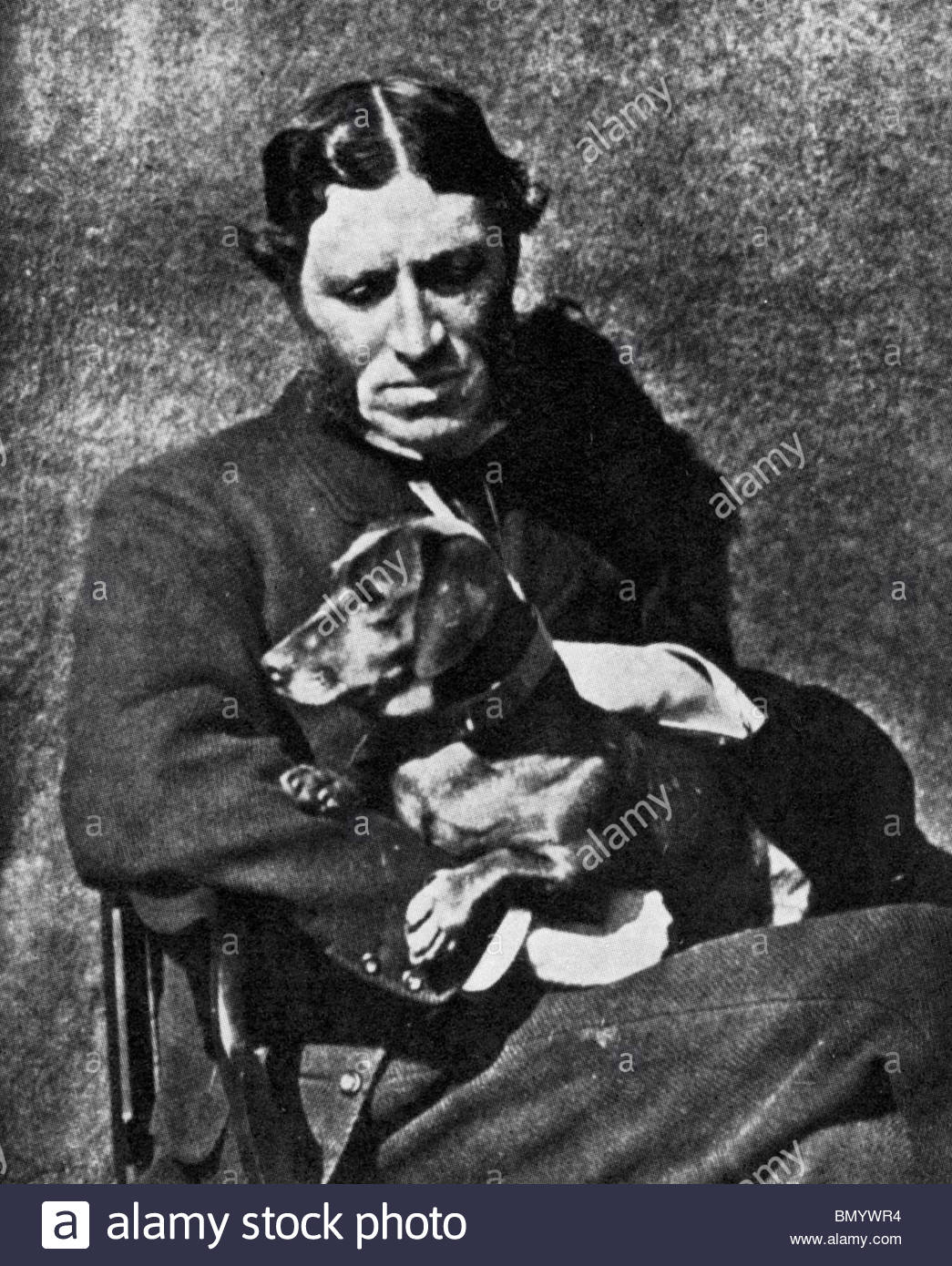
With his dachshund, Max.
Of course, Arnold did not get away with all of his 'sage' offerings. He was considered anachronistically out of time on many things, and by the time George was writing quotes in his American Notebook, Arnold was not considered to be one who had captured the zeitgeist in a bottle. What he lacked was the 'common touch' of those he disparaged as 'New Journalists'. All his definitions of culture were not written for the ordinary reader, but take this, written by WT Stead, who did have the common touch - which is really what New Journalism was about: accessibility. Stead wrote, when his Review of Reviews started:

Culture, according to Matthew Arnold, consists in knowing the best thoughts of the best men upon the subjects that come before us. The aim of this magazine will be to make the best thoughts of the best writers in our periodicals universally accessible. When Thor and his companions travelled to Jotunheim, they were told that no one was permitted to remain there who did not, in some feat or other, excel all other men. Therein Jotunheim resembled the memory of man. All but the supremely excellent fades into oblivion and is forgotten. The first step towards remembering what is worth while storing in the mind is to forget that which is worthless lumber. The work of winnowing away the chaff and of revealing the grain is the humble but useful task of the editorial thresher. The work of selection will be governed solely by the merits or demerits of the articles, not in the least by the opinions which they may express. Without pretending to be a colourless mirror, in which may be seen, in miniature, a perfect reflection of the periodical literature of the month, the Review of Reviews will honestly endeavour, without fear or favour, without political prejudice or religious intolerance, to represent the best that is said on all sides of all questions in the magazines and reviews of the current month.
See? WT Stead valiantly claims the Nordic traditions for the common woman and man, and kicks the middle class Greco-Roman dominance out of the way. Something rather grand about that! 
 
Heimdall aka Idris Elba
guarding the Bifrost Bridge
More of the words George found wise:
M. Arnold says that business of criticism is simply to know the best that is known and thought in the world, and by in its turn making this known, to create a current of true and fresh ideas. Its business is to do this with inflexible honesty, with due ability; but its business is to do no more, and to leave alone all questions of practical consequences and applications, questions which will never fail to have due prominence given to them.

George enjoyed success towards the end of his literary career with his non-fiction. Works on his travels to Italy (By The Ionian Sea) and his criticism of the works of Charles Dickens are well worth going to for a taste of how good he can be with reality. His fiction could be pedantic and over-wordy, his descriptions un-involving and snide, but his work on Dickens, in particular, offers a rare opportunity to explore some of the unconsciously held but rarely expressed in print inner workings of George's mind - mainly because he is expressing his opinion and not sitting on any fence. 

The last mention of Matthew Arnold that George makes in his writings is this strange entry in his Diary for Wednesday, April 30th 1902 (about eighteen months before George died), possibly demonstrating how much he needed a father-figure to support him through his last struggle with syphilis; to reassure him there was a heaven he was on his way to; that his struggles had some point; and that his many transgressions would be forgiven. He wrote:
Impossible to account in any way for some of our dreams. Last night, I saw a corpse lying on a bed, and understood that it was Matthew Arnold. Just as he was about to be put in his coffin, I saw a movement of his hand, and cried out - 'He is not dead'. And he began to raise himself, and sat up, completely recovered. George with religious delusions that, Christ-like, he could raise the dead, caused by the paresis he suffered as a consequence of syphilis? Friedrich Nietzsche experienced something similar. 

 
Matthew Arnold is commemorated in Poets' Corner at Westminster Abbey click.


Saturday, 6 August 2016

Commonplace 197  George & His Contemporaries: Matthew Arnold. PART ONE.

Matthew Arnold (1822-1888) is not a name on everyone's lips these days, but when George was a nipper, Arnold was a towering figure, involved is all aspects of social and cultural life. He epitomised the cliché we now hold of a typical Victorian of the intellectual middle class - intelligent, serious, capable, driven by strict religious zeal, and totally committed to his own view of the world. We know George was a fan because he includes several quotes from Arnold in his American Notebook, and, on July 4th 1895, he visited the great man's grave in the Surrey village of Laleham.

The Man.

Matthew Arnold travelled the well-trod path that would guarantee success: he came from a family with a track record for involvement in social affairs; he was intellectually precocious; he achieved success with his university studies, particularly the Classics; he was capable of working a self-imposed schedule of untiring and unceasing endeavour for the greater good of others. One of his greatest attributes was his ability to challenge the orthodoxy of his day, especially on religious matters.
When he was at Oxford, he attended John Newman's lectures, but never fully joined the Oxford Movement, the group that promoted the reverting of some of the Protestant version of Christianity back to include some of Catholic, pre-Reformation doctrine.

Arnold started out being educated privately at home but soon joined the pupils at Rugby School where his father, Thomas Arnold, was headmaster. In one of those Douglas Adams Interconnectedness moments that spring up in George's life, his man-wife, Eduard Bertz, joined the Rugby Colony in Tennessee started by Thomas Hughes, the author of Tom Brown's Schooldays and a former pupil of Thomas Arnold's. Later, Matthew went to Winchester, the school where pupils were most likely to go up to Oxford University. Hughes was also a Liberal MP (for Lambeth) and worked with Frederic Harrison, George's some-time employer and mentor to help draft legislation to improve the legal rights of workers. When he graduated, Arnold had a stint as a teacher at Rugby School before becoming one of Her Majesty's Inspector of Schools in 1851. Although he described the work as 'drudgery', it gave him a chance to familiarise himself with the lives and aspirations of the people who lived in the provinces, well away from the dynamism of inner city life. And the constant travelling gave him plenty of chance to write.

Arnold was also a celebrated poet whose works, though nowadays out of fashion, are still things of wonder. In his younger years, he spent a good deal of time in the company of William Wordsworth, a family friend, and when Wordsworth died in 1850, Arnold wrote Memorial Verses as a tribute. In some ways, Arnold was the man George might have aspired to be. He will have marvelled at the older man's versatility and been slightly jealous of the Newdigate Prize awarded for his poem, Cromwell, kept on his mantelpiece: the Newdigate is the gold standard of poetry prizes. In 1878, when George was in the States, having been sent down from Owens College for stealing, the Divine One, Oscar Wilde won the Newdigate for his poem entitled Ravenna. Coincidentally, George wrote a poem entitled Ravenna during his first year at college (1873) and won the Ward prize - Owens College's own poetry prize; not quite the Newdigate, but a step in the right direction. Arnold also won a prize for a poem about Alaric I, the chap who sacked Rome; the sacking of Rome was, of course, a lifelong obsession for George, as we know from the reading he did and the work he put into his posthumously published but unfinished (and unreadable) novel, Veranilda.

In 1857, Arnold was appointed Professor of Poetry at Oxford University, and broke with tradition by presenting his lectures in English as opposed to Latin. In 1861, he published On Translating Homer, a selection of these lectures. George considered himself a bit of an expert on Homer, and will have been interested in Arnold's criticism of the various versions of the Odyssey. According to the Wikipedia page: Arnold identifies four essential qualities of Homer the poet to which the translator must do justice: that he is eminently rapid; that he is eminently plain and direct both in the evolution of his thought and in the expression of it, that is, both in his syntax and in his words; that he is eminently plain and direct in the substance of his thought, that is, in his matter and ideas; and, finally, that he is eminently noble. He championed the translating of Homer into 6-line hexameters, the way the Germans translated it. So, plenty here for George to riff off of, and a sign of how much the world needed television, back in 1861. 
The 1878 Newdigate Prize winner, every inch a poet.
Matthew Arnold is referred to as a 'sage writer', which means he often used publications as a pulpit from where he could lambaste public attitudes and mores. One celebrated skirmish was with the legendary WT Stead of the Pall Mall Gazette. (See Commonplaces 180 and 181 for more on WTS.) In 1887, Arnold is sometimes cited as the first one who coined the phrase 'new journalism' to describe the sleazy preoccupations of publications that chased sales by concentrating on salacious, sensational or controversial topics. Owen Mulpetre of the WT Stead website Attacking the Devil click begs to differ. Before WT Stead was appointed editor, Arnold had contributed to the PMG. He was friends with its first editor, Frederick Greenwood, a staunch Tory, and of its second, John Morley, a Liberal. Stead was the third, and a Scottish Presbyterian. 

One of Arnold's most celebrated works was another collection of lectures published in the Cornhill Magazine as 'Culture And Anarchy'. Arnold introduces terms he is most often associated with: culture and Philistinism, among them. Here is his definition of culture:
The whole scope of the essay is to recommend culture as the great help out of our present difficulties; culture being a pursuit of our total perfection by means of getting to know, on all the matters which most concern us, the best which has been thought and said in the world, and, through this knowledge, turning a stream of fresh and free thought upon our stock notions and habits, which we now follow staunchly but mechanically, vainly imagining that there is a virtue in following them staunchly which makes up for the mischief of following them mechanically. 
Matthew Arnold's grave.

JOIN ME IN PART TWO TO SEE HOW CLOSELY GEORGE FOLLOWED 
MATTHEW ARNOLD'S TEACHINGS