Saturday, 21 November 2015

Commonplace 128  George & Slumming

With paintings by Abbot Handerson Thayer (1848-1821) who liked his angels click

When viewed through the prism of twenty-first century politics, slumming is an ugly word for an unattractive practice. The idea of visiting a locality or population to gawp at its residents is abhorrent to our way of thinking about privacy and human rights. In George's time, visits to places of 'social interest' such as mental asylums, workhouses, and areas of economic deprivation were almost part of the normal run of things for people in a slightly better position than the people on display- a sort of domestic alternative Grand Tour click. As we know from George's fiction, many 'ladies' involved themselves in the needs of the poor, and though George tended towards thinking this was an utter waste of time and effort, he was not averse, himself, from exploiting what might be a woman's natural tendency towards empathy and communication, especially when he manipulated the women he knew he could make use of - Clara Collet and Miss Orme, take a bow - into doing his bidding.
The Angel 1887

Who were these people who liked to study the disadvantaged? Were they philanthropists or scopophiliacs? And what were the factors that made slumming popular?

1) The scientists.
After the shock that was the Chartist Movement, and despite its reasonable aims, the most pressing matter for the ruling classes was controlling the masses. The Natural Selection theory of Charles Darwin raised notions of inherited traits which suggested to some that the deprived were innately beyond the pale, and as such, beyond change or redemption. Indeed, some saw them as surplus to requirements, and a drain on the economic system. Eugenics was the result of a misreading of many things, including Darwin, though the man himself was of the opinion that 'inferiors' are inferior for a reason, and he often cited women as the classic example of how inferiority manifests itself when judged against the other humans - the ones with the cocks. However, according to Darwin, men and women, like all living things, adapt to their environments, and so women, to succeed must fit into their prisons, or perish. By extension, it also proves that if you are born into squalor, it makes sense to behave in squalid ways; born into violence, you have to adopt violence.

Slumming had an acceptable face when it was done in the name of bringing about social change for the better. In order to study the poor, there had to be a methodology that served the purpose of those who wanted to control the masses. France gave us Auguste Comte and his philosophy of Positivism. George was, for a time, one of the British Positivists under the tutelage of Frederic Harrison. Positivism contended that all human behaviour subscribes to predictable systems and if you know what the systems are and how they work, you can control people and explain and then influence their behaviour. This became what we would now recognise as sociology - the study of people and social groups click. Sociology speaks via statistics, and so became what is taken for a useful tool in describing and containing the poor and needy. Not with the aim of making them happy, but to make them useful and acceptable, because to Positivists, that would mean they would be malleable and self-sufficient. Sociologists went out gathering their statistics and reporting back to those who debated the figures. Miss Clara Collet, sometime love botherer and all-round minion to George and scourge of Edith the second wife, was a government sociologist-cum-statistician for the Board of Trade. No doubt she honed her skills as a grass via this role, the old Tom Tale Tit that she was.
Winged Figure 1889

2) The Evangelists.
For a couple of centuries, the Church had been increasingly forced to adapt its presentation style, leading it to phase out the 'fire and brimstone' approach and introduce the idea that philanthropy would ensure Christianity prevailed. Befriending the poor was a core value of Methodism and the various 'new' sects such as Unitarianism and Quakerism and the best of them worked to get the better of the revolting masses by attempting to win them over to the Right Path by providing food, shelter, education, support, medicine, family guidance, leadership - I know! Christians actually doing what Jesus would have done!! Some worked for the greater good of the people, and some for the maintenance of the status quo in ensuring the prominent position the Church enjoyed in British society, but it can't be denied that genuine 'good' was done. Slumming in the name of god was a popular way for women to rise to their potential, and allowed access to experiences and challenges no other activity could offer them.

However, one dark cloud on the Church's horizon arrived in the form of Charles Bradlaugh click who unofficially stood for a humanistic alternative to theism, representing a modern take on individual responsibility towards one's responsibilities to one's fellows and one's conscience. Atheism was seen as akin to the godlessness of the poor and the Church needed to get to the tens of thousands of potential religion avoiders in the slum areas to prevent a slide towards the end of religion and the rise of atheism as a force of influence. Again, by working in areas of deprivation to directly influence the poor, religious groups rolled out their own form of sociology with direct action to influence the behaviour of the masses. There was a degree of competition, too, to make sure the many sects were able to boost numbers; competition from secular groups with no religious affiliations, especially the increasingly influential trades unions and Socialists posed another threat. Slummers gathered information about where to site churches and charitable institutions, and money could be raised to offset deprivation if it was targeted to a specific, preferably notorious, locale or identifiable group.
Winged Figure Seated on a Rock
1903

3) The Curious.
Freak shows were also popular, and gave everyone something to stare at. However, the life of John Merrick, also known as the Elephant Man click, shows us how exploitation gave a lifeline, albeit of the most basic and abusive sort, to a class of unfortunates who, if they lived in a village, might have had a support system to sustain them, but who found themselves alone and left to their own devices in the uncaring metropolis.

The inherent entertainment value in staring at the poor, disadvantaged and disabled was not a Victorian invention, but it would be wrong to think it is a particularly old concept. In Suzannah Lipscomb's informative piece, click, she makes the point that 'fools' were often persons with learning difficulties, and not the clever posing as wise that Shakespeare gave us. We now tend to think the care of anyone who does not subscribe to the mean of human behaviour requires some form of institutionalisation, but before that was the case, communities supported and protected their harmless mentally ill and disabled members, and no-one in genuine want would be left without shelter or sustenance. When the newspapers were full of stories of an exotic place George termed the 'Nether World'. it was no surprise anyone might seek to have a look for themselves. Today, we have 'Jack the Ripper' walks round Whitechapel, complete with dramatic reconstructions of the murders. As they say in the English north, 'there's nowt as queer as folk'.

4) The Perverse.
Some people do like to look at suffering and dirt, and derive sexual pleasure from it. It's what the French term 'nostalgie de la boue'. HG Wells thought this explained George's desire to marry both Marianne aka Nell and Edith, both supposed to be unsophisticated working class women. (This is unfair to the pair of them, but we will leave that for another day.) HG Wells knew something about sexual desire as he had so much of it in himself, and was a man not afraid to extend his rutting territory in any direction that presented itself. Though George would never have spoken about it to anyone, he must have put himself under the social microscope when he sought to explain his pretended interest in the lives of the poor. Perhaps he was afraid of what he saw?

In 1886, the new science of studying people had given the world sexology in the form of Germany's Richard von Krafft-Ebing, with his 'Sexualis Psychopathia'. Krafft-Ebing's pioneering study of his psychiatric patients gave an introduction to some of the many ways sexual feelings may be experienced and expressed. In one interesting chapter, he links religious martyrdom to masochism and hysteria. Those who disapproved of the physical freedom women were enjoying when they went out into poor areas to administer relief (no pun intended!) often misrepresented the drive for independence as a form of repressed sexuality by linking women's usually repressed sexual desire with guilt, and the need for self-punishment through wallowing in filthy lives and doings. George made good use of this in Demos, when he had his female protagonist, Adela, an irritatingly smug dabbler in dirt for reasons of social conscience, feel revolted when it arrived in the form of the priapic needs of her husband, the working class and, to George (though probably not to any of his readers) loutish Richard Mutimer. Her decision to marry a man she didn't like, who she regarded as being socially beneath her, suggests she had a capacity for Darwinian pragmatism all women would recognise. It takes Richard's death for her to realise he was one of her successful social projects, and that she might have loved him. Which is fiction.  

The Angel 1914

5) The writer in search of material.
The journalist looking for a good story fed off the anguish and pain of the deprived London boroughs. A trend was started with a major work that introduced a new genre: undercover journalism. After the death of Lord Palmerston (1784-1865) the inevitability of enfranchisement for the poorer classes seemed inevitable. The anxiety this provoked in the monied classes led to some novel ways of explaining the real world to the ignorant bourgeoisie. In 1866, the investigative work of James Greenwood in his 'A Night In A Workhouse', was published in the Pall Mall Gazette. Greenwood disguised himself as a pauper and joined the queue for admittance to Lambeth Workhouse, posing as a man in need of a bed. His article was so popular in the Gazette that it was published as a stand alone work, with a special penny edition for the poor to read about themselves - or about those without a penny to waste on newsprint, below them.

George took tours of the Paris Morgue and the Marylebone Workhouse that he lived near, looking for good copy for stories. Before him, Charles Dickens had done something similar, with his tours round Bedlam and various prisons, including the prison at Coldbath Fields click, a place George would have passed many times on his rambles. Have a look at this to read about one of its inmates click. Dickens' great friend John Forster (of the famous 'Life' revised by George) was a prominent Unitarian - a sect that prided itself on its work with the disadvantaged. Forster was head of the Lunacy Commission from 1861-1872, though his tenure was not considered enlightened.
George certainly made a lot of his superficial association with the poor, even though he never really had anything new to say about their plight, or cared enough to challenge the status quo of their predicament. In fact, he quickly ditched the poor in favour of the educated strapped for cash as the focus of his fiction. His concentration on their struggles was every bit as voyeuristic as his temporary preoccupation with the poor, but brought to it the shared perspective of a dispassionate outsider looking in: still slumming, but with toffs under the microscope. A case of 'big fleas and little fleas' click?
Boy and Angel 1918


Thursday, 19 November 2015


Commonplace 127 George & The Rise of Demos.

George was always interested in drawing a very wide line between the working and the middle (and above) classes. This was partly to disguise his own humble origins (son of a shop-keeper; failed academic; gaol bird) and to maximise his loftier pretensions to being somehow 'aristocratic'. In fact, this demarcation wasn't entirely based on money or class, but on 'aesthetic sensibility' - George thought the poor have no right to power because they lack a refined, artistic soul, and the rich and educated are equally philistine. so, it is only a few who are touched with the greatness of aristocracy, in the Classical sense click, who  deserve to prevail. Totally without irony or insight, George always placed himself in this elite by dint of the way he liked books and the Greeks. If you stop and ask yourself what, exactly, he brought to the 'aristocratic' party, you come up with... ? Maybe he confused the term 'aristocrat' with 'prig'.

The Sexton's House by "BB" c 1907
As the nineteenth century wore on, the rise of the Proletariat became a constant source of threat to the classes in charge of the resources. In 1836, a group arose that represented exclusively the interests of the working class: the Chartists. Leaders of the movement knew that effective change has to happen incrementally, but that no social progress can be made without a mandate from the People. The fear instilled in the British controlling classes by the French Revolution had made the likelihood of democracy being handed to the poor extremely unlikely, and so the Chartists set out to win a voice through challenging the established political structure. They had six basic tenets:
1) a vote for all men over 21
2) the secret ballot
3) no property qualification to become an MP
4) payment for MPs
5) electoral districts of equal size
6) annual elections for Parliament

There were three separate drives to secure better representation for the masses, but all were defeated. Finally, the movement disintegrated in the face of severe penalties from employers for known Chartists and their sympathisers. As with the UK Miners' Strike of 1983-4 click, starving the activists back to work was an effective means of control. However, progress, like fascism, once started, is unstoppable, and eventually, some of the Chartists' aims were incorporated when a more liberal party came into power. For an easy to understand account visit the National Archives site click.
Woman With Plant by Grant Wood 1929

George was initially enthusiastic about the new Socialist movement that was gaining some influence in the late 1800s. Socialism - the idea of political power being in the hands of the largest part of the population - has its roots in the English Civil War of 1642-1651. It wasn't the victorious Puritans who promoted it, but their rebel factions, the Levellers click, the Diggers click and the Fifth Monarchy Men click. By the time George took it up, it was a popular trend amongst the educated and demimonde, much like the Occupy Movement is today click. And, just as with Occupy, amongst the real devotees were dilettantes and hangers-on - and George was one of these. Part of his falling out of love with the movement may have been the distinct hierarchy above him that he would not be able to challenge or overtake. The likes of William Morris were already in the best positions, and there was nowhere a little minnow like George could establish a toe-hold (or a fin-hold haha). More likely, he turned his back on joining in with any movement that would have had strong and frequent links with his old hunting ground of Manchester.

The lure of Positivism claimed George, and through his association with Frederic Harrison he found employment, some social recognition, a limited readership for his fist novel, and a smattering of knowledge about statistics. So, what is Positivism? This click explains it fully. Basically, it was a belief system that relied on accepting only empirical evidence; this means what you experience from your own sensory input  is more valid than any interpretation you make of that sensory input. Current aspects of Behaviourism are close to the basic idea of Positivism. Because Positivism relied so wholeheartedly on the perspective of the individual, a system was required to establish norms of behaviour, so that human experience could be assessed and compared with what was usual in any particular social group. And so sociology was born.
Cookham by Stanley Spencer 1914
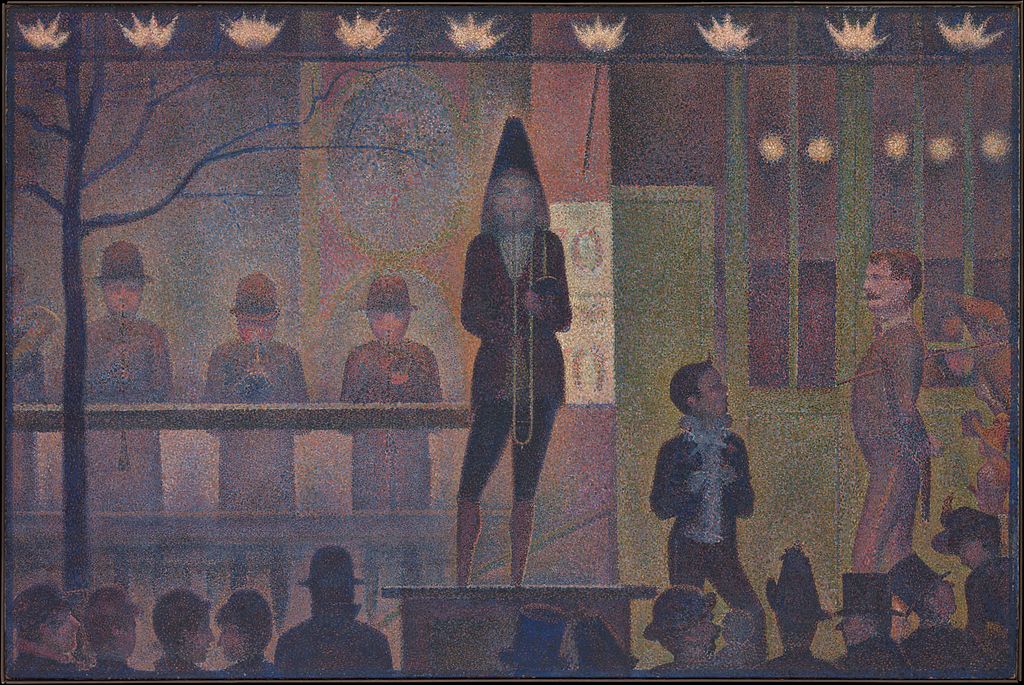
George would have recognised the dissonance between Positivism's reliance on systems, rules and norms, and the Artist's inherent spontaneity and creative flow. In fact, some of the legendary Art being produced at the time George was dabbling in Comte was produced by Artists who had thrown away the painting rulebook and were beginning to work in new methods. In fact, most painters are always working to long-established rules - even Monet was making use of colour theory and Jackson Pollock working on perspective - and one of the possibly least successful was Georges Seurat (or any of his fellow Pointillists).
Parade de Cirque by Georges Seurat 1887-1888


Apart from not wanting to be mistaken for a common oik, George was one of many who believed that life under the rule of Demos would be one where Art was relegated to a minority activity and that vulgarity would prevail. As Art has never been anything but a minority interest, and as the very definition of what is vulgar is the quotidian, it's difficult to know what George's problem was with either notion. But, wouldn't that have appealed to George? In fact, it would have suited him to live under a system where he could feel even more marginalised and even more of an outsider?

See also Commonplace 101 -  George & Eugenics.


Saturday, 14 November 2015

Commonplace 126   George & The Influence of Fyodor Dostoevsky. PART TWO.

George had doings with the Russians in 1880 when he wrote articles explaining English political and cultural life for the monthly periodical Vyestnik Evropy click. He was immensely proud of having received correspondence from Ivan Turgenev click who wrote to confirm his position. George considered himself to be at home amongst the Russian greats, and this was probably why he accepted the offer and lowered his standards and temporarily discarded his snobbish tendencies towards journalism. This from the Turgenev Wikipedia page click gives an idea of what George might have gleaned from reading his work, which is quintessential George (if you substitute 'Russian reader' for 'British reader'):
"The conscious use of art for ends extraneous to itself was detestable to him... He knew that the Russian reader wanted to be told what to believe and how to live, expected to be provided with clearly contrasted values, clearly distinguishable heroes and villains.... Turgenev remained cautious and sceptical; the reader is left in suspense, in a state of doubt: problems are raised, and for the most part left unanswered" – Isaiah BerlinLecture on Fathers and Children.
Ivan Turgenev in his youth

George would have relied on translations of Turgenev's and Dostoevsky's work, and some of these might have been in German or French, both languages in which George was more than competent. English translations filtered through to the British reading public - the first of Dostoevsky's novels, 'Poor Folk', was written in 1845, but was not published in English until the 1894 translation by Lana Milman (and published in the Yellow Book with illustrations by Aubrey Beardsley click). What makes 'Poor Folk' of interest to George enthusiasts is that it is about the life of poor people, their relationship with rich people, and poverty in general...  Which sounds familiar. Did George read it in German? We know he preferred both Turgenev and Dostoevsky to Tolstoy (he never forgave him for siding with the peasants!) and went to see a play version of 'Crime and Punishment' in October 1888 which he did not rate highly. 

Reader, cast your mind back to those 'slum' novels George wrote when he was a rising star in the English-speaking literary firmament; Workers In The Dawn and The Nether World... and then read on.

Fyodor Dostoevsky wrote 'The Beggar Boy at Christ's Christmas Tree' story in 1876 . It was first published in his 'The Writer's Diary', a periodical he set up that ran from 1873-1881. You can read the story for free here in this publication - The St Petersburg Times click. No, not the Russian city, the Florida USA city. If you do, you might experience a sense of deja vu - because it has a flavour of 'Workers In The Dawn' and all the 'slum' novels George wrote before he came to realise he might not be the only one to have a liking for Russian novelists, and so might be taken for a plagiarist. Consider this, from the Christmas Tree story: a poor boy who lives in abject poverty with his dead parent sparked out on a thin mattress on the floor when it's so cold 'steam' comes out of his little orphan's mouth...? Arthur Golding from 'Workers'? One of Mr Woodstock's tenants in 'The Unclassed'?

The litany of abused children in 'heaven' - something similar is the central theme of George's short story 'A Parent's Feelings'. This is one of George's most misanthropic tales, and is worth looking at more closely. You can read it here in this legendary resource: click. The Boundary Lane mentioned in the story is under the black dotted horizontal line on the Charles Booth map of 1898 click.

 
The story is the tragic tale of a woman who is guilty of maltreating her children, though in the times in which she lived, violence to children was considered a legitimate form of training. Just as it is nowadays amongst the less than enlightened. If you didn't know better, you might think child cruelty was/is rife amongst the working classes and absent in those deemed socially higher. This is not so. Abuse of children knows no social or cultural barrier, and middle class children were/are just as likely to be beaten and abused as their poorer peers. George's own mother was fond of violence towards her children - and any child who challenged her authority. Henry Hick (one of George's few childhood friends) tells of a child she locked in a cupboard as a punishment. By his own admission, George was a difficult child, and so no doubt felt the force of his mother's training. And George's own son, Walter, tried the patience of the two Gissing sisters'e, so they no doubt used the cane on him when they felt that to spare it was to spoil him. This 'Spare the rod and spoil the child' attitude is such a quintessentially Victorian phrase (just as is 'children should be seen and not heard') that we tend to assume everyone was making use of it. Today, we have an equally abusive and odious concept to childhood behaviour modification in the concept of the 'naughty step'. Only a moron would use this approach, but I suppose morons are as fertile as us smart folks, so I shouldn't be surprised. Anyone using either violence (physical assault) or Time Out/naughty step (emotional assault) or any form of punishment on a child needs to have a quiet word with themselves about power and its abuses, and then take themselves here click to learn about positive reinforcement (rewarding accepted behaviour) vs negative reinforcement (punishment for unaccepted behaviour), and then spend a minute or two remembering what it felt like to be a powerless child.
Peasant Women by Philipp Malyavin 1905
The eponymous parent in George's tale is not afraid to break her daughter's nose and spoil her chances of finding a good living or a good marriage just to make her abusive point. George tells us: In Boundary Lane, the 'rod was represented by a broom-handle, an old shoe, a rope-end, a fragment of firewood; in flagrant cases, perchance by the poker. This vile woman has probably killed at least one of her six dead children by over-zealous application of this sort of admonishment. The very short story is about how the child, Sue, is regularly beaten by her mother, and, as a consequence, develops anti-social tendencies that manifest themselves at school. One day, she is punished for her wrong-doing by a teacher who canes her hands as a punishment. Sue rushes home and tells her mother and the mother - well, she is outraged. Someone has dared to beat her child! What a cheek! Beating a child is the privilege of parents, not teachers... Sue's mother vows revenge on the teacher. Now, this might seem like an old-fashioned sort of tale that exaggerates its point, but how many teachers live in fear of parents coming to school to seek revenge for their told-off children? click to read more. 

George doesn't introduce any mitigating circumstances to his story, or anything like an explanation for the mother's behaviour, or any sort of clue as to what might make her 'tick'. For George, her vileness is symptomatic of her base class origins. This failure to find a psychological rationale for behaviour is where he and Dostoevsky part company. What makes Dostoevsky so compelling is that he delves deeply into things like psychology, morality, motivation, and gives characters rationales that are always convincing and reasonable - even when murder is the plan. Raskolnikov in 'Crime and Punishment', is the most obvious of his creations click to be behaving in what seems like a reasonable and logical manner, with every twist and turn of his crackpot social theory to justify murder seeming convincing. His enemy, the policeman Ilya Petrovich represents an equal match in terms of guile and intelligence, but is really a reflective device to frame Raskolnikov's re-emerging conscience. Dostoevsky shows us that theory is all very well, but upbringing which provides a lodestar of morality wins out in the end. Raskolnikov is arrested, tried and punished, but he emerges from his sentence of exile in Siberia a much improved fellow. No such level of psychological awareness leading to a moral awakening is rewarded with salvation in George's main tale of exile (I say 'main' because many of George's stories are about exile). His pessimism would not allow Godwin Peak from 'Born in Exile' to benefit from his moral epiphany. Oddly, murder in Russia was punished with banishment for a few years; the punishment (albeit self-inflicted) for pretending to be a middle class Christian, was suicide. 

'Crime and Punishment' will have been a book with which George felt some affinity. Raskolnikov rationalised his crimes to explain the murder he committed and framed his behaviour as a political act. George did something similar with his crime spree - he claimed (to Frederic Harrison et al) that he was a Robin Hood stealing small change from the rich to give to the poor. Utter tosh, of course. George stole money because he could.

Many of Fyodor Dostoevsky's works in English translations are available free at Project Gutenberg click.


Friday, 13 November 2015

Commonplace 125 George & The Influence of Fyodor Dostoevsky. PART ONE.

George's collected short stories offer up a treasure trove of insights into his unique take on the world. He regarded the short story as a money-spinner (and he was not wrong, as he made a steady income from them) though it's difficult to work out how popular he was with his reading public as the stories mostly appeared in periodicals, and were not 'stand alone' publications. George's never impartial world view was well-served by the genre and it often feels that the short story format is his way of settling scores in his ongoing battle with the 'accursed social order' that designated him lower middle class, with no private income, and a tendency to be misogynistic.
Fyodor Dostoevsky by Vasily Perov 1872

Short story writing is an art form easily misunderstood as a cheap alternative to a novel, but each of the tales has to stand alone as a beguiling and fascinating world of its own, at the heart of which is a gem-like universal truth (even if that is dark and perverse) that reveals a nugget of wisdom. A much better definition can be found here click. There is no fixed word count for a short story and George's vary in length; some are mildly amusing, many are irritatingly didactic, but a few are bits of the best writing he produced.

One of the great myths George promulgated throughout his career was that he had a working knowledge of the poor and poverty. I realise it is heresy to say this, but I don't believe he did. Not first-hand. There is no evidence he socialised with poor people, lived in their midst (not according to the Poverty Maps of the times when checked against his addresses), or had anything personally to do with them, other than as a dispassionate slummer and flâneur - one who roamed the back alleys and by-ways of the impoverished neighbourhoods in search of vile material for his stories. And, of course, he employed domestic servants. His poorest address, Colville Place, was no poorer than the family shop where he'd grown up in Wakefield. See Commonplace 93 if you don't believe me. He made much of relocating from Colville Place's attic to its cellar to save money, but this move might have happened because George had very Heath Robinson click ideas about economics - as with his crazes for only subsisting on lentils, or tinned meat, or packet soups whilst never giving up smoking or buying books, in order to save money. This lack of skill with the management of finances should not be taken as him having no finances to manage.

As for having to rub shoulders with the so-called lower classes, George did everything he could to avoid it. He cultivated a middle class crass separateness from his neighbours, at a time when many intellectuals were beginning to see the injustice and anachronism of class distinctions. Partly from a need to protect his infamous prison history from the public gaze, and partly because his fragile sense of self depended on feeling superior to everyone he met, George forever harked back to a time when the gulf between rich and poor kept people rigidly in their place. It was a constant source of anxiety and emotional and psychic pain to him that his natural place was on the losing side of that divide. Of all those he came into contact with, there isn't anyone George rated higher than himself. This is often misreported as him having an 'aristocratic' sensibility, but that is tosh and nothing more than a cheap trick to excuse him his most egregious beliefs. He had a relatively narrow gene pool of social contacts and what he had of friendship with his peers was artificial and limited, and always on George's terms, rarely allowing for what in psycho-dynamics is termed 'authenticity' click,

At no stage did George chose to socialise with the lower classes - even when he first arrived in the capital, he was repulsed at having to spend time with his London relatives who seemed, to him, to be so far beneath him. He never taught in a state school, and his own education had been with other lower middle class boys, so he had no exposure to playing with working class children who were his Wakefield peers, so even his experience of childhood was of no use except as from the position of outsider looking in. He despised working class social activities and gatherings and forbade his first wife Marianne aka Nell to mix socially and when she defied him he locked her in the house. Second wife Edith was prevented from chatting to neighbours and then George claimed she was incapable of socialising. Whatever George's neighbours made of this mild-mannered, passive-aggressive, paranoid, northern, effeminate-looking, misogynistic snob, would have made a good short story in itself haha.

Study for Peasant with Harness
by Mina Moiseev 1883
So, there is no evidence at all George was ever in the the thick of it with the sort of people he wrote about in Workers In The Dawn or The Nether World. However, he took up writing at a time of great national interest in the poorer classes, when radical approaches to deprivation were the realm of a new breed of 'scientist': the sociologist. This meant any writer claiming to be actually reporting back from the front line of the war against the rise of the working class was guaranteed a hearing, but they would have to have something new to say in order to win a readership. The middle class mindset tends towards blaming the working class for its own predicament, with Tories (as ever) espousing the idea that we live in a meritocracy, and hard work will pay dividends if the diligent apply their talents to social climbing out of the abyss. This false belief nurtures self-interest and fails to acknowledge the part greed plays in the economic plight of the poor.

So, if George was not a genuine denizen of the Nether World himself, where did he get his ideas from? Obviously, the newspapers and periodicals available free to look at in the British Library Reading Room, and from the news-stands of places like WH Smith, situated at every railways station (and nowadays, high street - which English town doesn't have a WH Smith's?). And, the Gissing family swapped periodicals in the post - sending printed materials via Royal Mail used to be far cheaper than sending a letter or package. Stories of shock! horror! about the depraved deprived always do well, and the fierce battle for readers carried on by the big beasts of Fleet Street ensured readers would be desperate for salacious scandal. We can see from the news coverage of the so-called Jack The Riper murders how far the press went in the 1880s to win readers - as far as manufacturing letters taunting the police -  and we know from the ongoing British Leveson Inquiry click into phone hacking by newspapers how ineffectual we all are at stopping them from whipping up controversy.

There was another source of inspiration for George. Many of George's British contemporaries wrote short stories focusing on the lives of the poor from the perspective of the religious activism, seeking to save the world and its unfortunates with prayer, much like missionaries toiling in exotic outposts. The likes of Walter Besant click telling his tragic tales of the poor was a long way from the type of work George wanted to do. George wanted his creative outpourings and observations to fit into a broader tradition of reflecting on poverty as an inevitable evolutionary condition. The European writers he admired rarely tried to redeem the poor they wrote about. Two of  his favourites were France's Alphonse Daudet and Russia's Fyodor Dostoevsky. (The historic tradition of pre-Revolution Russia being included in Europe for cultural purposes is explained here click.) As much as he admired Daudet for his warm-hearted stories about happy peasants leading blissfully unsophisticated lives, it was Dostoevsky who was the writer George most wanted to be.
Constructed Head No 2 by Naum Gabo 1916
Charles Caleb Colton click (I hadn't heard of him, either!) once said that 'imitation is the sincerest form of flattery'. As covered in Commonplace 35, from time to time George 'borrowed' from Dostoevsky but we must take this in the spirit of Colton and not think of that ugly term, plagiarism. (No-one says artists plagiarise when they do their own versions of things like portraits, still-lifes, etc.) From that Commonplace post, where I link a novel written by Dostoevsky to the myth George invented to conjure up an origin story to stage manage perceptions of his first wife, Marianne aka Nell, there is this:
However, let us look slightly to the side - to one of his heroes, Dostoevsky and The Insulted and Injured (sometimes also called Humiliated and Insulted) of 1861. First serialised in monthly instalments in the fortnightly periodical 'Vremya', it in part tells the story of a poor young orphan of the streets who is prevented from being a prostitute when the hero, Vanya, rescues her from the clutches of an evil procuress. (Note: a 'person of the street' in UK English idiom is not a prostitute as in 'streetwalker'; it is someone who is homeless.) The girl's name is Elena - Vanya suggest she give herself a new name to mark the difference between the old life and the new - and she chooses Nell as her new name. Nell suffers from epilepsy. Vanya takes her to his room and looks after her - no hanky-panky (Vanya is an intellectual and all-round good egg) - and she thrives. Vanya begins to teach her the ways of a middle-class life, with the help from his love interest, a girl who is marrying someone else. Nell responds well, helps the plot along with some homely wisdom and housekeeping skills before an untimely death from heart failure. What a coincidence, I hear you say. I can imagine George reading this in his Owens days and hoping some young Elena - or Marianne Helen might drop into his lap just waiting to be re-branded as a Nell... And, we know George read this novel: in a letter of November 4th 1889, he recommends it to Eduard Bertz. Read the novel for free here

What was it George so admired - even envied - in Dostoevsky's work? And did he ever make use of Dostoevsky's ideas in his stories? Yes, he did. SO JOIN ME IN PART TWO TO FIND OUT MORE.
13th November 2015


Saturday, 7 November 2015

Commonplace 124 George & Money

With the works of Sir Antony Gormley click - a personal favourite.
Another Place (Crosby Beach)
George Orwell famously summed up the themes and subject of all of George's works as being about 'not enough money' - you can read Orwell's article, as covered in the Gissing Journal/newsletter, here click. He goes on to say: Gissing is the chronicler of poverty, not working class poverty (he despises and perhaps hates the working class), but the cruel, grinding 'respectable' poverty of underfed clerks, downtrodden governesses and bankrupt tradesmen. He believed, perhaps not wrongly, that poverty caused more suffering in the middle class than in the working class. So, the working class, being inured to poverty, are 'better off' than their middle class peers? Someone should tell them this, as I am sure they would like to know! Nowadays in the UK, those who are doing better in this time of austerity are definitely not from the working classes, so what is really being addressed here? Is it the class-ist notion that when you cut the working class, they don't bleed? And that only the privileged miss wholesome food, warm homes, adequate health care, good education for their children when it is no longer an option? Let's not forget: if you take away 20% of a middle class person's income, they are still well-off. Take away 20% of a poorly-paid person's income and they are wrecked. Marianne aka Nell found this out when George docked 25% of her alimony in 1883 and was still paying the same amount in 1888 when she died from sickness exacerbated by poverty. As George would have been aware of the economic depression stalking the land click at that time, with its knock-on effects on the price of coal and basic necessities, no-one could ever claim he treated her at all compassionately, fairly or heroically. 
Exposure (Lelystad, Netherlands)
George was the sort of cove who loves money but hates work. Is that an unfair assessment? He makes it clear in The Private Papers of Henry Ryecroft, that odious temple of cod philosophy so loved by those who set their intellectual and aesthetic bar very low, that he isn't much of a worker. Two of George's best known internet quotes are to be found here in this section of TPPOHR headed 'Winter XXIV':
Time is money – says the vulgarest saw known to any age or people. Turn it round about, and you get a precious truth – money is time. I think of it on these dark, mist-blinded mornings, as I come down to find a glorious fire crackling and leaping in my study. Suppose I were so poor that I could not afford that heartsome blaze, how different the whole day would be! Have I not lost many and many a day of my life for lack of the material comfort which was necessary to put my mind in tune? With money I buy for cheerful use the hours which otherwise would not in any sense be mine; nay, which would make me their miserable bondsman. Money is time, and, heaven be thanked, there needs so little of it for this sort of purchase. He who has overmuch is wont to be as badly off in regard to the true use of money, as he who has not enough. What are we doing all our lives but purchasing, or trying to purchase, time? And, most of us, having grasped it with one hand, throw it away with the other.

As with all of 'Ryecroft', it's difficult to know how much of this goldmine of insipid platitudes is genuine George and how much is his passive-aggressive piss-taking provocative snipe at critics luring them in to taking it over-seriously - with George off stage laughing at their efforts enjoying an 'Emperor's New Clothes' moment of intellectual superiority. Can he really have ever thought such pedestrian writing was artistically acceptable? (Anyhoo, I will save my thoughts on Ryecroft and how much I hate it for another post - though one could compose an entire blog round how nauseating it is - with its Have I not lost many and many and his vulgarest - such an inelegant word - and his nay and his wont to and overmuch!) Of course, Ryecroft isn't meant to be George - but I bet there are those who think it is autobiography. (If that were so, George would be an infinitely less loveable bod than he is.)
The Angel Of The North (Gateshead, UK)
It seems to me only part of this 'money is time' claim is true, because the main thing money really buys is choice. When people have choice they demand and expect a better standard of living, better environments, the freedom to pursue broader ambitions. Humanists know this, and Abraham Maslow set it out in his famous hierarchy of needs clickBy keeping the vast majority of society at the bottom level of the hierarchy, anxious about the basic necessities of food and water, you deprive them of the ability to progress up the pyramid. The next rung is safety needs and when governments need to destabilize society as a means of controlling the people, they introduce threats to safety. These range from job losses to terrorism - or, a global financial crisis. All people have the potential to climb the hierarchy to reach self-actualization, but governments don't want everyone reaching their potential - they would become ungovernable if they did. Because we are all wage slaves, the flow of money is what fuels the processes of governments, with the control of money being a means of regulating people's behaviour in favour of compliance, because we all fear poverty - we no longer have the means to be self-sufficient, so we have to keep in with our oppressors. This is not, as they say, rocket surgery.
Untitled (Tate Gallery)
November 5th 2015 saw the mass demonstration of the Anonymous Movement and they have quite a lot to say about money click and the way it enslaves us all. Spend a few hours of your life learning about economics. Learn the difference between money (which is real stuff like gold and silver coins) and fiat currency (which is just numbers on a charge sheet or fungible paper with no intrinsic value). A long time ago, the American Federal Reserve cunningly took over the world and if you want to understand this in more depth, then take yourself to this highly educational series of well-presented films click to learn more. 
from Bodies At Rest (Saatchi Collection)
All this talk of a world-wide coming together in the name of Revolution would have sickened George. He wasn't one for crowds haha. He did think of dabbling in Capitalism himself, with some minor money-making enterprises that did not rely on writing - stealing from coat pockets, being one of them haha - but never followed through on any of them. When he came into his £300 inheritance in 1879, he thought of buying a house outright and possibly making money from letting rooms while he spent his time writing. but he ploughed most of that windfall into getting Workers In The Dawn published. And, thank goodness, say I! Later, he thought of starting a periodical with Algernon, but this project did not come to fruition. He thought he might write plays... He claimed to have steadfastly refused many of the offers of money-making journalism, but he did write articles and criticism so maybe he managed to see the wisdom of lowering his artistic standards. He could have made more money if he hadn't made so many daft decisions about selling copyrights. But if he had made more money, where would he have found his mojo to write? It was resentment that partly fuelled his work - a feeling of being hard-done-to, misunderstood and passed-over that gave him a much-needed gritty edge. (Maybe also something biblical about prophets not being listened to in their own lands: Luke 4:24?) Without it, he might have ended his days as the real-life embodiment of the loathsome Ryecroft!   

Orwell's claim that all of George's works can be summed up as 'not enough money' can be checked out in Simon James' excellent book 'Unsettled Accounts: Money and Narrative In the Novels of George Gissing' click.

Last word to the Divine Oscar: It is better to have a permanent income than to be fascinating. 


Thursday, 5 November 2015

Commonplace 123 George & Money PART TWO


In February 1895, George's longest-serving friend, Morley Roberts, wrote asking if he could write a  
piece about him in the Fortnightly Review. Roberts liked to bask in what there was of George's glory, but, naturally, George needed to stage-manage the affair. He once said Morley Roberts didn't really understand him or his work, so that probably gave an urgency to compiling his own version for Roberts to use. But there was a more pressing matter of three fairly negative articles in the sort of publications that secured a wide readership (the Spectator, Sketch, and Illustrated London News) that was preying on his mind. Nettled, George grabbed at the chance to respond to all three (but especially the Spectator) making use of Roberts as his willing, and partisan mouthpiece.

Charon on the Shores of Acheron, from Canto III of 'Inferno' from 'The Divine Comedy' by Dante Alighieri (1265-1321) by Amos Nattini 1926
It is a masterly work, this reply from George agreeing to the request, and opens with a classic line of control-freak manipulation: 
My dear Roberts, - What objection could I possibly have - unless it were that I should not like to hear you reviled for log-rolling? (Logrolling is the practice of authors bigging up each other's work often to increase sales). 
So, George starts off making sure Roberts keeps his praise reasonably restrained and beyond the gushing that would give away his motives. George assumes Roberts would want to gush, of course. And no mention of how much fake logrolling he might have to do to reciprocate - after all, it takes two to logroll! 
click and translate with google translate 
George goes on:
But it seems to me that you might well write an article which would incur no such charge; and indeed, by so doing, you would render me a very great service. For I have in mind at present the careful and well-written attack in the current Spectator. Have you seen it? Now I will tell you what my feelings are about this frequent attitude in my critics.

There we have it - removing Roberts' freedom to write what he pleased. George could have written the piece himself and published under his own name, but that would have disrupted his cunning plan to be eternally aloof and seemingly indifferent to outside influences. And, Roberts, desperate to please and with the devotion of an unrequited lover, was happy to play the eternal patsy fully prepared to take a bullet for his hero if the response backfired. 

The Spectator piece published 9th February 1895 was Anonymous, but George commented that it was a careful and well-written attack. In fact, it is a very good piece, and gives an introduction and overview to George's main themes, whilst fairly critiquing his strengths and weaknesses. It sums up the central theme of the 'post slum ghetto' (or whatever George's early works can be termed) books as being preoccupied with middle class men with mediocre education, talents and expectations, who have aspirations to climb the greasy pole to the upper middle class but no big plan or motivation/options to achieve this. The author of the article makes the point that the lower middle classes and below had Charles Dickens as their champion - now the aspirational but dismal middle classes have George. (As there is a tinge of sarcasm here, we can take it this was not meant as a compliment!) But the author goes on to observe that, anyone from this class who reads about themselves as George portrays them (probably having borrowed a volume from a circulating library) will turn away from the finished work 'as if dissatisfied'... they will only feel in a vague, uncomfortable, resentful sort of way that the general effect is false, misleading, even libellous; that it is in essence caricature, though it has been produced without any of those obvious tricks of draughtsmanship which make ordinary caricature at once recognisable for what it is.

Anon goes on to say that George has a way of caricaturing his types by what they don't do or fail to say as much as what they actually do, and by the omitting useful information and insights into their motives and thoughts, rather than by delineating details that might make them seem real to the reader. The author (who could be male or female - I rather hope female) points out:

The artist who sees life steadily and sees it whole, never allows us to forget that whatsoever be a man's caste, or calling, or condition, he is first of all a human being, and only secondarily a courtier, a rustic. a lawyer, a publican, a barbarian, or a Philistine. The humanity which unites him to his fellows is really more significant, and should, in any serious art, be made more emphatic than the idiosyncrasies which distinguish him from them; but it is Mr Gissing's way to give distinctness and force to his delineation of a species by emphasising its special isolating features, which are frequently, if not generally, the features that indicate weakness or limitation.


So far, so true. In the Year of Jubilee was George's most recent fictional offering, so this comes in for some harsh but fair flak. In discussing the characters, this Anon author writes:
The seniors live a dull, colourless, vegetating life, unglorified by any fine emotion or elevating instinct; the young throw the energies of youth either into sham culture, which leads only to unlovely priggishness, into degraded pleasures which land them in still more unlovely profligacy, or into a sordid money-worship which, in the young, is perhaps the unloveliest, because the most unnatural of all.   


Satan Resides at the Centre of the Frozen Lake of Cocytus
from the Divine Comedy by Amos Nattini 1923


The insightful author goes on:
Now, no one will deny that such characters as these represent existing types, or that such types (at least some of them) are most frequent in communities where the materials of comfort are in marked excess of the resources of culture; but to paraphrase Matthew Arnold, even in a cheap suburb life may be lived with well, - certainly not less well in the main than in any other civilised human sphere. But in Mr Gissing's pages the brutish stupefaction of his men and women is obviously treated as the inevitable, unescapable (sic) result of their social conditions and surroundings; therefore, in so far as fidelity to the fact is essential to art (and to realistic art such fidelity in the one thing needful), his treatment may be challenged on purely artistic grounds by critics who would treat its fatalistic pessimism  as an indifferent thing for which they have neither approval nor condemnation. 

You can see why George was pissed off.

There's more:

Mr George Gissing must therefore be regarded not as a realist, but as an idealist of the new school... His acquaintance with certain social features is hardly less intimate than that of the Greek sculptor with certain anatomical features; but just as we know that there never was a living man or woman so physically perfect as the Apollo Belvedere or the Venus of Milo, so do we know that there never was a civilised community in which human nature was so largely denuded of its attractive elements as is the human nature of the community depicted in Mr Gissing's latest story. He has lately been the recipient of enthusiastic praise, and though we think that some of it has been extravagantly expressed, we do not grudge it to him. But it is in the interests of art that praise should be awarded on the right grounds; and praise can be awarded to Mr Gissing only for the vigour and vividness with which he renders his own vision - a most distorted vision it seems to us - of the vulgarity, sordidness, and ugliness of life.

George must have thought this piece of criticism was accurate or he never would have formulated a response - most of the time, he remained above any debate about his work. and was always happy to disregard what he didn't think much of in terms of understanding of his writing. Being misunderstood was George's thing, and he revelled in it. He added in his letter to Roberts, a clear manifesto for Roberts to repeat:
My books deal with people of many social strata. There are the vile working-class, the aspiring and capable working-class, the vile lower-middle, the aspiring and capable lower-middle, and a few representatives of the upper-middle . . . . But what I desire to insist upon is this: that the most characteristic, the most important part of my work is that which deals with a class of young men distinctive of our time – well educated, fairly bred, but without money.


This doesn't quite address the points raised in the Spectator piece, which charges him with accentuating the vile and sordid and failing to do justice to the good and uplifting in the lives of these well educated, fairly bred paupers. (Oddly, as George puts it, he deals with all social strata except the middle class and the actual hereditary aristocracy!) 

These young middle class poor people George so wanted to champion - when they received their fancy education, did no-one tell them about Charles Darwin and his Theory of Natural Selection? Did they not learn we all have to adapt to survive? This was where George might have given them hope. 
There was work, of course, for them to do, if they accepted it. Not middle class well-paid work, but honest labour in lowly trades - like teaching. 

George ends his letter to Roberts moaning about the cold weather: I write with a numbed hand. I haven't been warm for weeks. This weather crushes me. Poor George, as usual. 

The Spectator piece and the letter from George to Morley Roberts appears in the The Critical Heritage edited by Pierre Coustillas pages 238-245.

JOIN ME IN PART THREE TO EXPLORE THE DIFFERENCE BETWEEN MONEY AND CURRENCY - AND WHAT ANONYMOUS THINKS ABOUT IT TODAY.